
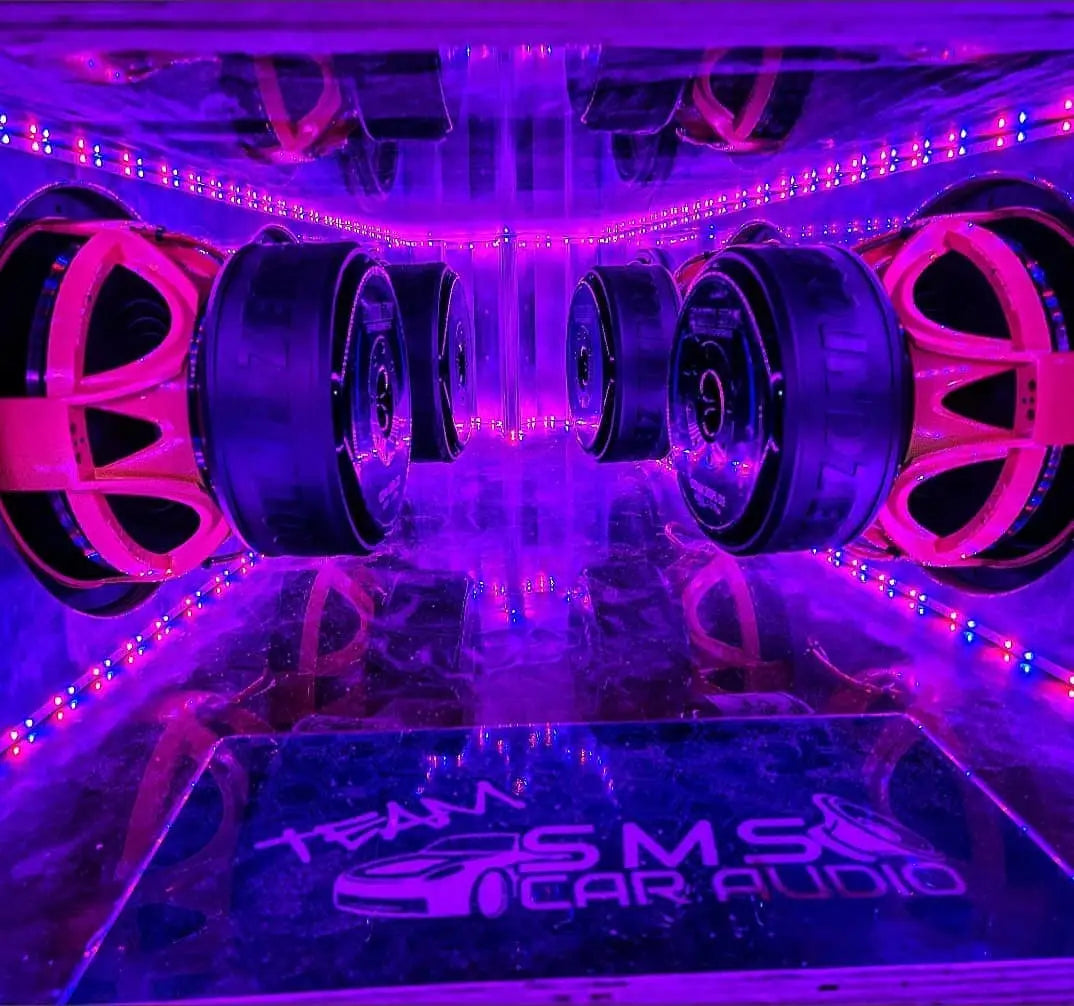
Why a Custom Subwoofer Enclosure Matters
A good subwoofer in the wrong box is still the wrong bass system.
The enclosure controls a huge part of what you actually hear: how deep it plays, where it gets loud, how much cone control the woofer has and whether the system can use the amplifier power you paid for.
That is why we do not treat the box like an accessory that gets picked after the subwoofer. The woofer, enclosure, amplifier, electrical and vehicle all have to work together.
What are you trying to get out of the bass?
Tight daily bass, strong low-end weight, maximum output, a shallow under-seat system or something that keeps most of the cargo room all need different enclosure choices.
Start with the result. Then we decide whether sealed, ported, under-seat, behind-seat, bandpass or another custom layout makes sense.
Sealed and ported are different tools.
A sealed enclosure is usually more compact and uses the trapped air inside the box to help control cone motion. A ported enclosure can add efficiency and output around its tuning range, but it needs more space and enough port area and length to work correctly.
Neither one is automatically better. The subwoofer, available space, amplifier power and the way you want the bass to behave decide which design makes sense.
Why prefab boxes sometimes miss the goal.
A prefab can be perfectly fine when the airspace, tuning, construction and fitment match the subwoofer and the vehicle. The problem is when the box only fits physically.
- The internal volume may be wrong for the woofer.
- The port may be too small, too short or tuned where you do not want it.
- The baffle or panels may flex when output goes up.
- The subwoofer may not have enough mounting depth or excursion clearance.
- The enclosure may kill seat travel, storage or service access.
When the standard box solves those problems, use it. When it does not, that is where custom work earns its keep.
Truck and tight-space bass gets complicated fast.
Under-seat and behind-seat enclosures can look large from the outside and still have very little usable net airspace once the floor shape, seat brackets, bracing, subwoofer displacement and port are accounted for.
That is why a deep high-power woofer can be a worse choice than a properly matched shallow sub in the right enclosure. The truck decides what is realistic.
Construction matters once the system starts making real pressure.
Panel thickness, bracing, baffle strength, fasteners, sealing and port construction all matter when output increases. If the box is flexing or leaking, some of the amplifier power is being turned into movement and noise instead of bass.
We use in-house CNC fabrication and the shop's normal woodworking process where the build calls for repeatable fitment, strong joints, engraved details or a more complex layout.
The amplifier comes after the final load and enclosure plan.
Once the subwoofer quantity, voice-coil wiring and enclosure are locked, we know what impedance the amplifier will actually see and how much useful power makes sense.
Larger bass systems may also need heavier OFC cable, stronger grounds, battery reserve or alternator support. A bigger amplifier does not fix an undersized box or weak electrical system.
What we review before building a box
- Vehicle and usable dimensions.
- Seat, cargo and service-access requirements.
- Subwoofer model, quantity, impedance, displacement and mounting depth.
- Recommended airspace and the customer's bass goal.
- Amplifier power and final electrical load.
- Port area, tuning, port length and internal displacement where applicable.
- Bracing, baffle strength and finish requirements.
- How the bass system will integrate with the front speakers and DSP.
Tell us how much bass you want and how much vehicle you need to keep.
Send the vehicle, photos of the space, current equipment, the subwoofer and amplifier if you already have a direction, and what you are not willing to give up—seat travel, cargo room, factory seat height or something else.
We will figure out whether the right answer is a loaded enclosure, vehicle-specific box, sealed build, ported build or a fully custom enclosure.
Custom Enclosure Planning | Truck Bass Planning | Built-to-Order Enclosures | Plan a Bass System