
Description
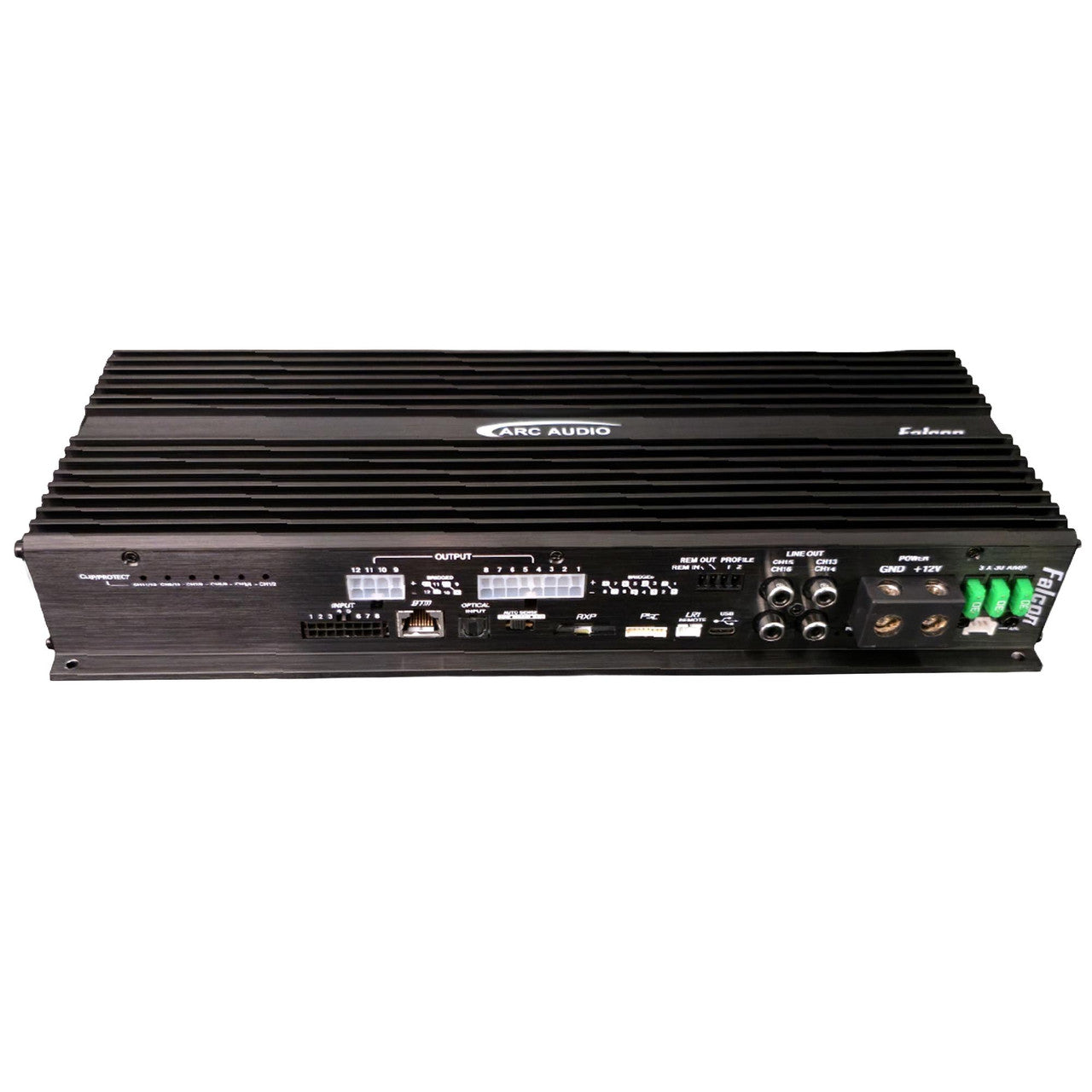
ARC Audio Falcon 12-Channel DSP Amplifier
Twelve amplified channels. Sixteen channels of DSP control. One serious system brain.
When a system starts needing separate control for tweeters, mids, midbass, rear speakers, factory integration and an external sub amp, the equipment count can get out of hand fast. The Falcon is ARC Audio’s answer to that problem: twelve bridgeable Class-D amplifier channels and sixteen channels of Pro-Series DSP control in one compact chassis.
This is not just an amplifier with a basic EQ stuffed inside it. ARC had the Falcon designed specifically for the company by amplifier engineer Robert Zeff, then paired the power section with the same kind of high-resolution processing architecture used across ARC’s serious Pro-Series DSP platform.
The big deal isn’t just the channel count.
The Falcon gives us enough amplifier channels to build a serious active front stage, handle rear fill and still keep the whole system under one DSP. ARC Audio’s DNA software gives us control over EQ, crossovers, time alignment, all-pass filters, phase and input/output routing, so the system can be tuned around the vehicle instead of forcing the vehicle to work around the equipment.
That matters when we are trying to make the dash, doors and subwoofer all sound like one system instead of a pile of speakers playing from different places.
The Pro-Series processing section uses an Analog Devices ADAU1462 DSP with AKM Velvet Sound conversion and supports up to 192 kHz / 32-bit audio. The reason that matters is not so we can brag about a giant sample-rate number. It gives the tuning platform the resolution and processing headroom to make detailed crossover, phase, timing and EQ corrections without turning the processor itself into the weak link.
Factory radio staying? Good.
The Falcon is built for modern OEM integration. It supports iDatalink Maestro AR on compatible vehicles, and its eight balanced analog inputs can work with low-level RCA or speaker-level signal. It also accepts high-resolution digital signal through its optical input, with additional digital-over-copper capability available through ARC Audio’s D.O.C. connection.
For the customer, that means keeping the factory features you actually want while giving us the processing and routing control needed to build the aftermarket system correctly.
That becomes especially useful in premium factory-amplified vehicles where replacing the radio is either undesirable or impossible. Instead of throwing away the factory interface just to get better audio, the integration path lets us start with the cleanest usable source we can get and rebuild the system from there.
Need more power on one part of the system?
You are not boxed into using only the Falcon’s internal amplifier channels. DSP channels 13 through 16 feed four processed RCA outputs, so we can add an external amplifier for higher-power midbass, subwoofers or another section of the system while keeping those channels inside the same tuning platform.
The Falcon’s amplified channel pairs can also be bridged when the system design calls for fewer channels with more power. That is what makes the channel count useful instead of restrictive: we can spend the internal channels where they make sense, bridge them where the system benefits, and use the processed RCA outputs anywhere we need a different amplifier.
Why the amplifier section matters in a DSP amplifier.
A great processor does not help if the amplifier section adds noise, runs out of control or creates installation problems. Falcon’s twelve Class-D channels are rated at 75 watts each into 4 ohms and 125 watts each into 2 ohms, with bridgeable pairs producing 250 watts into 4 ohms.
That is enough flexibility to power tweeters, widebands, midranges and serious midbass combinations directly from the Falcon in a lot of systems. If the bass section needs substantially more power, the processed line outputs let us hand that job to a dedicated mono amplifier without leaving the Falcon’s DSP environment.
ARC also includes adjustable Class-D switching-frequency control. In a complicated modern vehicle with radios, antennas, data networks and multiple electronic modules, that gives the installer another tool for dealing with potential high-frequency interference instead of simply accepting noise as part of the install.
This is why we like the Falcon.
It solves a system-design problem instead of creating another one. We get amplification, OEM integration, high-resolution DSP, flexible routing and expansion in one platform. The customer gets a cleaner installation, fewer separate pieces to stack in the vehicle and a system we can tune as a complete package.
If you are building a high-channel-count sound-quality system, keeping a premium factory radio or planning an active front stage with room to expand, this is the kind of amplifier/DSP platform that makes the rest of the build easier to design correctly.
The result: fewer boxes, fewer signal handoffs, one tuning environment and enough routing flexibility that the system can be designed around the vehicle instead of around the limitations of the electronics.
Manufacturer Specifications
- Amplified channels: 12 Class-D channels
- Bridgeable channel pairs: Yes
- Power at 4 ohms: 75 watts × 12
- Power at 2 ohms: 125 watts × 12
- Bridged power at 4 ohms: 250 watts × 6
- Total DSP channels: 16
- Channels 13–16: Four DSP-controlled RCA outputs for external amplification
- Main DSP processor: Analog Devices ADAU1462
- ADC/DAC architecture: AKM Velvet Sound™ AK5558B ADC / AK4438VN DAC
- High-resolution processing: Up to 192 kHz / 32-bit
- DSP software: ARC Audio DNA
- Equalization: Up to 444 bands
- Tuning functions: EQ, crossover control, time alignment, all-pass filters, phase and input/output matrix routing
- Analog inputs: 8 balanced inputs supporting RCA or speaker-level signal
- Digital input: S/PDIF optical; digital-over-copper support with compatible ARC Audio D.O.C. hardware
- OEM integration: iDatalink Maestro AR compatible
- Controller compatibility: ARC Audio PSC and LR-2
- Cooling: Microprocessor-controlled fan cooling
- Class-D switching frequency control: Adjustable
- User presets: Up to 4
- Design: Designed exclusively for ARC Audio by Robert Zeff; engineered in the USA
Where this fits in the build
This is a system-control or DSP component. The correct choice depends on the signal path, channel count, routing, retained features and the rest of the amplifier and speaker plan.
Authorized Dealer — In-Store Purchase