

Description
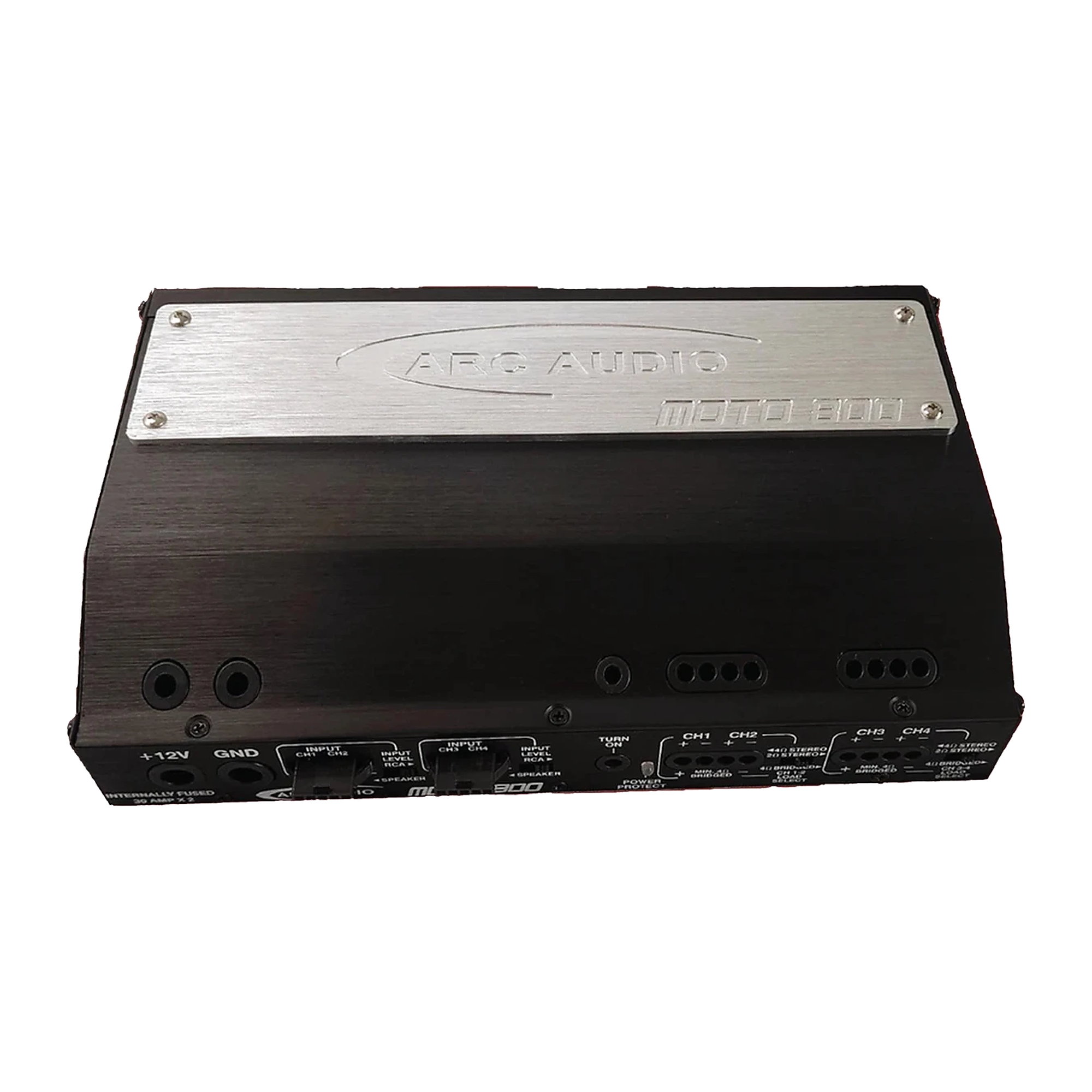
ARC Audio MOTO 800 4-Channel Amplifier
Motorcycle and powersports audio has a nasty combination of problems: almost no space, limited charging-system capacity, heat trapped inside tight fairings, wind and exhaust fighting the speakers, and an electrical environment where a noisy little amplifier can create problems all over the vehicle.
The MOTO 800 is ARC Audio’s answer to that whole package—not just a small amp that happens to fit on a bike. It puts more than 800 watts of total four-channel output into a compact motorcycle-specific chassis while keeping the low-distortion sound, signal-to-noise performance, thermal control and integration flexibility ARC expects from its car-audio amplifiers.
ARC specifically points out that this is what separates the MOTO 800 from many ultra-compact motorcycle and powersports amplifiers. Small size is easy. Making a small amplifier stay clean, efficient and stable when the bike is moving and the volume is up is the harder part.
Enough power to make the system work while the vehicle is actually moving.
ARC rates the MOTO 800 at 180 watts × 4 into 4 ohms, 200 watts × 4 into 2 ohms, or 400 watts × 2 bridged into 4 ohms.
That is the kind of output that makes sense with higher-efficiency motorcycle speakers like ARC’s MOTO CX6, CX69 and 602HD. Parked in the shop, almost any amplifier can make a speaker sound loud. The real test is what happens when wind, road noise and exhaust come up and the speaker needs enough clean headroom to stay intelligible.
The MOTO 800 gives us the power to build around that real listening environment without immediately jumping to a physically larger automotive amplifier that creates a mounting problem inside the fairing.
Load Select lets us use the power where the system actually needs it.
Each channel pair has its own Load Select setting. That allows the amplifier to optimize its power-production strategy for the impedance connected to that pair instead of treating every speaker configuration the same.
That gives us useful system options. We can run four individual speakers, bridge both pairs for two high-output 4-ohm speakers, or build a mixed system where one pair powers full-range speakers while another pair is bridged into a 4-ohm load.
ARC specifically calls out side-by-side and automotive layouts where one pair of speakers needs full 4-ohm power and another section of the system uses a bridged load. That is why Load Select is not just another switch on the amp—it gives the installer a way to match the amplifier to the actual wiring strategy.
94% efficiency matters more on a motorcycle than it does on a spec sheet.
ARC rates the MOTO 800 at 94% efficiency. That means more of the electrical energy pulled from the charging system becomes speaker power instead of heat.
On a bike or side-by-side, that matters immediately. The charging system may already be supporting lighting, fuel injection, accessories and the rest of the vehicle electronics. Wasting current as amplifier heat can turn into voltage problems, thermal shutdown or a system that only works properly under ideal conditions.
ARC also says advances in the MOTO 800 power-supply design and components reduce EMI and RFI noise production. In an installation surrounded by radios, antennas and vehicle electronics, keeping switching noise under control is part of making the amplifier behave like a professional piece of equipment instead of just making power.
Factory or aftermarket signal—either way, there is a proper way in.
The MOTO 800 uses ARC’s proven quick-connect input plugs, the same basic connection format used through its motorcycle ecosystem. The connectors work with the supplied RCA input dongles and are compatible with ARC MPAK and PSM-Pro wiring strategies.
Front-panel input-range switches let the installer choose between low-level and speaker-level operation. ARC specifies 200 mV–4 V sensitivity in low-level mode and 600 mV–14 V in high-level mode, with independent sensitivity adjustment for each channel pair.
That gives us a clean path whether the bike has an aftermarket source, a retained factory radio or a processor upstream. We do not need to invent an integration scheme just because the source does not have conventional RCAs.
The crossover section is there to make the speakers survive and perform better.
Each channel pair has defeatable high-pass and low-pass filtering adjustable from 50–500 Hz.
For fairing speakers, the high-pass filter is often the important one. Asking a 6.5-inch motorcycle speaker to reproduce deep bass it physically cannot use wastes amplifier power and excursion. Set the high-pass correctly and more of the speaker’s movement is available for the midbass, vocals and upper range that actually have to fight through road noise.
ARC specifically references the MOTO CX6, CX69 and 602HD as speakers whose performance can be optimized with the MOTO 800’s high-pass section.
The cooling system is active because a fairing is not a friendly thermal environment.
An internal fan is controlled by the amplifier’s microprocessor. The processor monitors amplifier operation across multiple zones and manages cooling as conditions change.
That same microprocessor also provides diagnostic fault codes through the amplifier’s indicator lights. If the installation has a shorted speaker cable, damaged speaker or another operating fault, the flash sequence gives the installer useful information instead of reducing the diagnosis to “the amp shut off.”
For us, that is a serviceability feature. A system hidden inside a motorcycle fairing should be diagnosable without tearing half the bike apart just to guess at the problem.
Weather-resistant does not mean waterproof—and ARC actually tells you the difference.
The MOTO 800 main circuit board receives two conformal-coating layers to protect against high humidity and incidental water exposure such as riding in rain. ARC enlarged the top accent panel to cover panel gaps, tightened those gaps, and uses upgraded speaker terminal blocks that route moisture away from the circuit board.
Those are meaningful motorcycle-specific protections. ARC still explicitly says the amplifier is not waterproof.
That is exactly how we treat it during installation: choose a protected location and let the environmental engineering provide another layer of protection, rather than mounting the amp where it will be directly soaked and assuming conformal coating makes the laws of electricity disappear.
It says MOTO on it, but the footprint solves automotive problems too.
At roughly 8.125 × 5.5 inches, the chassis is small enough for motorcycle fairings, but ARC also specifically points to under-seat exotic-car installations, behind-seat truck systems and side-by-side builds.
That makes the MOTO 800 useful anywhere the system needs four strong channels and the amplifier location is the problem. You do not need to own a motorcycle to benefit from the power density, efficiency and environmental construction.
Why we would choose it instead of a generic compact amp.
If the only requirement is “make four speakers louder for as little money as possible,” there are cheaper amplifiers.
The MOTO 800 makes sense when the customer wants the amplifier to stay clean at high output, use limited electrical capacity efficiently, fit a difficult location, integrate cleanly with factory or aftermarket signal, survive an open-environment installation and give us useful diagnostics if something goes wrong later.
The result: a compact amp that was actually engineered around the problems motorcycles and powersports vehicles create—not a normal car amp shrunk down until it happens to fit.
Manufacturer Specifications
- Amplifier type: Full-range Class D
- Channels: 4
- Rated power at 4 ohms: 180 watts RMS × 4
- Rated power at 2 ohms: 200 watts RMS × 4
- Bridged power at 4 ohms: 400 watts RMS × 2
- Load configuration: Independent Load Select control for each channel pair
- Low-level input sensitivity: 200 mV–4 V
- High-level input sensitivity: 600 mV–14 V
- High-pass crossover: 50–500 Hz, defeatable
- Low-pass crossover: 50–500 Hz, defeatable
- Turn-on detection: DC-offset and signal detection
- Efficiency: 94%
- Cooling: Microprocessor-controlled internal fan
- Diagnostics: Microprocessor-monitored fault-code indicator system
- Environmental protection: Dual conformal coating and moisture-resistant construction; not waterproof
- Power and ground connections: Accept up to 8-AWG cable
- Footprint: 8.125 × 5.5 in.
Where this fits in the build
An amplifier should be chosen around the channels, load, speaker or subwoofer plan, available electrical support and how hard the system needs to play.
Authorized Dealer — In-Store Purchase