
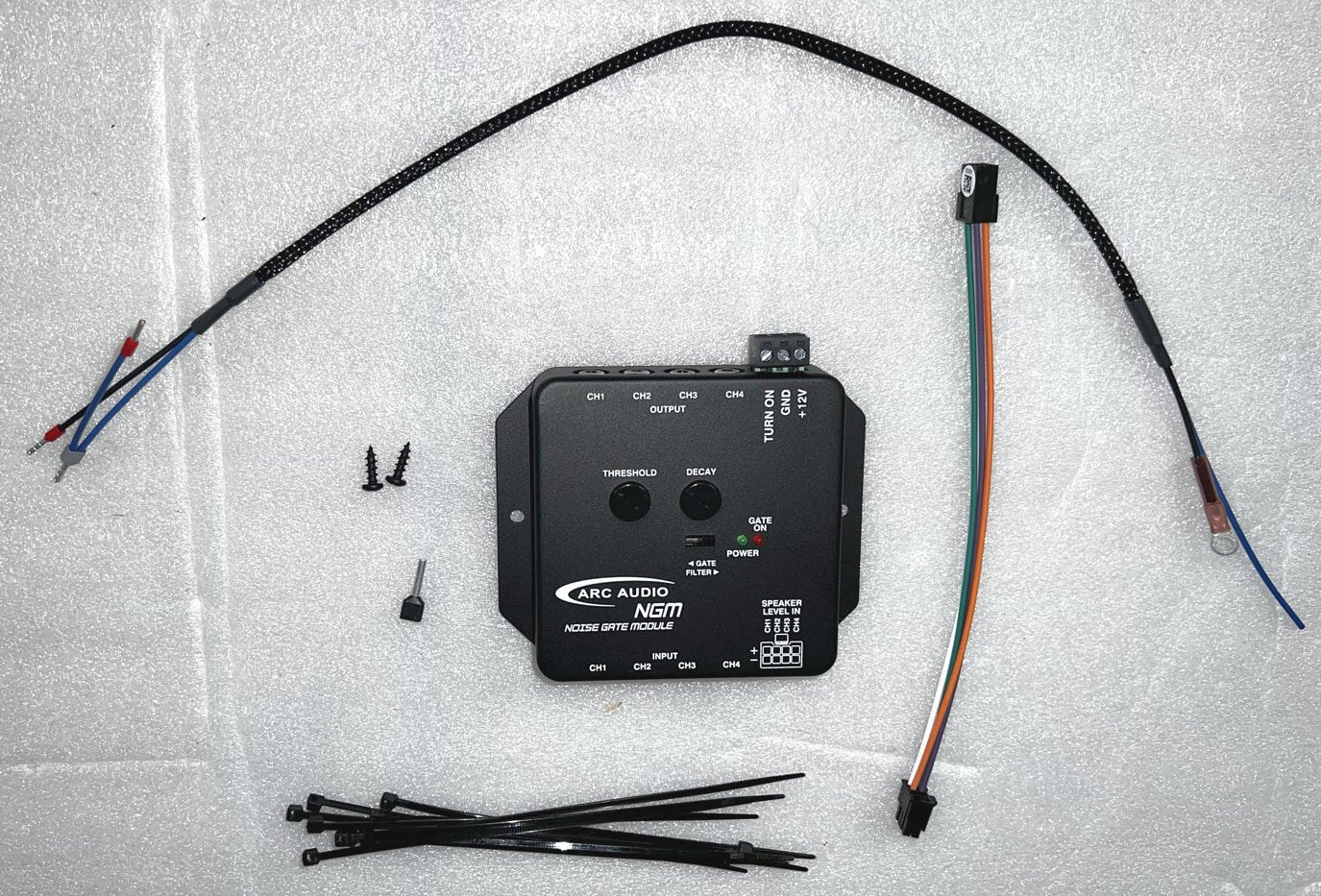

Description
ARC Audio NGM Noise Gate Module
Some factory audio systems have a noise floor that stays audible even when the music should be quiet. Turning amplifier gains down can hide some of it, but that also gives away usable output and does not fix the source of the problem. The NGM is for that specific integration issue: standing hiss or background noise coming through the signal path between tracks or during quiet passages.
The NGM watches the incoming signal and opens or closes the audio path around a user-set threshold. That lets the system stay quiet when the source is effectively idle, then pass the music normally once the signal rises above the gate point.
Where it makes sense
- OEM integration where the factory source or amplifier leaves an audible background noise floor
- Aftermarket systems with a known source-level hiss that remains after proper gain structure and wiring have been verified
- RCA-level or supported speaker-level signal paths
This is not a universal cure for every alternator whine, bad ground or damaged component. Those problems should be repaired at the source. The NGM is useful when the system is electrically correct but the source architecture itself leaves standing noise that needs to be gated.
Signal flexibility
ARC supports both low-level RCA and speaker-level input, with speaker-level input capability up to 20 volts and output capability up to 7 volts. That makes the module useful in both conventional aftermarket signal chains and selected factory-radio integration jobs where a high-level signal has to be managed before it reaches the next component.
ARC also provides selectable filtering behavior so the module can be configured around the actual noise problem instead of treating every installation the same.
NGM vs. SRI vs. BXM
Choose NGM when the problem is standing background noise or hiss in an otherwise usable signal.
Choose SRI when the factory system divides the music across multiple band-limited speaker outputs and those signals need to be summed into a usable full-range feed.
Choose BXM when the signal is clean but the system needs perceived low-frequency extension without simply piling on boost below the speaker's useful range.
Manufacturer specifications
- Low-level RCA and speaker-level input capability
- Speaker-level input capability up to 20 V
- Output capability up to 7 V
- User-adjustable noise-gate operation
- Selectable filter behavior
- Compact installation format
- Power, ground and remote-turn-on connection
Where this fits in the build
This is a system-control or DSP component. The correct choice depends on the signal path, channel count, routing, retained features and the rest of the amplifier and speaker plan.
Authorized Dealer — In-Store Purchase