
Description
ARC Audio PSM-Pro Motorcycle and Powersports DSP
Motorcycle audio does not need less DSP than a car. It needs the same kind of control packed into a fraction of the space.
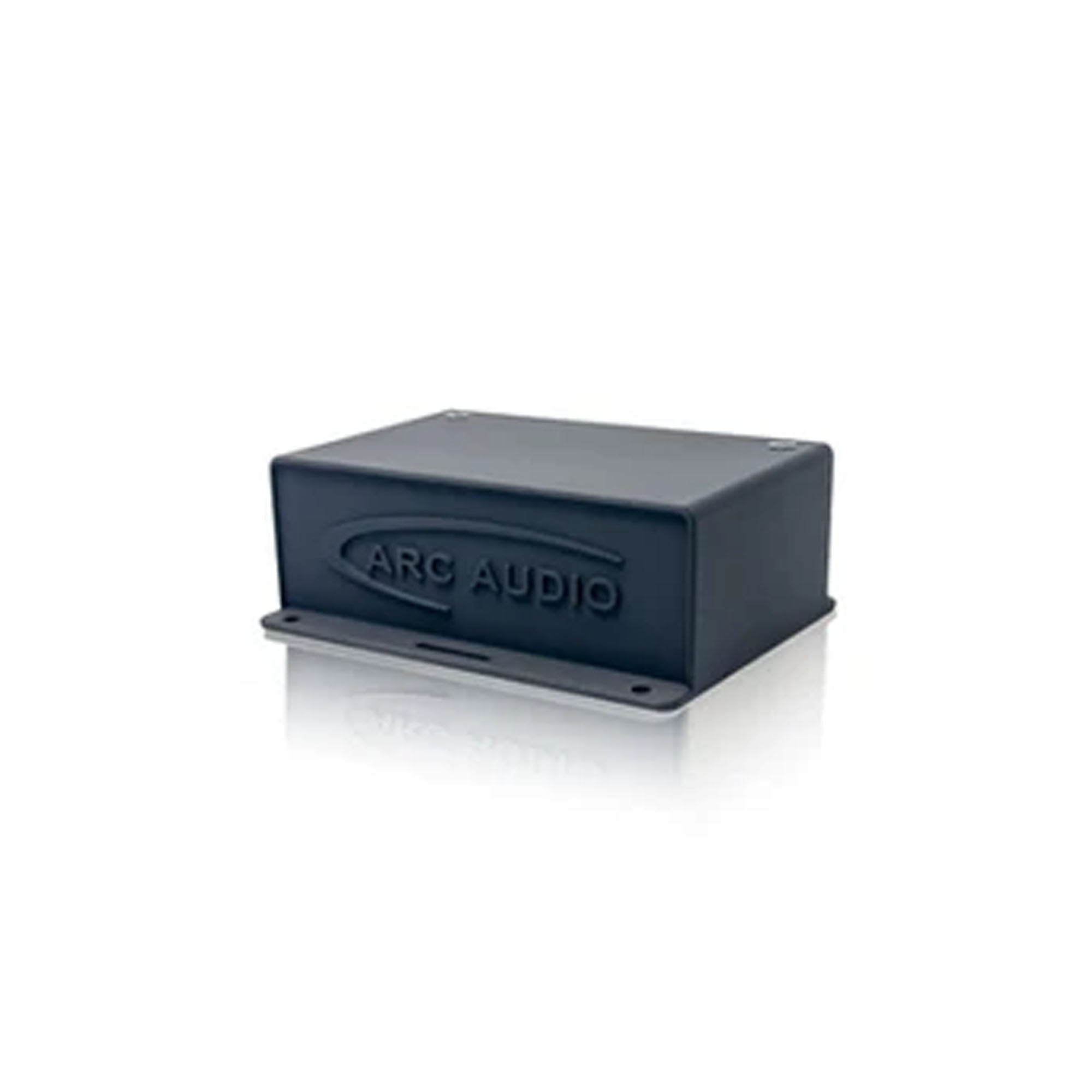
That is the problem ARC Audio built the PSM-Pro to solve. It takes the tuning tools normally associated with a full-size processor—signal correction, routing, crossovers, delay, phase and detailed EQ—and puts them into a 3.75 × 3.0 × 1.35-inch chassis designed for motorcycles, powersports and other installations where hiding a conventional DSP is the first problem before the tune even starts.
ARC does not treat the PSM-Pro like a stripped-down motorcycle EQ. It is a real six-input / eight-output processor built around a 32-bit Analog Devices ADAU1452 DSP core and controlled through ARC Audio DNA software. The size changes. The reason we use DSP does not.
The first problem is usually the signal—not the speakers.
Factory motorcycle radios can have EQ, frequency shaping and output behavior baked into the signal before the aftermarket amplifier ever sees it. If we start tuning on top of a bad source, a lot of DSP time gets wasted trying to undo what the factory system did first.
The PSM-Pro accepts six differential analog inputs by RCA or speaker level, with a published analog input range of 2–16 V RMS. That gives us enough input capability to work with a wide range of retained factory and aftermarket sources without automatically stacking extra line-output hardware in front of the processor.
When the system has a compatible digital source, PSM-Pro also provides a 96 kHz coaxial digital input. That lets us bypass unnecessary analog conversion when the integration path supports it.
What that solves: get the cleanest usable signal into the processor first, then spend the tuning time making the system sound better instead of fighting the source.
Eight outputs means we can actually build the bike as a system.
The PSM-Pro gives us eight processed RCA outputs, each capable of up to 3.5 volts. That is enough output count to do more than a simple front/rear fade adjustment.
We can independently control fairing speakers, lowers, saddlebag speakers, a subwoofer section or multiple amplifier zones. In a more advanced build, those channels can be crossed over and delayed separately so every speaker is doing the part of the frequency range and acoustic job it is actually good at.
That matters on a motorcycle because the speaker locations are rarely ideal. The left and right speakers may not be the same distance from the rider, the bags are behind you, the fairing is in front of you and every location is competing with wind and road noise. Eight independent outputs give us enough control to make those locations work together instead of simply making every speaker louder.
DNA gives us real tuning tools—not just bass, treble and a graphic EQ.
ARC Audio DNA gives the PSM-Pro 37 bands of output EQ per channel—31 standard bands plus six flexible bands—across all eight outputs. Those bands can be used as parametric EQ, shelving filters or all-pass filters depending on what the system needs.
There is also input EQ, open-architecture crossover control, phase adjustment and signal delay. ARC publishes up to 40 ms of output delay per channel and up to 15 ms of input delay per channel.
That lets us correct more than frequency response. We can manage arrival time, crossover interaction and phase relationships so the music has a chance to form one coherent stage instead of sounding like individual speakers mounted all over the bike.
The practical result: vocals can pull together instead of coming from whichever speaker is closest, midbass can hit at the same time as the upper range, and every amplifier channel can be tuned around the actual vehicle instead of around a generic preset.
Harley factory-radio integration is one of the PSM-Pro’s strongest jobs.
On supported Harley-Davidson applications, PSM-Pro can work with iDatalink Maestro AR and the required vehicle-specific harnessing. ARC specifically developed this path so owners can keep compatible factory GT or GTS radios while giving the aftermarket system a much cleaner signal foundation.
The point is not simply “keep the radio.” The point is to retain factory features without forcing the aftermarket system to live with the factory amplifier’s processing and frequency response.
When that integration path is available, we can start with a flatter, more usable signal into the PSM-Pro and spend the DSP tune building the system instead of correcting avoidable factory damage first.
If the vehicle does not use Maestro AR, PSM-Pro can still operate as a conventional analog or digital stand-alone processor. Maestro is an integration option, not a requirement for the DSP to work.
The chassis was designed around the environment, not borrowed from a car processor.
ARC uses a compact fiber-reinforced, water-resistant ABS housing with pigtail-style wiring connections. That construction makes a lot more sense inside a motorcycle fairing, saddlebag or powersports installation than a large metal processor covered in exposed RCA jacks.
The small size is also useful in cars and trucks when we need real DSP capability but the processor has to disappear behind a panel, under a seat or inside a compact equipment rack.
We still install it like electronics. Water-resistant construction helps the processor survive the environment; it does not make careless mounting a good idea.
Low operating voltage matters on motorcycles and start-stop vehicles.
ARC specifies normal operation from 6 to 17 volts, with start-stop compliance down to 4.5 volts.
That wide operating range matters because motorcycles and modern start-stop vehicles do not always give the processor a perfect 14.4 volts. A DSP at the center of the whole system has to stay alive and behave predictably when system voltage changes.
DC/BTL signal sensing is also built in for automatic turn-on when the integration strategy uses the factory amplified signal instead of a conventional remote lead.
Four presets give one tune more than one job.
The PSM-Pro can store up to four user presets. That can be useful for different listening situations, different source behavior or system configurations where one tune is not ideal for every condition.
The optional ARC remote gives us assignable level control, and the processor also supports hardwired preset triggering. The customer does not need to connect a laptop every time they want a practical adjustment that was planned into the tune.
PSM-Pro or PS-6.8?
Choose PSM-Pro when packaging and environment matter. Motorcycles, powersports, small fairings, saddlebag systems and stealth automotive installations are exactly what its compact chassis and pigtail architecture were built around.
Choose the PS-6.8 when six inputs and eight outputs still fit the system, but the installation is inside a conventional vehicle where the larger chassis and standard connection layout are not a disadvantage.
We do not choose the processor by price first. We choose it around the vehicle, source signal, number of independently controlled speakers and how the electronics need to physically live in the install.
The result: full-system DSP control in a chassis small enough for places that normally force installers to compromise. The PSM-Pro lets us fix the signal, divide the work between the speakers correctly, align their timing and tune the finished system without giving up the installation just because the vehicle is tight on space.
Manufacturer Specifications
- Processor type: Stand-alone digital signal processor
- DSP resolution / sample rate: 32-bit / 96 kHz
- DSP platform: Analog Devices ADAU1452
- Analog inputs: 6 differential inputs, RCA or speaker level
- Analog input sensitivity: 2–16 V RMS
- Digital input: Coaxial, up to 96 kHz
- Processed RCA outputs: 8
- RCA output voltage: Up to 3.5 V
- Output equalization: 37 bands per output channel; parametric, high-pass shelf, low-pass shelf and 1st/2nd-order all-pass functions
- Total output EQ bands: 296 across 8 channels
- Input equalization: 12-band parametric EQ per input channel with all-pass and shelving functions
- Output signal delay: Up to 40 ms per channel
- Input signal delay: Up to 15 ms per input channel
- Crossovers: AP / HP / LP / BP on all channels
- Crossover slopes: 6, 12, 18, 24, 30, 36, 42 and 48 dB/octave
- Crossover types: Butterworth, Linkwitz-Riley, Bessel and Chebyshev
- Crossover frequency range: 10 Hz–20 kHz on every channel
- Operating voltage: 6–17.0 V
- Start-stop compliance: Down to 4.5 V
- Auto turn-on: DC / BTL signal sensing
- User presets: Up to 4
- Remote level control: Supported with compatible ARC Audio remote
- OEM integration: iDatalink Maestro AR capable with required Maestro hardware and vehicle-specific harnessing
- Computer compatibility: 64-bit Windows 10 / Windows 11
- Chassis: Fiber-reinforced water-resistant ABS with pigtail-style connections
- Dimensions: 3.75 × 3.0 × 1.35 in.
Where this fits in the build
This is a system-control or DSP component. The correct choice depends on the signal path, channel count, routing, retained features and the rest of the amplifier and speaker plan.
Authorized Dealer — In-Store Purchase