

Description
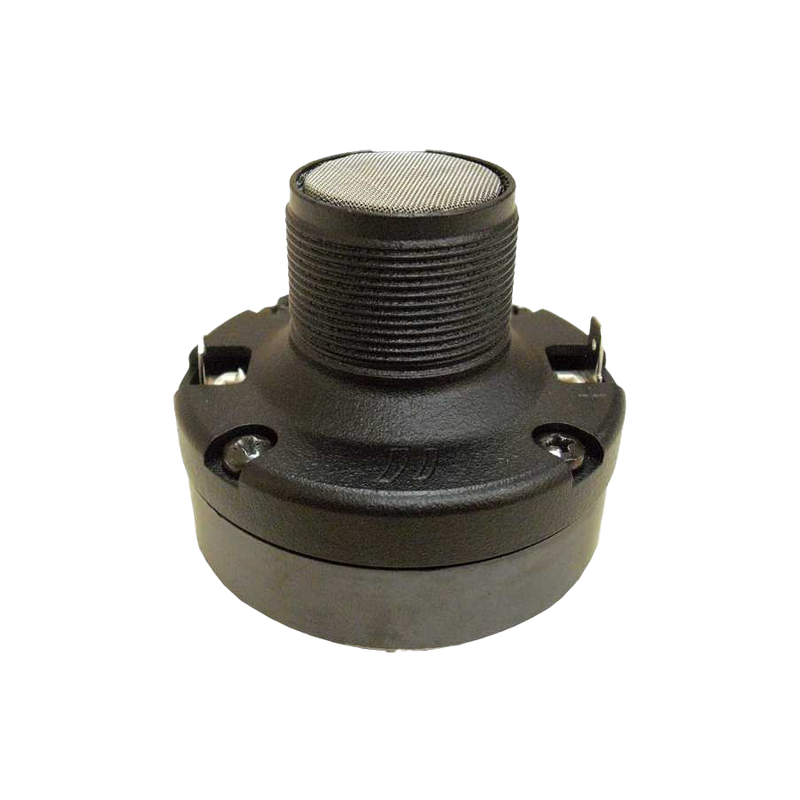
Beyma SPL30FE 1-Inch 8-Ohm Ferrite Compression Driver
If the system already has enough midrange but starts losing clarity and bite once the volume comes up, the SPL30FE is the small compression driver that handles the top end without asking a conventional tweeter to fight a wall of larger mids.
This is where a compression driver makes sense instead of simply adding another bullet tweeter. The SPL30FE is built around a 1-inch throat, 8-ohm nominal impedance, ferrite motor, PM4 polymer diaphragm, and a published 2 kHz–20 kHz operating range. Beyma rates it at 106 dB sensitivity, so it does not need a huge amount of amplifier power to become a serious part of the system.
The important part is using it for the job it was actually designed to do. With a 2 kHz published lower limit and a 1-inch voice coil, the SPL30FE is the high-frequency member of the SPL family. We would use it when the midrange section already plays high enough and clean enough that the compression driver does not need to reach deep into the vocal range. That lets the SPL30FE concentrate on projection, detail and upper-frequency output.
Why choose the SPL30FE instead of a conventional tweeter?
A normal car-audio tweeter is usually the easier answer when the goal is smooth high-frequency detail inside a conventional front-stage system. The SPL30FE makes sense when output and controlled horn loading become part of the design.
The horn is what turns the compression driver into a useful acoustic system. Instead of mounting the diaphragm directly into the panel and letting it radiate on its own, the driver couples to a compatible 1-inch horn or waveguide. The horn controls how the energy leaves the driver, which can give a high-output build more projection and usable coverage than simply adding more small tweeters around the vehicle.
That also means the horn is not an accessory we would choose randomly. Throat size, mounting depth, coverage pattern and where the horn will actually aim all matter. The SPL30FE is the driver; the horn determines how that output is delivered into the vehicle or open-air listening area.
SPL30FE vs. SPL70FE vs. SPL90FE
SPL30FE: choose this one when the midrange section can already play high and you mainly need an efficient compression-driver top end. It uses a 1-inch throat, 1-inch voice coil and a published 2 kHz–20 kHz range.
SPL70FE: this is the next step when the compression driver needs to reach substantially lower. It uses the same 1-inch throat but a larger 1.75-inch voice coil, 109 dB sensitivity and a 700 Hz–19 kHz published range. That is a different system role because it can be crossed into the upper midrange much lower than the SPL30FE.
SPL90FE: this is the larger-format option. It moves to a 1.4-inch throat and 2.84-inch voice coil, with 109 dB sensitivity and a 700 Hz–18 kHz published range. That is the driver we would look at when the system is being built around a larger horn and the compression driver is expected to carry more of the upper-midrange workload.
The mistake would be buying the biggest driver automatically. If the midrange already reaches cleanly to the crossover point, the SPL30FE can be the more logical piece because you are not paying for lower-frequency capability the system does not need.
Where we would use the SPL30FE
This makes sense in high-output motorcycle, Jeep, powersports and custom multi-speaker systems where conventional tweeters are being overwhelmed by the midrange section. It can also work in fabricated door panels, rear speaker panels and other builds where the horn can be placed and aimed deliberately instead of buried behind a factory grille with no control over dispersion.
In a motorcycle or open-air system, that controlled projection becomes especially important. The speaker is not working in a quiet cabin. Wind, road noise and distance from the listening position can eat up high-frequency detail quickly. A properly selected horn and compression driver can keep that information present without relying on harsh EQ or stacking multiple small tweeters in the same area.
How we would integrate it into a real system
We would not connect the SPL30FE full range and rely on the driver to protect itself. The published 2 kHz lower frequency limit is not automatically the crossover frequency for every installation. Final crossover frequency and slope depend on the horn, amplifier power, expected volume, the midrange below it and how much safety margin the system needs.
With DSP, the cleaner approach is to let the midrange play up to a controlled handoff, high-pass the SPL30FE above the point where it is being stressed, then level-match the horn to the rest of the system. Because 106 dB sensitivity is high compared with many conventional mobile-audio speakers, the compression driver often needs less amplifier voltage than the mids around it. More amplifier gain is not automatically better.
Time alignment and polarity still matter. A loud horn that arrives early or overlaps too aggressively with the midrange can make the system sound sharp even when both drivers are individually good. The goal is not simply more high frequency. The goal is making the upper range stay clear and present while still sounding like one system.
The practical result: the SPL30FE gives a high-output system a real horn-loaded top end without forcing a larger compression driver into a job the installation does not require.
Manufacturer Specifications
| Model | SPL30FE |
|---|---|
| Sold as | Single compression driver |
| Nominal impedance | 8 ohms |
| Throat diameter | 1 inch |
| AES power handling | 30 watts |
| Sensitivity | 106 dB, 2.83 V / 1 m |
| Frequency range | 2,000–20,000 Hz |
| Voice-coil diameter | 1 inch |
| Diaphragm | PM4 polymer |
| Magnet | Ferrite |
Horn required: the SPL30FE is a compression driver and must be used with a compatible 1-inch horn or waveguide. Horn choice, crossover, amplifier power and final tuning should be matched to the complete system.
Where this fits in the build
Speaker choice should follow the listening goal and the location it has to work in. Factory replacement, sound quality, loud daily and high-output builds have different priorities.