
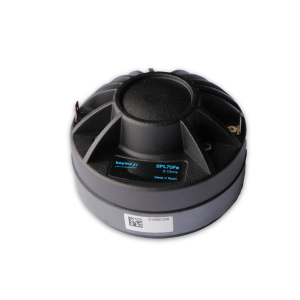

Description
Beyma SPL70FE 1-Inch 8-Ohm Ferrite Compression Driver
If the midrange section starts running out of clean output before a small high-frequency compression driver can safely take over, the SPL70FE is the step that closes that gap.
The SPL70FE keeps the compact 1-inch throat format, but it is a much broader-range driver than the SPL30FE. It uses a 1.75-inch voice coil, 109 dB sensitivity and a published 700 Hz–19 kHz frequency range. That combination changes how we would use it. Instead of treating the compression driver as a top-end-only piece, the SPL70FE can be built into a system where the horn is responsible for a larger portion of the upper-midrange and high-frequency range.
That matters when the speakers below it are large, aggressive midbass or midrange drivers that sound best when they do not have to stretch too far upward. A good 8- or 10-inch midrange may have plenty of output but still need a controlled handoff before the upper range gets ragged or directional. The SPL70FE gives the system designer more room to make that handoff happen cleanly.
Why this makes sense instead of just adding a louder tweeter
A tweeter is still the right tool when the system only needs the top octave filled in. The SPL70FE is for a different problem. Its published range extends much farther down, so it can take over more of the vocal presence and upper-midrange region when the horn and crossover are designed for it.
That is useful in high-output mobile systems because the transition between a large midrange and a tiny tweeter can be the weak point. If the midrange beams or loses smoothness before the tweeter is comfortable playing, the system can end up with a hole in response or a harsh overlap trying to cover it. A broader-range compression driver gives us another way to solve that.
The horn still matters just as much as the driver. The SPL70FE must be coupled to a compatible 1-inch horn or waveguide, and that horn determines the physical coverage pattern, mounting footprint and how the acoustic energy is aimed into the listening area.
SPL30FE vs. SPL70FE vs. SPL90FE
SPL30FE: the simpler top-end choice. It uses a 1-inch throat and 1-inch voice coil, with 106 dB sensitivity and a published 2 kHz–20 kHz range. Choose it when the midrange section can already carry the system high enough and the compression driver mainly needs to add projection and high-frequency detail.
SPL70FE: the broader-range 1-inch-throat option. It uses a larger 1.75-inch voice coil, is rated at 109 dB sensitivity and has a published 700 Hz–19 kHz range. Choose it when the horn needs to meet the midrange lower and cover more of the upper-midrange job.
SPL90FE: the larger-format option. It moves to a 1.4-inch throat and 2.84-inch voice coil, with 109 dB sensitivity and a published 700 Hz–18 kHz range. Choose it when the installation is being built around a larger horn and the compression driver is expected to carry more acoustic workload.
The SPL70FE makes sense when the 1-inch horn format fits the fabrication and coverage goal, but the SPL30FE does not reach low enough for the crossover plan.
Where we would use the SPL70FE
This is the kind of driver we would consider in a large motorcycle system, Jeep or powersports build, custom door panel, rear speaker wall or other open-air/high-output installation where the midrange section has enough cone area to get loud but needs a stronger upper-range partner than a conventional tweeter.
For example, if a build uses multiple 8-inch midrange or midbass drivers, asking those speakers to carry too far into the upper range can make the system more directional and harder to blend. Bringing in a properly aimed compression driver earlier can keep the upper vocal range and attack of instruments projected toward the listener instead of letting the large cones do work they are not best suited for.
On the other hand, if the system already uses 6.5-inch mids that comfortably play high and the only missing piece is sparkle and projection, the SPL30FE or a dedicated tweeter may be the cleaner answer. Bigger capability is only useful when the system actually needs it.
How we would integrate it
The 700 Hz figure is the published lower end of the manufacturer's frequency range. It is not an automatic crossover recommendation. In a real system we would choose the high-pass frequency and slope from the horn being used, amplifier power, expected listening level, the driver below it and the amount of protection margin required.
With DSP, the goal would be to create a controlled acoustic overlap between the midrange and the SPL70FE, then use level, delay, polarity and EQ to make that transition disappear. At 109 dB sensitivity, this driver can produce substantial output from relatively little voltage, so level matching matters. A compression driver that is several decibels too hot can make an otherwise good system sound aggressive even when the frequency response looks reasonably flat.
We would also pay close attention to horn placement. A high-efficiency driver pointed at the wrong part of the cabin is not fixed by adding more amplifier power. The horn needs a useful line of sight and coverage pattern for the listening area.
The practical result: the SPL70FE gives a high-output system a compact 1-inch horn platform that can meet the midrange much lower than the SPL30FE, making it easier to build a strong upper-midrange and high-frequency section without forcing the larger cone drivers to play outside their best range.
Manufacturer Specifications
| Model | SPL70FE |
|---|---|
| Sold as | Single compression driver |
| Nominal impedance | 8 ohms |
| Throat diameter | 1 inch |
| Sensitivity | 109 dB, 2.83 V / 1 m |
| Frequency range | 700–19,000 Hz |
| Voice-coil diameter | 1.75 inches |
| Diaphragm | PM4 polymer |
| Magnet | Ferrite |
Horn required: use the SPL70FE with a compatible 1-inch horn or waveguide. Final crossover frequency, slope and amplifier setup should be established from the complete horn/driver/system combination.
Where this fits in the build
Speaker choice should follow the listening goal and the location it has to work in. Factory replacement, sound quality, loud daily and high-output builds have different priorities.