

Description
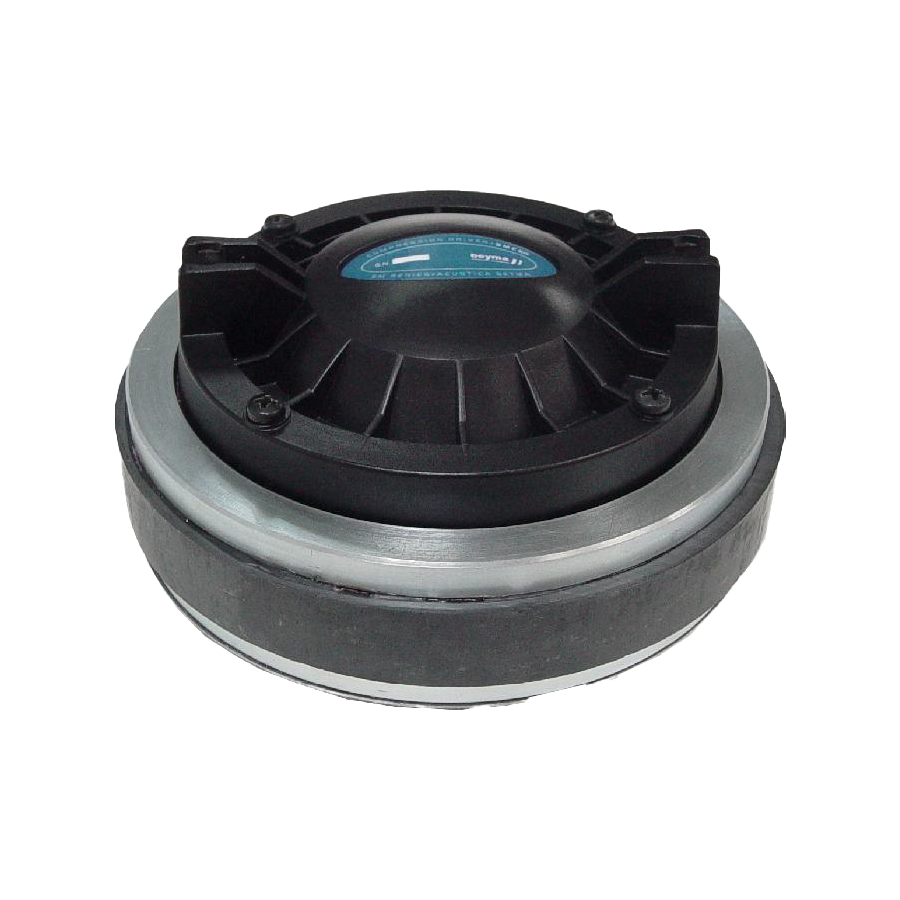
Beyma SPL90FE 1.4-Inch 8-Ohm Ferrite Compression Driver
If the compression driver is expected to do more than just add top-end sparkle—if it needs to carry a serious part of the upper-midrange while staying efficient at high output—the SPL90FE is the large-format option in this Beyma SPL group.
The SPL90FE moves to a 1.4-inch throat and a 2.84-inch voice coil, while keeping an 8-ohm nominal impedance, ferrite motor and PM4 polymer diaphragm. It is rated at 60 watts AES, 109 dB sensitivity and a published 700 Hz–18 kHz frequency range. Those numbers tell you why this driver exists: larger acoustic loading, more diaphragm and voice-coil area, and a broader job than a small top-end compression driver.
This is not the model we would choose simply because it is the biggest. A 1.4-inch compression driver also needs the room for a compatible horn, and that horn becomes part of the fabrication and system layout. The SPL90FE makes sense when the installation has space for that larger horn and the crossover plan benefits from letting the compression driver meet a large midrange lower in frequency.
What problem the SPL90FE solves
Large 8-, 10- and 12-inch midrange drivers can make a tremendous amount of output, but they become increasingly directional as frequency rises. If the entire upper vocal range is left on a large cone, the system can be loud straight in front of the speaker and fall apart off axis. Trying to fix that only with EQ does not change the physical radiation pattern.
A large-format horn and compression driver give the system designer another tool. The SPL90FE can take over earlier, allowing the horn to control more of the upper-midrange and high-frequency coverage while the large cone driver stays focused on the range where it has the strongest combination of output and usable dispersion.
That does not mean we would automatically cross this driver at the bottom of its published 700 Hz range. The horn, crossover slope, amplifier power and target output still determine the safe acoustic handoff. The advantage is having the capability to design that handoff lower than we could with a small top-end driver.
SPL90FE vs. SPL70FE
These two models overlap on paper, but they are not interchangeable.
SPL70FE: 1-inch throat, 1.75-inch voice coil, 109 dB sensitivity and a published 700 Hz–19 kHz range. It makes sense when the system needs broader compression-driver coverage but the fabrication is built around a compact 1-inch horn format.
SPL90FE: 1.4-inch throat, 2.84-inch voice coil, 60-watt AES rating, 109 dB sensitivity and a published 700 Hz–18 kHz range. It makes sense when the horn and driver are being asked to carry more acoustic workload and there is room for the larger format.
The SPL90FE does not win because its published lower frequency is lower—it uses the same 700 Hz published figure as the SPL70FE. The difference is the physical platform: larger throat and substantially larger voice coil. That is what makes it the more serious choice when the horn section itself is a major part of the system.
SPL90FE vs. SPL30FE
The SPL30FE is a different tool entirely. It uses a 1-inch throat and 1-inch voice coil, is rated at 30 watts AES and 106 dB sensitivity, and its published range starts at 2 kHz. We would use that when the midrange already plays high cleanly and the compression driver only needs to handle the top section.
The SPL90FE is what we look at when that crossover needs to happen much lower and the horn has to contribute to the upper-midrange instead of behaving like a powerful tweeter.
Where we would use the SPL90FE
This driver makes the most sense in large high-output builds: motorcycle systems with major saddlebag or fairing fabrication, Jeep and powersports speaker panels, multi-driver doors, demo-style vehicles and other installations where the midrange section has enough output that a conventional tweeter becomes the weak link.
For example, a system with multiple 10-inch midrange drivers may have no problem getting loud through the vocal range, but it can still become narrow and aggressive as those large cones are pushed higher. A properly selected 1.4-inch horn can take that upper-range workload and project it over a wider useful listening area.
That is also why horn placement has to be designed before cutting panels. The driver itself is only half of the package. Coverage angle, horn depth, mouth size and actual aim determine whether the SPL90FE solves the problem or simply creates a very loud hot spot in the wrong place.
How we would power and tune it
The SPL90FE is rated at 60 watts AES. With 109 dB sensitivity, that does not mean the correct amplifier is simply the biggest amplifier available. Compression drivers are efficient. A small amount of voltage can create a lot of acoustic output, and improper crossover or gain structure can damage the diaphragm long before the rest of a large speaker system sounds stressed.
We would build the protection first: choose the horn, establish a high-pass point and slope with enough margin for the intended output, then set amplifier gain from the actual voltage requirement rather than knob position. In a DSP system, the SPL90FE would then be level-matched to the midrange below it and corrected for the acoustic behavior of the horn in the installed location.
Delay and polarity matter because a large horn often sits physically behind or ahead of the cone drivers it is crossing to. If those acoustic centers do not line up, the crossover region can cancel or stack even when both drivers are wired correctly. That is the kind of problem tuning solves; simply adding more EQ does not.
The practical result: the SPL90FE is the Beyma choice when the build needs a real large-format horn section that can carry meaningful upper-midrange output, not just a louder substitute for a tweeter.
Manufacturer Specifications
| Model | SPL90FE |
|---|---|
| Sold as | Single compression driver |
| Nominal impedance | 8 ohms |
| Throat diameter | 1.4 inches |
| AES power handling | 60 watts |
| Sensitivity | 109 dB, 2.83 V / 1 m |
| Frequency range | 700–18,000 Hz |
| Voice-coil diameter | 2.84 inches |
| Diaphragm | PM4 polymer |
| Magnet | Ferrite |
Horn required: the SPL90FE must be paired with a compatible 1.4-inch horn or waveguide. Horn choice, crossover frequency and slope, amplifier setup and final DSP tuning should be designed as one system.
Where this fits in the build
Speaker choice should follow the listening goal and the location it has to work in. Factory replacement, sound quality, loud daily and high-output builds have different priorities.