

Description
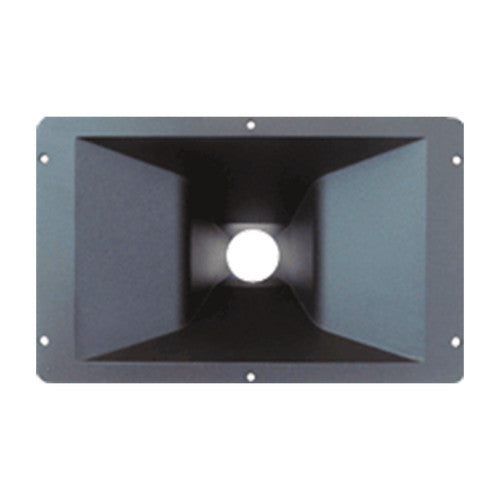
Beyma TD-372/DB 2-Inch 60° × 60° Cast-Aluminum Horn
If the system is being built around a true 2-inch compression driver, the TD-372/DB gives that large-format driver a 60° × 60° cast-aluminum horn with an 800 Hz published cutoff and enough physical mouth area to do a job the compact 1-inch horns are not designed for.
The first thing to understand is compatibility. This is a 2-inch throat horn. It is not the horn for Beyma's SPL30FE or SPL70FE, which use 1-inch throats, and it is not a direct throat-size match for the 1.4-inch SPL90FE. Buying a horn by appearance or assuming “larger is better” can leave you with two expensive parts that do not mate together.
The TD-372/DB is for a system planned around a compatible 2-inch compression driver. It uses a symmetrical 60° × 60° coverage pattern, an 800 Hz horn cutoff, overall dimensions of 305 × 190 × 140 mm and cast-aluminum construction. Those numbers immediately tell us this is a different class of horn from the compact TD-8060.
What a 2-inch horn changes in the system
A large-format horn is not just a bigger version of a small tweeter horn. It changes the packaging, the driver options and the portion of the spectrum the horn system may be capable of handling.
The 800 Hz published horn cutoff gives the acoustic platform more low-frequency capability than a compact horn such as the TD-8060, which Beyma rates with a 1,500 Hz cutoff. That does not mean every 2-inch compression driver should automatically be crossed at 800 Hz. The connected driver still has its own minimum operating range and power-dependent crossover requirement. The horn and driver have to be safe at the same crossover point.
What the lower horn cutoff does give the designer is room to build a large-format horn section that can potentially meet a large midrange lower than a small high-frequency horn can. That matters in systems using 10- or 12-inch midrange drivers where we do not want to force the cone speakers too high just to meet a small tweeter.
Why 60° × 60° coverage matters
The TD-372/DB uses a symmetrical 60° horizontal by 60° vertical published coverage pattern. That is a more focused pattern than the TD-8060's 80° × 60° coverage.
In a real build, that can make sense when the horn is aimed at a defined listening zone and we want to keep more energy concentrated there rather than spreading it as broadly across the horizontal plane. The tradeoff is that placement and aim become even more important. A focused horn pointed away from the listener does not become a wide horn because we add EQ.
On a motorcycle or open-air demo build, a 60° × 60° horn can be useful when each horn has a deliberate coverage zone. In a vehicle cabin, the same pattern may require more careful left/right aiming to keep both seats inside the useful acoustic window. The coverage number is not automatically good or bad; it tells us what geometry we have to work with.
TD-372/DB vs. TD-8060
These two horns solve different packaging and system-design problems.
TD-8060: 1-inch throat, 80° × 60° coverage, 1,500 Hz cutoff, compact 140 × 140 × 67.4 mm polycarbonate construction. Choose it when a compatible 1-inch compression driver, broader horizontal coverage and compact lightweight packaging fit the system.
TD-372/DB: 2-inch throat, 60° × 60° coverage, 800 Hz cutoff, larger 305 × 190 × 140 mm cast-aluminum construction. Choose it when the build is intentionally designed around a compatible 2-inch compression driver and the larger horn section has room to work.
Neither is an upgrade path for the other by itself. The compression driver, crossover target, available space and desired coverage decide which horn belongs in the system.
Where we would use the TD-372/DB
This is a large-format part, so we would expect it in a serious custom installation rather than a factory tweeter opening. Think large motorcycle or powersports enclosures, demo vehicles, speaker walls, custom rear panels or other fabricated systems where the horn section has enough panel area and depth to be designed correctly.
The 305 × 190 mm face size has to be considered before any cutting starts, and the 140 mm horn depth is only the horn itself. The compatible compression driver adds additional depth behind it. On a crowded panel with multiple 8-, 10- or 12-inch speakers, that rear package can affect bracing, enclosure space, wiring and serviceability.
This is also where a cardboard-template or CAD layout makes sense before fabrication. The horn needs room physically, but it also needs a useful acoustic path. Putting a large horn wherever a rectangle happens to fit is not the same as designing its coverage around the listener.
How we would integrate and tune it
We would select the 2-inch compression driver first or at the same time, verify the mechanical mounting pattern, then establish the safe crossover from the complete driver/horn combination. The horn's 800 Hz cutoff is only one boundary. The driver's published minimum frequency and the required crossover slope still control how low the assembly can actually be used at the intended power.
In a DSP system, the large horn would be level-matched to the midrange section, then checked through the crossover for phase, polarity and time arrival. Large horns and large midranges often have very different acoustic-center depths, so the electrical crossover can look correct while the installed acoustic response still has a cancellation problem.
EQ comes after those fundamentals. If we try to EQ around a bad crossover or bad horn aim, we can use amplifier headroom without fixing the underlying problem.
The practical result: the TD-372/DB is the Beyma horn for a build that genuinely needs a 2-inch large-format high-frequency section, a focused 60° × 60° pattern and the physical platform to let that system operate as designed.
Manufacturer Specifications
| Model | TD-372/DB |
|---|---|
| Sold as | Single horn |
| Throat diameter | 2 inches |
| Coverage | 60° horizontal × 60° vertical |
| Cutoff frequency | 800 Hz |
| Overall dimensions | 305 × 190 × 140 mm |
| Material | Cast aluminum |
Driver matching: the TD-372/DB requires a compatible 2-inch compression driver. Confirm the exact mounting pattern, total rear depth and driver crossover requirements before fabrication. Do not assume compatibility with Beyma's 1-inch or 1.4-inch SPL compression drivers.