
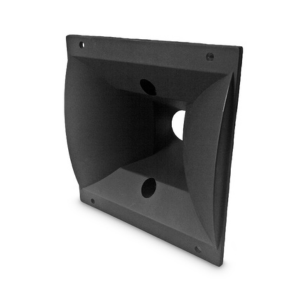

Description
Beyma TD-8060 1-Inch 80° × 60° Constant-Directivity Horn
If the high-frequency section needs to cover a useful area instead of firing like a narrow spotlight, the TD-8060 gives the system designer something the other small Beyma car-audio horns do not document as clearly: a defined 80° horizontal by 60° vertical coverage pattern.
That is the reason to choose this horn. It is not just a lightweight way to mount a 1-inch compression driver. Beyma designed the TD-8060 as a constant-directivity horn, with its beamwidth specified at 80° horizontal and 60° vertical from 2 kHz through 16 kHz. In a vehicle or open-air build, that gives us a known starting point for deciding where the horn needs to sit and how it needs to be aimed.
The body is polycarbonate rather than cast aluminum, and the complete horn is compact: 140 × 140 × 67.4 mm overall, with a 113 × 130 mm baffle cutout and a net weight of only 0.130 kg. That packaging matters on motorcycles, Jeeps, UTVs and fabricated door panels where every inch behind the panel and every pound hanging from a custom insert matters.
The problem the 80° × 60° pattern solves
A horn that is extremely narrow can be loud on axis and disappointing everywhere else. A horn that is too broad for the installation can throw energy into glass, body panels or open space where we do not need it. The TD-8060 gives us a documented pattern we can actually design around.
The wider 80° horizontal coverage is useful when the horn needs to spread energy across a seating area or across the width of an open-air listening zone. The 60° vertical pattern keeps that spread more controlled in the vertical plane. In practice, that can make it easier to place the horn so the listener gets strong high-frequency information without wasting as much output above and below the useful area.
That does not mean 80° × 60° is automatically perfect for every build. The right coverage depends on where the horn is mounted, how far it is from the listener and whether the goal is one primary seat, both front seats, riders behind a motorcycle, or a broader show/demo listening area. What the TD-8060 gives us is a published pattern instead of a guess.
Why constant directivity matters
As frequency rises, many horns and large cone speakers change their coverage substantially. The TD-8060 is designed to maintain controlled directivity through its working passband. Beyma publishes a directivity factor of 10.3 averaged from 1–16 kHz and a directivity index of 7.7 dB.
For the customer, the practical point is not the math by itself. The goal is more predictable coverage as the frequency changes. That helps us build a high-frequency section that stays useful across the listening area instead of becoming progressively narrower as the music moves up in frequency.
TD-8060 vs. TD-1LR and TD-PH35
TD-8060: choose it when documented coverage and compact packaging are the priorities. We know the 80° × 60° pattern, the 1,500 Hz horn cutoff, the physical dimensions and the cutout before fabrication starts.
TD-1LR: a 1-inch cast-aluminum horn. Choose it only after confirming exact physical fit and intended acoustic application; do not apply TD-8060 coverage, cutoff or dimensions to it.
TD-PH35: another 1-inch cast-aluminum option. Choose it only after confirming exact physical fit and intended acoustic application; do not assign it TD-8060 dispersion or dimensional data.
The TD-8060 therefore makes the most sense when its known 80° × 60° pattern, 1,500 Hz cutoff and compact polycarbonate package fit the design. The cast-aluminum models may still be correct for a particular installation, but their exact fit and intended coverage need to be confirmed before fabrication.
What the 1,500 Hz cutoff does—and does not—mean
Beyma publishes a 1,500 Hz cutoff frequency for the TD-8060. That is a property of the horn. It is not a universal recommendation to cross every 1-inch compression driver at 1,500 Hz.
The connected driver still has its own safe operating range and power-dependent crossover requirements. For example, Beyma/PAC publishes the SPL30FE from 2 kHz upward, while the SPL70FE reaches substantially lower. Bolting either driver to a 1-inch horn does not erase that difference.
We would choose the crossover from the complete horn-and-driver combination, expected amplifier power, desired output and the speaker below it. In other words, the horn has to support the crossover, and the compression driver has to survive it.
Where we would use the TD-8060
This horn makes sense in custom high-output systems where we need a separate compression driver but do not have room for a large-format 2-inch horn: motorcycle fairings and saddlebag panels, Jeep and powersports pods, custom doors, rear panels and compact demo builds.
Its low 0.28-pound net weight is useful where the horn is mounted to a fabricated panel that already carries multiple speakers. The shallow 67.4 mm horn depth also helps with packaging, although the compression driver attached behind it still has to be included when checking total rear clearance.
In a motorcycle application, we might orient and aim the 80° horizontal pattern so it covers the rider area instead of firing directly at one narrow point. In a Jeep or UTV, the same published pattern gives us a better way to decide whether a single horn per side can cover the intended listening area or whether the system layout requires more than one high-frequency source.
How we would tune it in the complete system
Once the horn and driver are mechanically correct, DSP is where we make the acoustic handoff work. We would high-pass the compression driver at an appropriate frequency and slope, level-match the horn to the mids, then check polarity and arrival time through the crossover region.
Horn EQ should be based on measured response in the installed location, not on a generic “horn curve.” Windshields, fairings, door panels and nearby surfaces can all change what reaches the listener. We tune what the installed system is actually doing.
Because a compression driver can be far more efficient than the cone speakers below it, gain structure matters. The goal is not to use all of the horn's available output just because it is there. The goal is enough headroom that the highs stay clean at the system's target volume while still blending naturally with the rest of the build.
The practical result: the TD-8060 is the Beyma 1-inch horn we reach for when compact packaging and predictable 80° × 60° coverage need to be part of the system design from the beginning.
Manufacturer Specifications
| Model | TD-8060 |
|---|---|
| Sold as | Single horn |
| Horn type | Constant directivity |
| Throat diameter | 25.4 mm / 1 inch |
| Coverage | 80° horizontal × 60° vertical |
| Horizontal beamwidth | 80° at -6 dB, 2–16 kHz |
| Vertical beamwidth | 60° at -6 dB, 2–16 kHz |
| Directivity factor (Q) | 10.3 average, 1–16 kHz |
| Directivity index (DI) | 7.7 dB, +4 / -3.7 dB |
| Cutoff frequency | 1,500 Hz |
| Overall dimensions | 140 × 140 × 67.4 mm / 5.51 × 5.51 × 2.65 in |
| Baffle cutout | 113 × 130 mm / 4.45 × 5.12 in |
| Net weight | 0.130 kg / 0.28 lb |
| Shipping weight | 0.225 kg / 0.50 lb |
| Material | Polycarbonate |
Driver matching: pair the TD-8060 with a compatible 1-inch compression driver and set crossover, power and DSP around the limits of the complete horn/driver system.