
Description
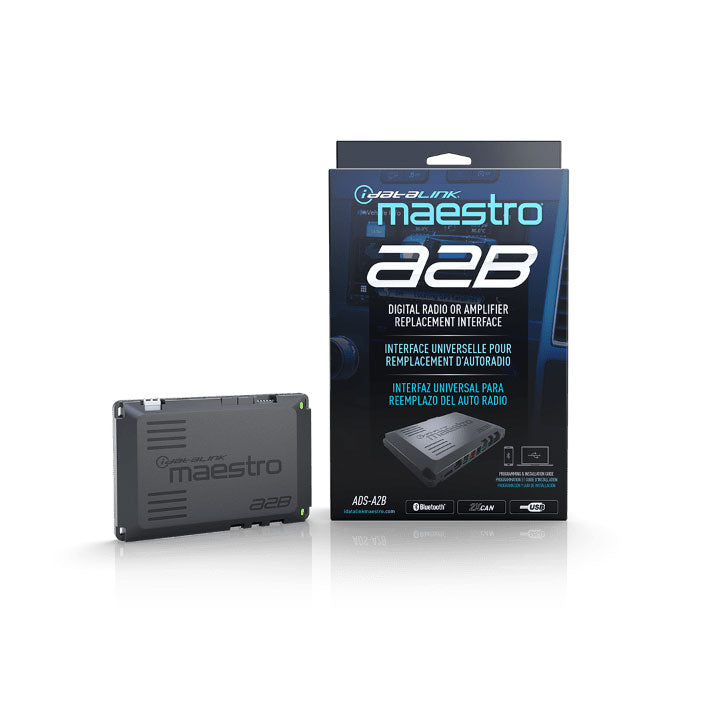
iDatalink Maestro A2B Digital Amplifier Replacement Interface
When the factory amplifier lives on an A2B digital network, replacing it is not a speaker-wire job. The integration has to understand the network first.
In supported Ford and Lincoln A2B systems, the factory amplifier receives digital audio and vehicle-control information over the Automotive Audio Bus. Pull that amp out without the right interface and the problem is bigger than losing sound—you can also lose the factory behavior tied to prompts, controls and other audio functions traveling through the original system.
Maestro A2B is built specifically for that architecture. It lets us keep the factory radio in place, remove the factory digital amplifier and hand the new DSP or amplifier a usable signal path without trying to fake an analog connection where one never existed.
A2B Is Its Own Integration Path
This is not AR2 with a different connector. A2B is a different factory-audio network, so it needs an interface designed around that bus. That is why the ADS-A2B and its vehicle-specific harnesses are matched to supported A2B applications instead of being treated like another universal amplifier bypass.
That distinction matters in a real build. If the goal is more power, a properly tuned active front stage and a modern DSP, we want the factory radio and supported vehicle functions to stay where they belong while the aftermarket equipment takes over the audio job. A2B gives us that handoff point.
The matching vehicle-specific A2B T-harness connects at the factory-amplifier wiring without cutting the original harness. From there, the replacement system can use six analog RCA channels supplied through the supported harness or the module's TOSLINK digital output, depending on what the downstream DSP or amplifier wants to see.
Why That Matters in the System
Instead of stacking a new amplifier behind the factory digital amp and then working around its processing, the factory amplifier comes out of the signal chain. The new DSP or amplifier becomes the part we tune around.
Supported factory functions can remain integrated on compatible applications, including vehicle-dependent fade, balance, tone controls, warning chimes, navigation prompts and Bluetooth audio. Exactly what is retained depends on the vehicle application, which is why the correct year, trim and factory audio package matter.
Programming Is More Than Just Selecting the Vehicle
ADS-A2B has built-in Bluetooth and is web-programmable. In supported programming, iDatalink provides adjustment/remapping for functions such as signal routing, tone control, chime level and balance so the interface can be configured around the vehicle and replacement system rather than acting as a fixed-output black box.
The module can be programmed through the supported Weblink workflow, including compatible mobile programming through the built-in Bluetooth connection. Vehicle-specific flashing is required before installation.
Fitment and Hardware Are Part of the Product
ADS-A2B requires the correct vehicle-specific A2B T-harness and replacement aftermarket amplification. Harness families include Ford and Lincoln applications such as A2B-AR-FO4, A2B-AR-FO5 and A2B-AR-LI2.
The vehicle, year, trim, factory audio package, harness and downstream equipment must match. If the vehicle is AR, AR2 or another architecture instead of A2B, we use the proper path for that system rather than trying to force the wrong interface into it.
Manufacturer Specifications
- Model: ADS-A2B
- Product type: Maestro A2B digital factory-amplifier replacement interface
- Factory architecture: Supported Automotive Audio Bus (A2B) Ford/Lincoln audio systems
- Vehicle connection: Requires a compatible vehicle-specific Maestro A2B T-harness
- Aftermarket compatibility: Works with conventional aftermarket amplifiers; downstream channel requirements depend on the vehicle/system
- Analog signal path: Six RCA channels provided through the supported vehicle-specific T-harness
- Digital output: TOSLINK for compatible DSPs/amplifiers
- Programming: Web-programmable with vehicle-specific flash required
- Bluetooth: Built in for supported wireless/mobile programming
- Programmable functions: Supported signal-routing, tone-control, chime-level, balance and related vehicle/audio remapping vary by application
- Approximate dimensions with harness connections: 4.71 × 0.743 × 4.26 in
Included
- ADS-A2B interface module
- 4-pin connection cable
- 3-pin harness
- Radio-replacement connection harness
- USB-C to USB-A programming cable
Required separately: Compatible vehicle-specific A2B T-harness and aftermarket amplifier or DSP/amplifier system.
Manufacturer: iDatalink Maestro
Where this fits in the build
This is a system-control or DSP component. The correct choice depends on the signal path, channel count, routing, retained features and the rest of the amplifier and speaker plan.