
Description
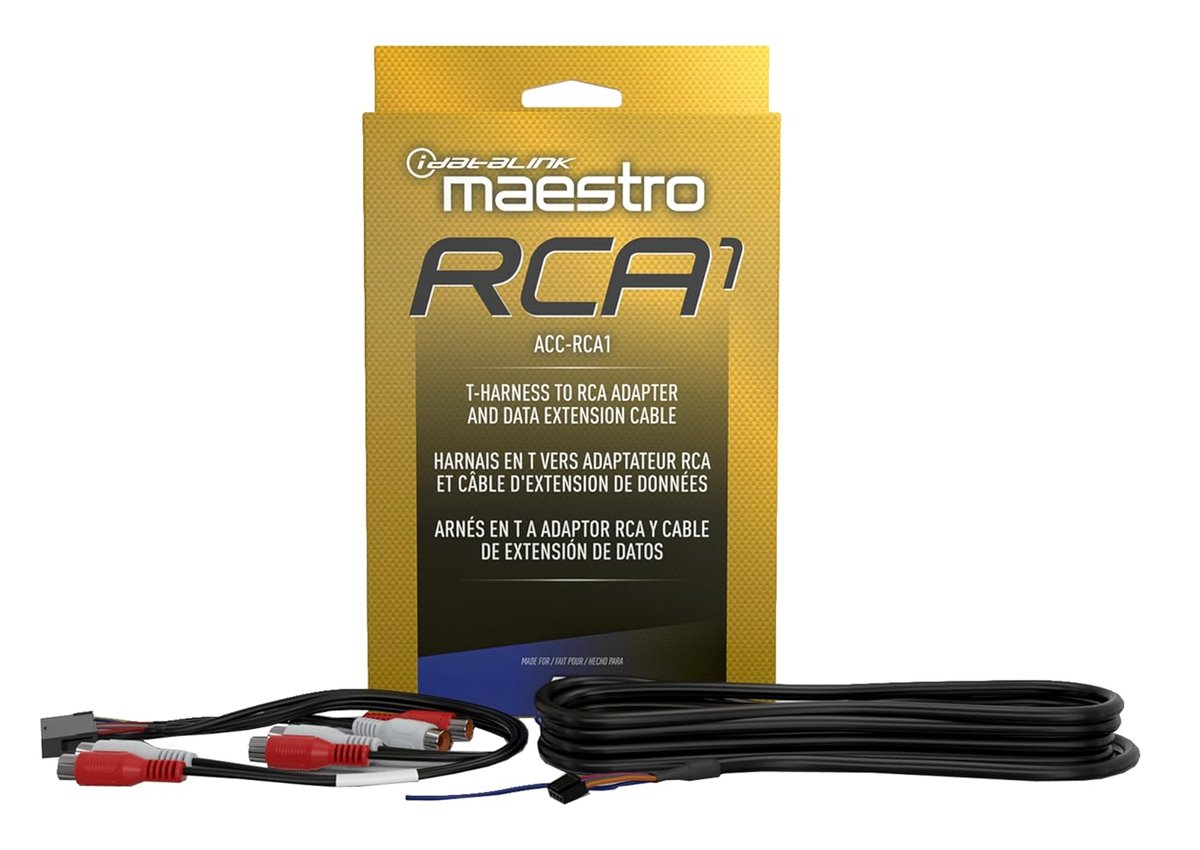
iDatalink Maestro ACC-RCA1 AR / DSP Harness-to-RCA Adapter
The vehicle-side harness can be exactly right and the install can still stall if the DSP or amplifier on the other end expects conventional RCA. ACC-RCA1 is the clean handoff for the Maestro applications that call for it.
On supported Maestro AR and DSP-harness installations, ACC-RCA1 adapts the compatible harness connection to three pairs of female RCA outputs so a non-Maestro DSP or amplifier can receive the signal in the format it was built for. The kit also includes a 5-meter / 16.4-foot data extension cable for supported remote equipment placement.
That lets us keep the vehicle-specific wiring where it belongs and still put the DSP or amplifier where the system makes sense physically—under a seat, behind a panel or on a rear equipment rack—without cutting apart a proper Maestro harness just because the downstream equipment wants RCA.
Use It When the Downstream Equipment Needs RCA
On a supported non-amplified HRN-DSP installation, the vehicle harness can provide the factory-radio signal and access to the original speaker wiring. If the selected DSP or amplifier needs RCA and the Maestro application specifies ACC-RCA1, this adapter gives us that analog handoff cleanly.
The same idea applies on compatible AR amplifier-replacement paths. We choose the correct vehicle harness and Maestro architecture first, then look at what the downstream equipment accepts. RCA1 belongs in the system when that supported workflow calls for an RCA connection; it is not something we add automatically to every AR or DSP harness.
The Extension Cable Solves a Different Problem
The included 5-meter data cable is there because the integration point and the amplifier location are often not the same place. The factory connection may be behind the radio or near the OEM amplifier, while the new equipment belongs farther away for cooling, service access, power wiring or rack layout.
The RCA adapter harness is approximately 11 inches long, and the extension gives roughly 16.4 feet of reach for the supported data connection. That is useful installation hardware, not additional signal processing.
One Compatibility Line Matters
ACC-RCA1 does not work with the Rockford Fosgate/iDatalink DSR1. DSR1 uses its own supported Maestro harness workflow. If DSR1 is the processor, adding RCA1 because an HRN-DSP or HRN-AR harness is present is the wrong move.
RCA1 is also not a DSP, line-output converter or universal RCA adapter. It does not create vehicle support or make unsupported equipment compatible. It adapts the connection on supported Maestro AR/DSP installations where RCA is the correct next step.
Manufacturer Specifications
- Model: ACC-RCA1
- Product type: Maestro AR / DSP harness-to-RCA adapter and data extension kit
- Application: Compatible Maestro AR and DSP harness installations
- RCA adapter: Approx. 11 in
- RCA outputs: Three pairs of female RCA connections
- Data extension: 5 m / 16.4 ft
- Remote installation support: Extension cable allows compatible equipment to be mounted away from the vehicle connection point
- DSR1 compatibility: Not compatible with Rockford Fosgate/iDatalink DSR1
Included: RCA adapter harness and 5-meter data extension cable.
Required separately: Compatible vehicle-specific harness, Maestro interface where required, DSP/amplifier and other installation hardware.
Manufacturer: iDatalink Maestro
Where this fits in the build
This is a system-control or DSP component. The correct choice depends on the signal path, channel count, routing, retained features and the rest of the amplifier and speaker plan.