
Description
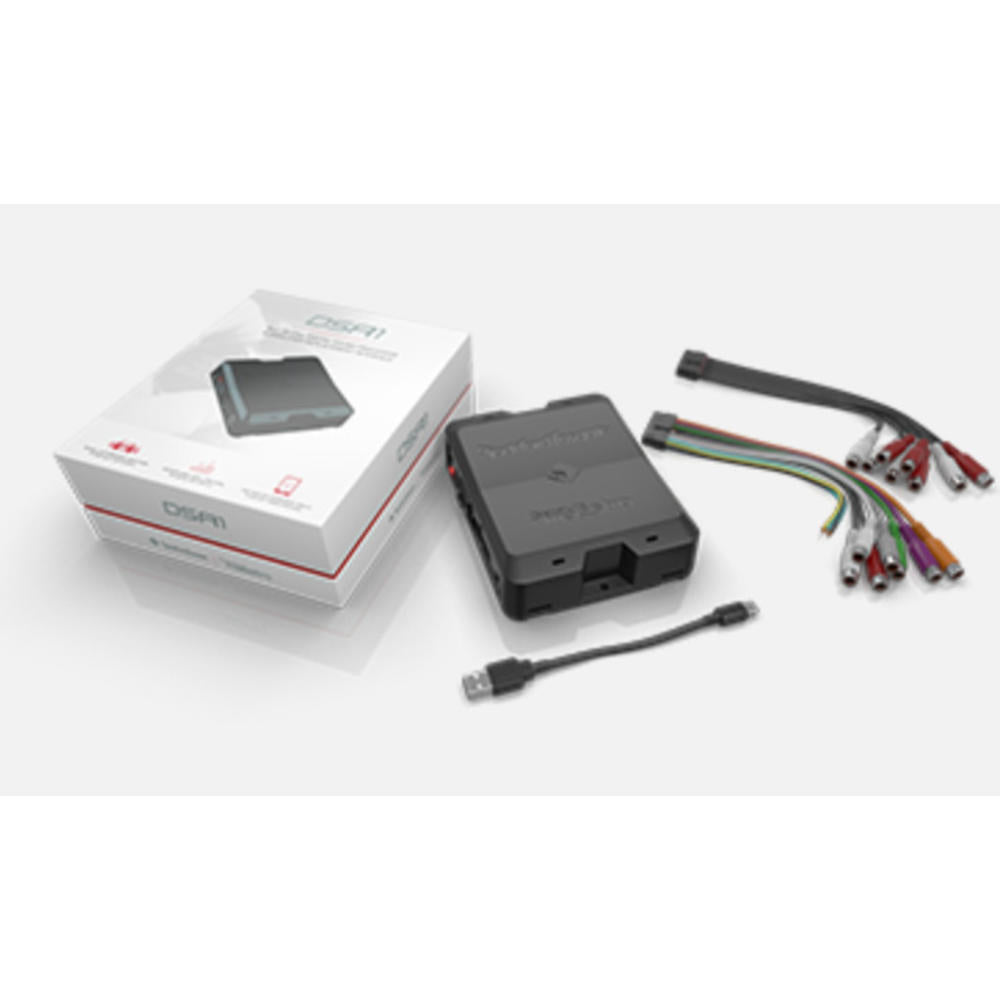
iDatalink Maestro / Rockford Fosgate DSR1 8-Channel DSP & Amplifier Replacement Interface
Some factory systems need an integration interface before the DSP ever gets a usable signal. DSR1 combines those two jobs when the vehicle and the eight-channel system design fit it.
On a supported Maestro vehicle, DSR1 can replace the factory amplifier, translate the vehicle-side audio/control data and give the aftermarket amplifiers eight processed RCA outputs from one compact processor. That gets us upstream of the factory amplifier instead of adding better equipment after OEM EQ, crossover and channel processing that we then have to fight.
Rockford Fosgate built the processing side around its 3Sixty technology and controls it through PerfectTune. Crossover, EQ, level, time alignment, polarity and routing are handled in the processor, while the integrated Maestro side handles the supported vehicle-specific integration. The result is a cleaner architecture than using one box for factory integration and a second box for DSP when DSR1 already has enough inputs and outputs for the system.
Where DSR1 Makes the Most Sense
If the customer is keeping the factory source, the vehicle is supported by Maestro and the finished system can be built around eight processed outputs, DSR1 can be a very efficient solution. The correct Maestro T-harness connects the vehicle, DSR1 becomes the processor, and its RCA outputs feed the aftermarket amplifiers.
Eight outputs are enough for a lot of real systems: a three-way front stage plus subwoofer, a two-way active front stage with rear fill and subwoofer, or other layouts that stay inside eight processed channels. If the build needs more channels, more advanced routing or a different DSP ecosystem, choose that processor architecture instead of forcing the system around DSR1 simply because the vehicle is compatible.
It Is Also a Standalone DSP
DSR1 is not limited to Maestro amplifier-replacement applications. In non-vehicle-specific mode it works as a standalone 4-channel input / 8-channel output processor. The four primary analog input channels can accept balanced low-level RCA or high-level speaker signal, and Rockford also provides a stereo AUX RCA input plus a coaxial SPDIF digital input.
Out of the box, the eight outputs are arranged as Front L/R, Spare L/R, Rear L/R and Sub L/R. The subwoofer output is derived from all four primary input channels in the default configuration. PerfectTune is used when the routing and tune need to be changed around the actual speaker layout.
PerfectTune Is the Tuning Side of the Product
Bluetooth 4.0 connects DSR1 to Rockford Fosgate PerfectTune on compatible mobile devices. Each output gets the controls that matter in a real DSP tune: parametric EQ, crossover, level, polarity and time alignment. Rockford publishes up to 10 ms of delay per channel, and the app provides 31-band parametric EQ capability along with a master EQ and subwoofer-level control.
That is an important distinction from a basic amplifier-replacement interface. DSR1 is not only getting usable audio out of the vehicle; it is the piece that gets tuned to make the speaker locations, crossover points and arrival times work together.
High-Level, Low-Level, AUX and Digital Give It More Than One Use
The primary input can be switched for low-level RCA or high-level operation, so DSR1 can work with factory or aftermarket sources outside the vehicle-specific Maestro workflow as well. High-level signal sensing can provide turn-on in the appropriate standalone installation, while the separate AUX and SPDIF inputs give additional source options when the system design calls for them.
The eight RCA outputs provide up to 4 volts RMS according to Rockford Fosgate. An optional PLC2 level controller can also be assigned to supported level-control functions when physical adjustment from the listening position makes sense.
Programming Is Part of a Maestro Installation
For a vehicle-specific Maestro install, update the DSR1 first, then complete the Maestro vehicle flash for the exact supported application. The correct HRN-AR or HRN-DSP T-harness must also match the vehicle and factory-audio architecture.
One accessory rule is easy to get wrong: ACC-RCA1 is not compatible with DSR1. DSR1 uses the dedicated supported Maestro harness path, so RCA1 does not belong in the DSR1 workflow just because an HRN-AR or HRN-DSP harness is involved.
DSR1 vs. AR2 + Separate DSP
DSR1 makes sense when eight processed outputs and the Rockford PerfectTune platform fit the system and integration plus DSP in one unit is the goal.
Maestro AR2 with a separate DSP makes more sense when the system needs a different processor, a different channel count or a tuning platform already chosen for the rest of the system. AR2 handles the supported vehicle integration and can hand analog RCA or TOSLINK to the downstream processor instead of making DSR1 the DSP.
Neither architecture is automatically better. The correct choice depends on the vehicle, channel count, tuning requirements and equipment plan.
Manufacturer Specifications
- Model: ADS-DSR1 / Rockford Fosgate DSR1
- Processor type: 8-channel interactive DSP with integrated iDatalink Maestro vehicle interface
- Primary analog inputs: 4 channels; balanced low-level RCA or high-level speaker input
- Auxiliary input: Stereo RCA AUX
- Digital input: Coaxial SPDIF
- Outputs: 8 RCA channels
- Maximum output voltage: Up to 4 V RMS
- Default output layout: Front L/R, Spare L/R, Rear L/R, Sub L/R
- Default subwoofer routing: Sum of all four primary input channels
- Tuning platform: Rockford Fosgate PerfectTune
- Wireless tuning: Bluetooth 4.0
- Equalization: 31-band parametric EQ capability per channel plus master EQ controls through PerfectTune
- Crossover: Adjustable high-pass, low-pass, band-pass and all-pass filtering with selectable slopes
- Time alignment: Up to 10 ms delay per channel
- Input impedance: 20 kΩ
- Frequency response: 20 Hz–20 kHz, ±0.5 dB
- Operating voltage: 9–16 VDC
- Low-level input capability: Up to 4 V
- High-level input capability: Up to 12.5 V
- AUX input capability: Up to 2 V
- Optional controller: Rockford Fosgate PLC2, sold separately
- Vehicle integration: Compatible Maestro vehicle-specific applications with the correct T-harness
- Vehicle programming: Weblink programming required for Maestro vehicle-specific installations
- Dimensions (H × W × D): 1.26 × 4.04 × 5.12 in (32 × 102.5 × 130 mm)
- ACC-RCA1 compatibility: Not compatible
Required separately for vehicle-specific integration: Compatible iDatalink Maestro T-harness, aftermarket amplification and system wiring.
Manufacturer: iDatalink Maestro / Rockford Fosgate
Where this fits in the build
This is a system-control or DSP component. The correct choice depends on the signal path, channel count, routing, retained features and the rest of the amplifier and speaker plan.