
Description
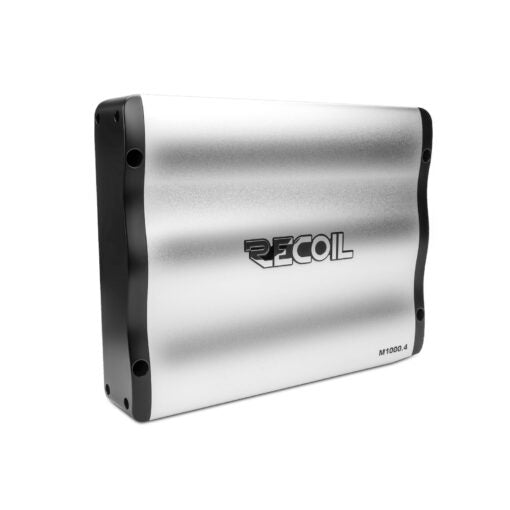
M1000.4 — 4-Channel Class-D Amplifier — 250W x4 @ 2Ω
Choose M1000.4 when the system needs four strong full-range channels and there is no reason to buy six or eight channels that will sit unused. It fits a conventional four-speaker system, a two-way active front stage, or a pair of higher-power 4-ohm loads when the amplifier is bridged.
SMS would use it when the speaker layout is complete at four channels and the drivers can use roughly 160 watts each at 4 ohms or 250 watts each at 2 ohms. If the build needs six independent outputs for a three-way front stage, M1200.6 is the cleaner architecture. If it needs eight, move to M1600.8 rather than adding another amplifier later.
MANUFACTURER SPECIFICATIONS
• 160W RMS x4 @ 4Ω
• 250W RMS x4 @ 2Ω
• 480W RMS x2 bridged @ 4Ω
• Full-range Class-D architecture
• HPF / FULL / LPF crossover modes
• High-level and RCA inputs
• Thermal, voltage, short-circuit and DC protection
Choose M1000.4 when the system needs four strong full-range channels and there is no reason to buy six or eight channels that will sit unused. It fits a conventional four-speaker system, a two-way active front stage, or a pair of higher-power 4-ohm loads when the amplifier is bridged.
SMS would use it when the speaker layout is complete at four channels and the drivers can use roughly 160 watts each at 4 ohms or 250 watts each at 2 ohms. If the build needs six independent outputs for a three-way front stage, M1200.6 is the cleaner architecture. If it needs eight, move to M1600.8 rather than adding another amplifier later.
MANUFACTURER SPECIFICATIONS
• 160W RMS x4 @ 4Ω
• 250W RMS x4 @ 2Ω
• 480W RMS x2 bridged @ 4Ω
• Full-range Class-D architecture
• HPF / FULL / LPF crossover modes
• High-level and RCA inputs
• Thermal, voltage, short-circuit and DC protection
AMPLIFIER SYSTEM FIT
Where this fits in the build
An amplifier should be chosen around the channels, load, speaker or subwoofer plan, available electrical support and how hard the system needs to play.
Plan aroundMatch usable channels and power to the actual speakers and load.
Match itPlan signal processing and gain structure before chasing wattage.
Finish itHigher output may require charging, battery and wiring upgrades.


