
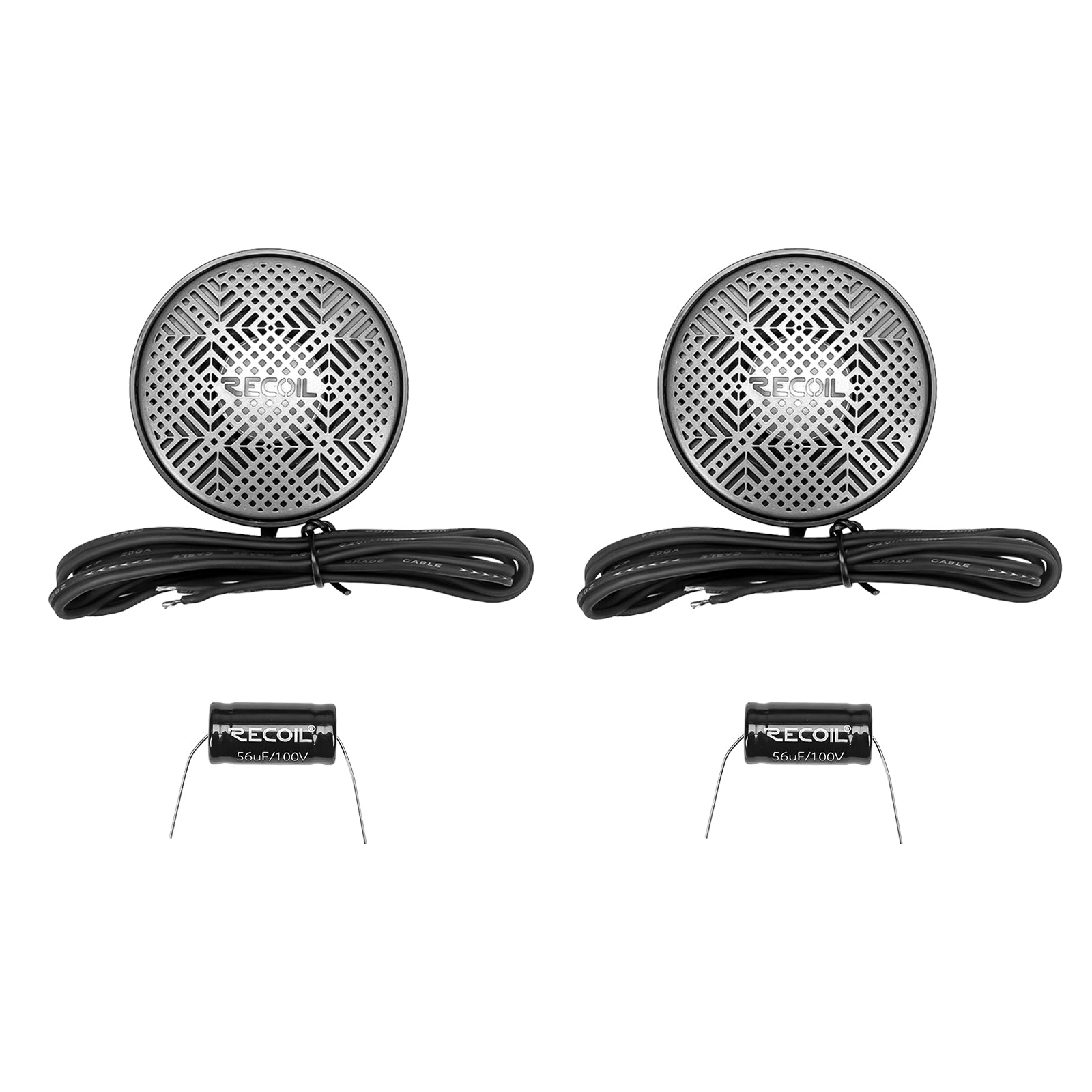

Description
Recoil MS275 2.75-Inch Sky-Channel Speakers
The MS275 is built for the spots where a normal door speaker will not fit and a tweeter does not cover enough range. Its shallow 2.75-inch format works well in headliners, upper pillars, overhead panels, and other custom locations used for height, ambience, or wideband fill channels.
This is not a replacement for a midbass driver. The usable range starts at 225 Hz, so the MS275 belongs in a properly crossed-over, DSP-controlled system where it can add height and space without being asked to carry low-frequency door-speaker work.
Why use the MS275?
- Ultra-shallow installation: 0.71-inch mounting depth helps in tight trim and headliner locations.
- Wideband coverage: 225 Hz–20 kHz response lets one compact driver cover midrange detail and upper-frequency ambience.
- Compact motor: N42 neodymium construction keeps the assembly small without using a bulky ferrite magnet.
- Rigid build: aluminum diaphragm, fiberglass cone, machined aluminum housing, and stainless-steel grille.
- DSP-friendly load: 4-ohm impedance works with most multi-channel DSP amplifiers when gain and crossover settings are handled correctly.
Specifications
| Speaker size | 2.75 inches |
| Configuration | Pair |
| Nominal impedance | 4 ohms |
| Power handling | 50W RMS / 100W max per pair |
| Frequency response | 225 Hz–20 kHz |
| Sensitivity | 80 dB |
| Mounting depth | 0.71 inch |
| Magnet | N42 neodymium |
| Housing / grille | Machined aluminum / stainless steel |
System Notes
Use a DSP high-pass filter and conservative gain structure. For most builds, these make the most sense as dedicated height, overhead, ambience, or wideband fill speakers—not as full-range replacements for larger door speakers. Confirm the cutout, grille clearance, mounting structure, and available depth in the vehicle before cutting.
Sold as one matched pair.
Where this fits in the build
Speaker choice should follow the listening goal and the location it has to work in. Factory replacement, sound quality, loud daily and high-output builds have different priorities.