


Description
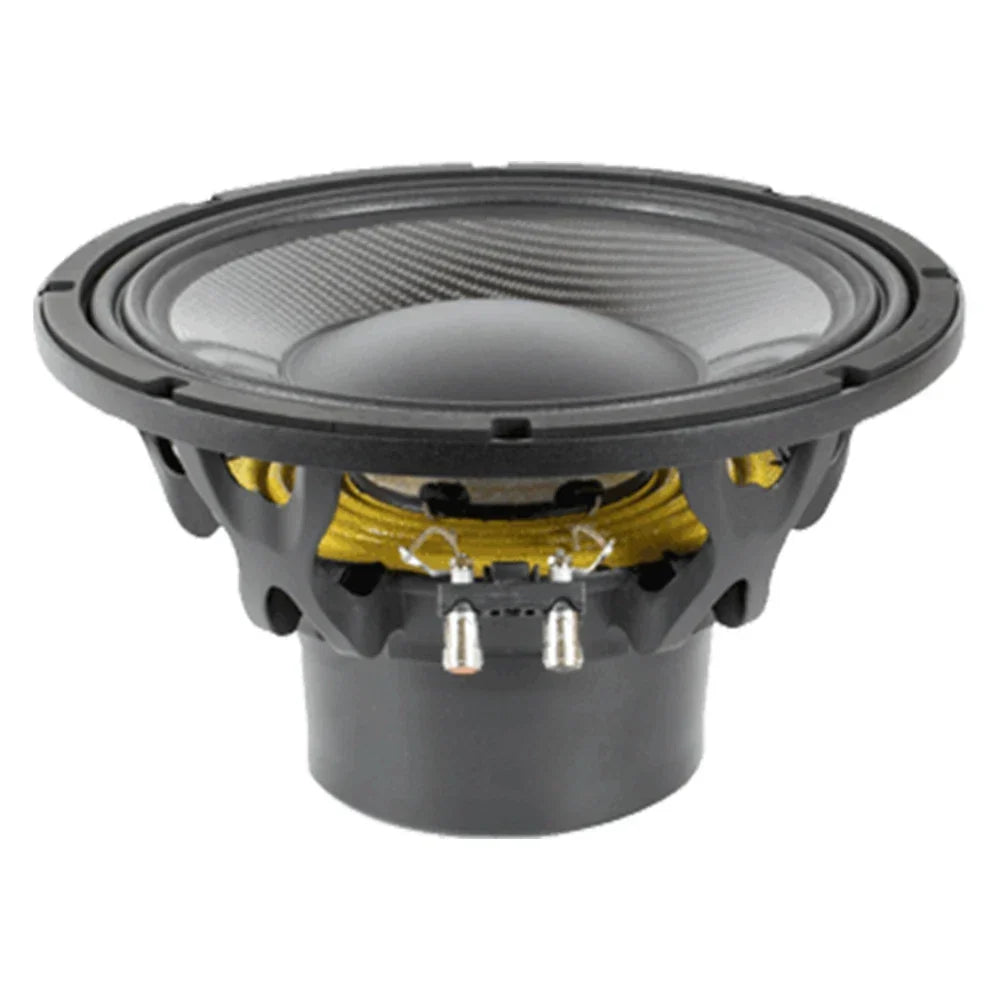
Beyma 12SCF1300ND 12-Inch Neodymium Carbon-Fiber High-Power Woofer
If you want the 12SCF1300 platform's 1,300-watt power handling and 12 mm excursion but do not want nearly thirty pounds of ferrite motor hanging off every speaker location, this is why the ND version exists.
The Beyma 12SCF1300ND is a 12-inch, 4-ohm neodymium low-frequency driver rated at 1,300 watts AES / 2,600 watts program, with 94 dB sensitivity, a 4-inch voice coil, 12 mm Xmax and a published 45 Hz–1.6 kHz operating range.
Acoustically, it is chasing the same serious bass and midbass job as the ferrite 12SCF1300FE. The reason to spend more on the ND is installation: Beyma's published data lists the neodymium driver at only 18.3 lb., while the ferrite FE is listed at 29.5 lb.
The upgrade is weight—not a fake wattage bump.
The 12SCF1300ND does not need an inflated power number to justify itself. Beyma publishes the same core 1,300-watt AES, 2,600-watt program, 94 dB sensitivity and 12 mm Xmax class as the FE.
What problem it solves: a motorcycle lid, removable speaker panel, powersports enclosure or fabricated structure can get the same type of serious low-frequency driver without carrying the mass of a large ferrite motor.
That matters even more when the build uses more than one 12. One heavy speaker may be manageable. Multiple heavy motors hanging from moving or removable structures become a fabrication issue fast.
The ND lets us solve that mechanical problem without backing away from the acoustic goal.
Twelve millimeters of Xmax still means real low-frequency displacement.
Beyma publishes 12 mm Xmax and 56 mm peak-to-peak excursion before damage for the 12SCF1300ND.
That is the mechanical capability that separates this from a short-travel 12-inch midbass or midrange driver.
The large cone can actually travel far enough to create serious bass and upper-bass output while remaining a professional-style low-frequency transducer with useful extension into the low mids.
The result is displacement with control. We are not asking cone diameter alone to do the work.
The 4-inch coil is built for sustained power, not just a big spec number.
The 12SCF1300ND uses a 4-inch / 101.6 mm inner/outer copper voice coil.
That large coil gives the driver the thermal platform behind its 1,300-watt AES rating. It also means amplifier choice needs to be deliberate. This is enough driver to expose a weak electrical system, a clipping amplifier or a bad enclosure design quickly.
The whole low-frequency section has to make sense: amplifier power, enclosure, tuning, limiting and crossover all have to support what the driver can actually do.
The carbon-fiber cone matters when the cone is moving this hard.
Exact-model published data specifies a moisture-resistant carbon-fiber cone and treated cloth suspension.
Carbon fiber gives Beyma a stiff diaphragm for a driver that is expected to see both high power and significant excursion. The goal is to keep the cone acting like one controlled piston instead of flexing as mechanical stress rises.
That also makes the treated construction a logical fit for motorcycles, powersports and other mobile environments where exposure is more realistic than it is in a sealed indoor loudspeaker cabinet.
We are describing the cone and treated components—not calling the complete loudspeaker submersible or assigning an IP rating that Beyma does not publish.
94 dB sensitivity keeps this from behaving like a power-hungry conventional sub.
Beyma publishes the 12SCF1300ND at 94 dB sensitivity.
For a 12-inch driver with 12 mm Xmax and this much thermal capacity, that gives us a strong starting efficiency.
That matters because the system does not have to spend every watt simply getting the driver audible before the real output begins. The 12SCF1300ND combines meaningful displacement with professional-style efficiency.
45 Hz–1.6 kHz means this can be more than a narrow-band subwoofer.
Beyma publishes the 12SCF1300ND from 45 Hz to 1.6 kHz.
That does not mean we automatically run a 12-inch cone anywhere near 1.6 kHz. It means the driver has useful upper-bass and low-mid capability, giving the system designer more options than a conventional subwoofer that is intended to stay entirely at the bottom of the spectrum.
Where we actually cross it depends on the enclosure and the driver above it. A dedicated midrange can take over much lower if that produces the better result.
12SCF1300ND or 12SCF1300FE?
12SCF1300FE: ferrite motor, 29.5 lb. published weight, same basic high-power carbon-fiber low-frequency concept. Choose it when the structure can comfortably carry the mass and there is no reason to pay for weight reduction.
12SCF1300ND: neodymium motor, 18.3 lb. published weight, with the same published 1,300 W AES / 2,600 W program rating, 94 dB sensitivity and 12 mm Xmax class. Choose it when reducing speaker mass makes the installation meaningfully better.
That can be a motorcycle lid, removable wall, race vehicle, powersports enclosure or simply a build where we do not want unnecessary weight bolted into the vehicle.
The ND is not the 'better sounding' version by default. It is the better installation choice when motor weight matters.
Where we would use it.
This makes sense in high-output motorcycle bags and lids, powersports enclosures, removable demo panels and other custom mobile systems where a serious 12-inch low-frequency driver is needed but structure and weight cannot be ignored.
Detailed model data supports ported, band-pass and horn-loaded low-frequency applications. The final enclosure still has to be modeled around the available volume and the actual system target.
With DSP and proper limiting, we can protect the driver below the enclosure's useful range, choose the upper crossover around the next speaker, and align level, phase and timing so the low-frequency section stays connected to the rest of the system.
The result: the 12SCF1300FE's basic high-power, high-excursion idea with a substantially lighter neodymium motor—exactly the kind of upgrade that matters in a serious mobile installation instead of just looking better on a spec sheet.
Manufacturer Specifications
- Model: Beyma 12SCF1300ND
- Product type: High-power low-frequency / woofer loudspeaker
- Sold as: Single speaker
- Nominal diameter: 12 inches / 300 mm
- Nominal impedance: 4 ohms
- Power handling: 1,300 watts AES
- Program power: 2,600 watts
- Sensitivity: 94 dB, 1 W / 1 m
- Published frequency range: 45 Hz–1.6 kHz
- Voice-coil diameter: 4 inches / 101.6 mm
- Voice-coil winding length: 30 mm
- Air-gap height: 15 mm
- BL factor: 23 N/A
- Resonant frequency (Fs): 43 Hz
- DC resistance (Re): 3.4 ohms
- Voice-coil inductance (Le): 1.0 mH
- Qms: 8.2
- Qes: 0.24
- Qts: 0.24
- Equivalent compliance volume (Vas): 41.4 L / 1.46 cu. ft.
- Xmax: 12 mm
- Peak-to-peak excursion before damage: 56 mm
- Effective cone area (Sd): 0.055 m²
- Moving mass: 139 g
- Overall diameter: 315 mm / 12.4 inches
- Front-mount cutout: 282 mm / 11.1 inches
- Overall depth: 175 mm / 6.9 inches
- Net weight: 8.3 kg / 18.3 lb.
- Basket: Die-cast aluminum
- Cone: Carbon fiber with moisture-resistant treatment
- Surround: Treated cloth
- Voice coil: Edgewound inner/outer copper wire
- Motor: Neodymium
System Design Guidance
The published frequency range is not an enclosure recommendation. Final box alignment, tuning, crossover points, amplifier power, limiting and DSP settings must be selected around the actual installation and required output.
Where this fits in the build
These speakers have to work where wind, road noise, mounting space and exposure change the job. Match the driver to the actual location, output target, amplifier power and environment instead of treating it like a normal door-speaker replacement.