

Description
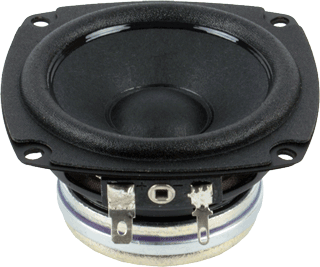
Beyma 3FR30ND 3-Inch Neodymium Full-Range Speaker
When the vehicle gives us a tiny speaker location but we still need actual vocals, instruments and top-end information from that spot, a tweeter alone does not solve the problem—and a normal 5.25- or 6.5-inch speaker simply will not fit.
The Beyma 3FR30ND was built for that kind of packaging problem. This is a 3-inch, 8-ohm neodymium full-range driver rated at 30 watts AES / 60 watts program, with 91 dB sensitivity, a published 180 Hz–20 kHz range, 4.5 mm Xmax and only 41 mm / 1.6 inches of mounting depth.
The point is not to make a 3-inch speaker pretend to be a door woofer. The point is to get a surprisingly broad amount of the music from a location that otherwise limits us to a small mid or tweeter.
The real advantage is bandwidth from a 3-inch footprint.
A dedicated tweeter can reproduce the top end, but it cannot carry the body of vocals and instruments down through the midrange.
A larger midrange can do that job, but it may not physically fit the dash, pillar, center channel or compact pod.
What the 3FR30ND solves: one small driver can cover a large portion of the vocal and high-frequency range from a location where adding multiple drivers may not be practical.
That makes it useful for dash locations, compact center channels, small pods and multi-driver arrays where packaging is the first problem we have to solve.
180 Hz–20 kHz does not mean we ask a 3-inch cone to make bass.
Beyma publishes the 3FR30ND from 180 Hz to 20 kHz.
That is an unusually broad measured range for a 3-inch driver, but the lower endpoint still has to be treated with common sense.
At high output, bass and deep midbass demand cone travel very quickly. Even with a useful 4.5 mm Xmax, a 3-inch cone has very little total radiating area compared with a proper door midbass or woofer.
So in a real system, we let the larger driver below it do the heavy low-frequency work. The 3FR30ND stays focused on the midrange and upper-frequency information where its compact size and broad response are actually advantages.
4.5 mm Xmax is still impressive for a driver this small.
Beyma publishes 4.5 mm Xmax for the 3FR30ND.
That gives this small cone more mechanical room than many tiny dash and center-channel drivers.
It does not turn the speaker into a midbass, but it gives us useful headroom through the lower part of its working range so the driver is not immediately running out of excursion every time a vocal or instrument carries energy below the upper mids.
The practical result: the 3FR30ND can sound like a real small full-range speaker rather than a fragile little upper-mid driver that needs to be crossed extremely high.
91 dB sensitivity means 30 watts AES is more useful than the watt number makes it look.
The 3FR30ND is published at 91 dB sensitivity at 1 watt / 1 meter.
That is not pro-midrange efficiency, but for a 3-inch wide-band driver it gives us a useful starting point.
The speaker is rated at 30 watts AES / 60 watts program. We are not trying to solve the output target by throwing huge amplifier power at a tiny cone. We use the bandwidth, sensitivity and proper crossover together.
Clean 30-watt-class power on a properly high-passed 3-inch driver can be far more useful than a large amplifier on a speaker being asked to reproduce frequencies it cannot physically support.
The 8-ohm load becomes useful when several small drivers share channels.
The 3FR30ND is an 8-ohm speaker.
For a single driver, that is an easier electrical load on the amplifier. In a multi-driver array, it gives us more wiring flexibility.
Two 8-ohm 3FR30ND drivers wired in parallel create a 4-ohm final load.
What that solves: we can add cone area and driver count in compact arrays without immediately forcing the amplifier into a very low impedance.
That is one reason 8-ohm small-format drivers can make so much sense in custom dash and multi-speaker applications.
The neodymium motor and 1.6-inch depth are doing real packaging work.
Beyma uses a neodymium motor, and the complete driver weighs only about 0.25 kg / 0.55 lb.
The published mounting depth is just 41 mm / 1.6 inches.
Those numbers matter more here than a huge power rating would. Dash cavities, pillars and compact pods often fail on rear clearance long before they fail on front opening size.
The 3FR30ND gives us a real motor and useful excursion without putting a large ferrite assembly behind a three-inch opening.
3FR30ND versus a tweeter.
A tweeter: much better suited to the highest frequencies, usually smaller, but cannot cover the body of vocals and instruments down into the midrange.
3FR30ND: covers a much broader 180 Hz–20 kHz published range, giving one small location the ability to reproduce midrange and top-end information together.
Choose a tweeter when another driver already handles the mids correctly. Choose the 3FR30ND when the small location itself has to cover more of the music.
3FR30ND versus a larger 4-inch full-range driver.
A 4-inch driver gives us more cone area and normally makes more sense when the installation can physically support the larger basket and cutout.
The 3FR30ND earns its place when the 4-inch simply will not fit—or when the smaller diameter lets us position the driver higher and closer to the intended acoustic location.
The choice starts with the vehicle: use the largest driver that actually fits the acoustic and fabrication goal instead of forcing size for the sake of size.
Where we would use it.
This is a strong option for dash corners, center-channel locations, A-pillars, compact custom pods and multi-driver arrays where a conventional 4-, 5.25- or 6.5-inch speaker is physically too large.
We would normally use a proper high-pass filter and let a larger door midbass or woofer handle the low-frequency work below it.
With DSP, we can choose the actual crossover around the installation, correct response at the listening position, level-match the driver and control timing so the small upper speaker integrates with the larger speaker below it instead of sounding like a separate source on top of the dash.
The result: a very small Beyma full-range driver that gives tight installations real midrange and top-end coverage, useful excursion and easy 8-ohm multi-driver wiring without pretending a 3-inch cone is supposed to replace the rest of the system.
Manufacturer Specifications
- Model: Beyma 3FR30ND
- Product type: Compact full-range loudspeaker
- Sold as: Single speaker
- Nominal diameter: 77 mm / 3 inches
- Nominal impedance: 8 ohms
- Minimum impedance: 6.4 ohms
- DC resistance (Re): 5.4 ohms
- Power handling: 30 watts AES
- Program power: 60 watts
- Sensitivity: 91 dB, 1 W / 1 m
- Published frequency range: 180 Hz–20 kHz
- Voice-coil diameter: 20.3 mm / 0.8 inches
- BL factor: 4.8 N/A
- Moving mass: 0.002 kg
- Voice-coil winding length: 10.5 mm
- Air-gap height: 3 mm
- Resonant frequency (Fs): 180 Hz
- Qms: 9.5
- Qes: 0.60
- Qts: 0.56
- Equivalent compliance volume (Vas): 0.55 L
- Effective cone area (Sd): 0.003 m²
- Xmax: 4.5 mm
- Voice-coil inductance (Le @ 1 kHz): 0.3 mH
- Overall diameter: 93.5 mm / 3.7 inches
- Baffle cutout: 75 mm / 2.9 inches
- Mounting depth: 41 mm / 1.6 inches
- Net weight: 0.25 kg / 0.55 lb.
- Motor: Neodymium
System Guidance
Final high-pass, amplifier power, enclosure/loading and DSP settings must be selected around the actual installation and required output.
Where this fits in the build
These speakers have to work where wind, road noise, mounting space and exposure change the job. Match the driver to the actual location, output target, amplifier power and environment instead of treating it like a normal door-speaker replacement.