

Description
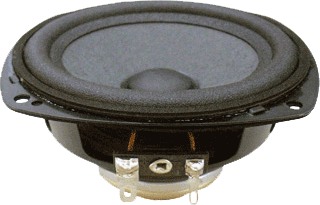
Beyma 4FR40ND 4-Inch Neodymium Full-Range Speaker
If a 4-inch full-range driver fits the location but still leaves the system a little thin through the lower vocals and upper midbass, the 4FR40ND is the next step without jumping all the way to a conventional 5.25- or 6.5-inch speaker.
The Beyma 4FR40ND is a 4-inch, 8-ohm neodymium full-range driver rated at 40 watts AES / 80 watts program, with 88 dB sensitivity, a published 100 Hz–20 kHz range, 3 mm Xmax and only 58 mm / 2.3 inches of mounting depth.
The reason to choose it is not because four inches automatically sounds better than three. The reason is that the extra cone area and lower published resonance give us more body from a compact location while keeping the speaker small enough for dash, pod, pillar and tight custom-fabrication work.
The extra cone area fills the gap between a tiny full-range and a real door speaker.
A 3-inch driver is excellent when packaging is the absolute limit, but cone area still matters.
The 4FR40ND gives us more radiating surface, which helps the driver carry more lower-midrange energy and gives vocals and instruments more physical weight.
What that solves: instead of asking a very small dash speaker to cover a large part of the vocal range while sounding light below it, we can use the 4-inch when the vehicle gives us enough room for the larger frame.
That makes it a strong bridge between a tiny wide-band speaker and the larger midbass or woofer below it.
100 Hz–20 kHz is a genuinely broad published range for a 4-inch driver.
Beyma publishes the 4FR40ND from 100 Hz to 20 kHz.
That is the core value of the speaker: one compact cone can reproduce a large portion of the audible range.
But the 100 Hz number is still capability—not a universal crossover setting.
At high output, lower frequencies demand excursion quickly. In most mobile systems we would still protect the 4FR40ND with a sensible high-pass and let a larger midbass or woofer below it handle the frequencies that need more displacement.
The broad response gives us crossover freedom. It does not remove the need to divide the work correctly.
Three millimeters of Xmax is useful movement for a compact wide-band driver.
Beyma publishes 3 mm Xmax for the 4FR40ND.
That is less than the 4.5 mm figure of the smaller 3FR30ND, but the larger 4-inch cone has more surface area to work with.
That combination gives the 4FR40ND useful lower-midrange capability without turning the suspension into a deep-excursion midbass design.
The system-design point is simple: use the 4FR40ND for broad midrange and upper-frequency coverage, then let a real low-frequency driver do the work that requires big cone travel.
40 watts AES is enough when the speaker is being used for the range it was designed to cover.
The 4FR40ND is rated at 40 watts AES / 80 watts program.
That power rating makes sense for a compact full-range speaker with a 0.8-inch voice coil and 88 dB sensitivity.
We are not choosing this product for brute-force SPL. We are choosing it because it fits where larger speakers do not and gives us broad usable bandwidth from that location.
A clean amplifier channel, proper crossover and rigid mounting matter far more than simply chasing a larger watt number.
The 8-ohm load becomes especially useful in arrays and multi-speaker locations.
The 4FR40ND is an 8-ohm speaker.
That gives the system designer useful wiring flexibility when multiple compact drivers are being used.
Two 8-ohm 4FR40ND drivers wired in parallel create a 4-ohm final load.
What that solves: we can increase driver count and cone area without immediately forcing the amplifier into an unnecessarily low impedance.
That is particularly useful in custom dash arrays, pods and motorcycle/powersports layouts where several small full-range drivers may share amplifier channels.
The neodymium motor keeps the larger 4-inch package surprisingly light.
Beyma uses a neodymium motor, and the driver weighs only about 0.28 kg / 0.62 lb.
The mounting depth is approximately 58 mm / 2.3 inches.
Those numbers matter because a four-inch speaker can still become difficult to package if the motor is large or heavy.
The 4FR40ND gives us more cone area than the 3FR30ND without adding the kind of motor mass we would normally see from a larger ferrite driver.
The paper cone and Santoprene surround are built around broad-band behavior.
Beyma specifies a paper cone and Santoprene surround on the 4FR40ND.
Paper remains useful in wide-band drivers because it combines relatively low mass with natural damping. The Santoprene surround gives the cone controlled movement around the outer edge while supporting the driver’s broad response.
The pressed-steel basket keeps the assembly compact and lightweight rather than turning a small full-range driver into an unnecessarily heavy piece of hardware.
4FR40ND versus 3FR30ND.
3FR30ND: 3-inch, 30 W AES, 91 dB sensitivity, 180 Hz–20 kHz, 4.5 mm Xmax and only 1.6 inches of depth. Choose it when the physical mounting space is extremely tight or when the smaller diameter lets us place the driver in the better acoustic location.
4FR40ND: 4-inch, 40 W AES, 88 dB sensitivity, 100 Hz–20 kHz and 2.3 inches of depth. Choose it when the installation has enough room and the system needs more cone area and lower-midrange body from the compact full-range location.
The 3-inch is more efficient and easier to package. The 4-inch reaches lower and sounds physically bigger through the lower part of the vocal range.
That is the real buying decision.
4FR40ND versus a dedicated tweeter.
A tweeter is still the better tool when the system already has a midrange covering the vocal band and only needs the highest frequencies.
The 4FR40ND makes sense when one small location has to cover much more of the music—from lower midrange through the top end.
That can simplify the driver count and give us a better acoustic source when separate mid and tweeter locations are not available.
Where we would use it.
This is a strong option for larger dash locations, custom pillars, center channels, small pods, motorcycle/powersports enclosures and multi-driver arrays where a 4-inch frame fits but a 5.25- or 6.5-inch speaker does not.
In a real front stage, we would normally let a larger door midbass handle the low-frequency work and use the 4FR40ND for the broad upper section.
With DSP, we can choose the actual high-pass based on the installation, correct response, level-match it to the driver below and control timing so the small full-range location blends into the stage instead of sounding like a separate speaker sitting high in the vehicle.
The result: a compact 4-inch Beyma that gives tight installations more lower-midrange body than the 3-inch platform while preserving broad full-range coverage, lightweight neodymium packaging and useful 8-ohm wiring flexibility.
Manufacturer Specifications
- Model: Beyma 4FR40ND
- Product type: Compact full-range loudspeaker
- Sold as: Single speaker
- Nominal diameter: 100 mm / 4 inches
- Nominal impedance: 8 ohms
- Minimum impedance: 7.2 ohms
- DC resistance (Re): 6.4 ohms
- Power handling: 40 watts AES
- Program power: 80 watts
- Sensitivity: 88 dB, 1 W / 1 m
- Published frequency range: 100 Hz–20 kHz
- Voice-coil diameter: 20.3 mm / 0.8 inches
- BL factor: 4.7 N/A
- Moving mass: 0.0045 kg
- Voice-coil winding length: 7.7 mm
- Air-gap height: 4 mm
- Resonant frequency (Fs): 94 Hz
- Qms: 10.8
- Qes: 0.78
- Qts: 0.73
- Equivalent compliance volume (Vas): 2.7 L
- Effective cone area (Sd): 0.0055 m²
- Xmax: 3 mm
- Voice-coil inductance (Le @ 1 kHz): 0.2 mH
- Overall diameter: 118.2 mm / 4.6 inches
- Baffle cutout: 92 mm / 3.6 inches
- Mounting depth: 58 mm / 2.3 inches
- Net weight: 0.28 kg / 0.62 lb.
- Cone: Paper
- Surround: Santoprene
- Basket: Pressed steel
- Motor: Neodymium
System Guidance
Final high-pass, amplifier power, enclosure/loading and DSP settings must be selected around the actual installation and required output.
Where this fits in the build
These speakers have to work where wind, road noise, mounting space and exposure change the job. Match the driver to the actual location, output target, amplifier power and environment instead of treating it like a normal door-speaker replacement.