
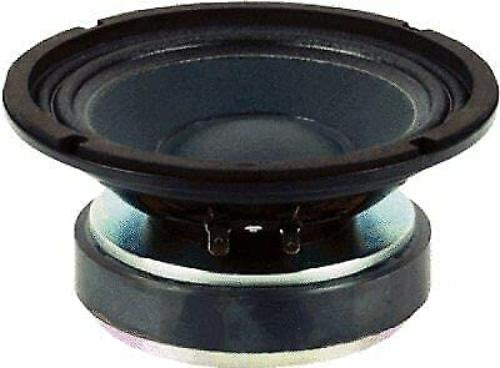

Description
Beyma 6V2BX 6.5-Inch Ferrite High-Output Coaxial
If the build needs a serious 6.5-inch coaxial but does not need to pay for the lighter neodymium PRO platform, the 6V2BX gives us a straightforward ferrite solution with real low/mid power and useful excursion.
The Beyma 6V2BX is an 8-ohm ferrite coaxial with separate low-/mid-frequency and high-frequency sections in one speaker location. Beyma publishes 220 / 25 watts AES LF/HF, 94 / 100 dB sensitivity, a 120 Hz–18 kHz overall range, a 1.5-inch LF voice coil and 5.7 mm LF Xmax.
This is the practical coaxial in the lineup: enough cone travel to give the 6.5 real body, enough efficiency to play hard, and one physical speaker location for the midrange and highs.
The 5.7 mm LF Xmax is why this does more than a basic replacement coaxial.
Beyma publishes 5.7 mm Xmax for the low/mid section.
That gives the 6.5-inch cone meaningful mechanical travel for upper-bass and lower-midrange energy when it is loaded and filtered correctly.
What that solves: the speaker can contribute real punch and body instead of sounding like vocals and treble sitting on top of a separate bass system.
It is still not a subwoofer, and the published 120 Hz lower range is not a universal high-pass setting. But the cone has enough movement to do useful low/mid work.
220 watts AES on the LF section gives the speaker real thermal headroom.
The 6V2BX low/mid section is rated at 220 watts AES. The HF section is rated at 25 watts AES.
Those are separate section ratings, not one combined conventional speaker number.
The low/mid and high-frequency sections need proper crossover integration so each part of the coaxial only sees the band it was designed to reproduce.
The basket gives us one mounting location. The crossover still divides the work.
94 / 100 dB sensitivity keeps it useful in high-output mobile systems.
Beyma publishes the LF section at 94 dB sensitivity and the HF section at 100 dB.
That gives the 6V2BX enough efficiency to make sense in motorcycles, Jeeps, powersports vehicles and custom speaker panels where road and wind noise can eat up a normal low-efficiency speaker fast.
It does not have the same published efficiency as the PRO6CXND, but it also does not carry the same premium neo architecture or price.
The ferrite motor is the tradeoff.
The 6V2BX uses a ferrite motor.
Ferrite is heavier than a comparable neodymium motor, so this is not the first choice when panel weight and rear packaging are the main constraints.
But when the structure can support it, ferrite gives us a proven motor platform without paying extra simply to reduce magnet mass.
That is the buyer decision: if weight matters, step into the neo PRO coaxials. If value and output matter more than motor weight, the 6V2BX can make more sense.
The 120 Hz–18 kHz range keeps the speaker focused on the useful two-way job.
Beyma publishes the 6V2BX from 120 Hz to 18 kHz.
That gives the coaxial broad coverage through the low/mid and high-frequency range, but the endpoints still are not automatic crossover settings.
The lower protection depends on the enclosure or rear cavity and required output. The HF section still needs correct frequency division from the low/mid section.
6V2BX versus PRO6CXND.
6V2BX: ferrite motor, 220 / 25 watts AES, 94 / 100 dB sensitivity and 5.7 mm LF Xmax. Choose it when the system wants a strong coaxial and the heavier ferrite motor is not a problem.
PRO6CXND: neodymium motor, 200 / 40 watts AES, 95 / 104 dB sensitivity and 5.5 mm LF Xmax. Choose it when higher HF capability, better published efficiency and lower motor mass justify the premium.
The 6V2BX gives us a lot of low/mid capability for the money. The PRO6CXND gives us the more refined high-output neo package.
6V2BX versus a separate mid + tweeter.
A separate component system gives us more freedom to position and aim the tweeter independently.
The 6V2BX makes more sense when one 6.5-inch location has to handle the complete two-way job and the installation does not justify the extra fabrication for separate drivers.
That is why coaxials remain useful even in serious systems: sometimes the packaging problem is more important than having unlimited driver-placement freedom.
Where we would use it.
This is a good fit for motorcycle fairings, powersports pods, Jeep and open-cabin systems, custom doors and speaker panels where one 6.5-inch location needs real output without pushing the budget into the premium neo coaxial range.
With the correct crossover and DSP, we can protect the low/mid section, balance the HF section, correct response and integrate the speaker with the rest of the system.
The result: a practical high-output Beyma coaxial with real LF excursion, strong power handling and one-location two-way coverage for systems where ferrite motor weight is an acceptable tradeoff for value.
Manufacturer Specifications
- Model: Beyma 6V2BX
- Product type: Professional coaxial loudspeaker
- Sold as: Single coaxial speaker
- Nominal diameter: 6.5 inches
- Nominal impedance: 8 ohms
- LF / HF power handling: 220 / 25 watts AES
- LF / HF sensitivity: 94 / 100 dB at 2.83 V / 1 m
- Published frequency range: 120 Hz–18 kHz
- LF voice-coil diameter: 1.5 inches
- LF Xmax: 5.7 mm
- Motor: Ferrite
Crossover / System Guidance
The 6V2BX contains separate low/mid and high-frequency sections in one coaxial frame. Final LF high-pass, LF/HF crossover, amplifier configuration, level and DSP settings must be selected around the actual installation and output target.
Where this fits in the build
These speakers have to work where wind, road noise, mounting space and exposure change the job. Match the driver to the actual location, output target, amplifier power and environment instead of treating it like a normal door-speaker replacement.