
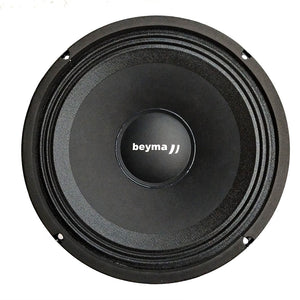

Description
Beyma 8MFE-4 8-Inch High-Efficiency Midrange
If the system needs an 8-inch midrange to get loud efficiently and the midbass is already being handled somewhere else, the 8MFE-4 is the simple, cost-effective tool.
Beyma rates the 8MFE-4 at 100 watts RMS, with 96 dB sensitivity, a published 150 Hz–7 kHz range, a 1.5-inch voice coil and only 1 mm Xmax.
That last number tells us exactly what this driver is—and what it is not. The 8MFE-4 is built around efficient midrange projection, not low-frequency excursion.
One millimeter of Xmax means stop asking this speaker to be a midbass.
Beyma publishes 1 mm Xmax for the 8MFE-4.
That is a very small amount of linear travel compared with Beyma's dedicated midbass and low-frequency drivers.
What problem that solves: the driver can stay light and efficient because it is not carrying the mechanical burden of deep cone travel.
But it also means the system has to protect it correctly. A dedicated midbass or woofer below the 8MFE-4 should handle the frequencies that need real displacement.
If somebody buys this because it is an 8-inch speaker and expects it to make bass, they are buying the wrong Beyma.
96 dB sensitivity is where the value is.
Beyma publishes the 8MFE-4 at 96 dB sensitivity.
That gives us useful output from modest amplifier power, which is exactly what we want from a dedicated midrange in a motorcycle, Jeep, powersports or multi-driver panel.
The speaker does not need huge wattage to become useful because it starts from a relatively efficient platform.
100 watts RMS makes more sense when the speaker is filtered correctly.
The 8MFE-4 is rated at 100 watts RMS.
That can look small next to 200-, 300- or 500-watt drivers, but those speakers may be designed to carry much more low-frequency energy.
Once the 8MFE-4 is high-passed correctly and kept in the midrange, the amplifier is not wasting power trying to force the cone through frequencies it cannot reproduce with much excursion anyway.
The system should use efficiency—not brute force—to get output from this driver.
The 150 Hz–7 kHz range gives the midrange section useful coverage.
Beyma publishes the 8MFE-4 from 150 Hz to 7 kHz.
That gives enough bandwidth to carry a substantial part of the vocal and instrumental range, but the published endpoints are not automatic crossover settings.
At high output, we would normally protect the lower end based on the installation and the midbass driver beneath it. The upper handoff depends on the tweeter or compression driver above it and the dispersion we want from the finished system.
8MFE-4 versus 8MND-4.
8MFE-4: ferrite motor, 96 dB sensitivity, 100 watts RMS and 1 mm Xmax. Choose it when the system needs an efficient dedicated 8-inch midrange and cost/weight are not being pushed to the premium end.
8MND-4: neodymium motor, 99 dB sensitivity and more published excursion. Choose it when higher output per watt, lighter motor weight and more mechanical capability justify the upgrade.
The MND is the more aggressive high-efficiency platform. The MFE is the straightforward value choice when the system already has a proper low-frequency foundation.
8MFE-4 versus PRO8MI.
PRO8MI: higher power handling and a more serious Competition-series high-output role.
8MFE-4: lower power, lower excursion and a simpler efficiency-focused role. Choose it when the output target does not require the more extreme PRO platform.
Again, the right choice is not the speaker with the largest number. It is the speaker that solves the system problem without paying for capability the build does not need.
Where we would use the 8MFE-4.
This makes sense in motorcycle fairings, custom doors, powersports pods, Jeep speaker panels and multi-driver systems where the 8-inch is being used specifically for vocals and instruments above a dedicated midbass section.
With DSP, we can protect the lower range, choose the upper crossover into the tweeter or compression driver, then control EQ, level, phase and timing so the 8-inch midrange stays clean instead of simply loud.
The result: a simple, efficient 8-inch Beyma midrange for systems that already understand the division of labor—midbass below it, highs above it, and the 8MFE-4 doing the vocal range it was built to reproduce.
Manufacturer Specifications
- Model: Beyma 8MFE-4
- Product type: High-efficiency midrange loudspeaker
- Sold as: Single speaker
- Nominal diameter: 8 inches
- Nominal impedance: 4 ohms
- Power handling: 100 watts RMS
- Sensitivity: 96 dB
- Published frequency range: 150 Hz–7 kHz
- Voice-coil diameter: 1.5 inches
- Xmax: 1 mm
- Motor: Ferrite
System Design Guidance
The 8MFE-4 is a dedicated midrange. Final high-pass, low-pass, amplifier power and DSP settings must be chosen around the actual installation and the drivers used above and below it.
Where this fits in the build
These speakers have to work where wind, road noise, mounting space and exposure change the job. Match the driver to the actual location, output target, amplifier power and environment instead of treating it like a normal door-speaker replacement.