


Description
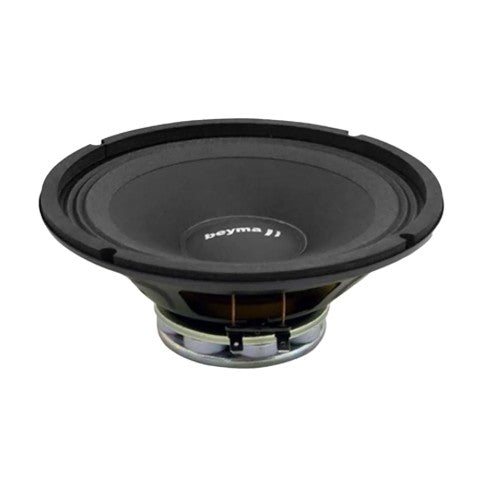
Beyma 8MND-4 8-Inch Neodymium High-Efficiency Midrange
If the system needs the vocal range to get loud without burning a bunch of amplifier power or hanging a heavy ferrite motor off the panel, the 8MND-4 is built around that exact problem.
The Beyma 8MND-4 is an 8-inch, 4-ohm neodymium midrange rated at 100 watts RMS / 200 watts program, with 99 dB sensitivity and a published 150 Hz–7 kHz response. That combination makes it an efficiency-first driver: more output per watt, broad midrange coverage and a lightweight motor structure for high-output mobile systems.
This is not the driver we choose when we need the 8-inch to make deep midbass. It is the one we choose when vocals and instruments need to stay strong, clear and present while the rest of the system gets loud.
99 dB sensitivity is the whole reason this speaker makes sense.
At 99 dB sensitivity, the 8MND-4 does not need huge amplifier power to become useful.
That matters in motorcycle, powersports, Jeep and multi-driver door systems because the electrical system and amplifier space are not unlimited. Every watt we do not waste trying to drag an inefficient midrange up to the rest of the system is power we can use somewhere else.
What that solves: the midrange can keep up with a strong bass section and open-cabin road noise without turning every speaker channel into an amplifier-sizing problem.
The 150 Hz lower response tells you this is a midrange first.
Beyma publishes the 8MND-4 from 150 Hz to 7 kHz.
That lower range is exactly why we do not sell this like an 8-inch woofer. The driver is optimized around mid-frequency output and efficiency, not deep cone travel.
In a proper system, we let a dedicated midbass, woofer or subwoofer handle the lower frequencies. That keeps the 8MND-4 inside the range where it can stay efficient and controlled.
The payoff: the speaker spends its available movement and thermal capacity on the part of the music it was designed to reproduce instead of wasting excursion on bass.
Controlled dispersion to 7 kHz matters in a real installation.
Exact-model technical listings for the 8MND describe controlled dispersion up to 7 kHz.
That matters because an 8-inch cone naturally becomes more directional as frequency rises. If the driver maintains useful controlled behavior through the upper midrange, we have more flexibility when choosing the handoff to the tweeter or compression driver above it.
It does not eliminate the need for crossover design. It gives us a better starting point.
100 watts RMS can be plenty when the speaker is this efficient.
Some customers see a 100-watt RMS rating and immediately compare it with a 250- or 300-watt midrange.
That misses the point of the 8MND-4. This speaker starts at 99 dB sensitivity. It does not need the same amplifier power to reach the same acoustic output as a much less efficient driver.
The right question is not “which speaker handles the most watts?” The right question is “how much clean output does the system need, and what driver gets us there without unnecessary amplifier load?”
For a high-efficiency midrange role, the 8MND-4 can make a lot of sense with relatively modest power.
The neodymium motor is useful when the installation has to carry several speakers.
The 8MND-4 uses a neodymium motor.
That is valuable in motorcycle fairings, saddlebag lids, pods and large fabricated door panels because motor weight adds up fast. Four or six ferrite 8-inch drivers can turn a panel into a structural problem.
Neo lets Beyma create the motor force needed for this application with less mass than a comparable large ferrite assembly.
The rear volume is still part of the system.
Exact-model technical data publishes a recommended enclosure range of roughly 18–30 liters / 0.65–1.10 cu. ft.
That does not mean every door or motorcycle bag has to be built to one exact box alignment. It means the acoustic environment behind the cone matters.
A rigid baffle, controlled rear chamber and proper sealing give the driver a predictable load. A random leaking cavity gives us a different speaker than the one on the spec sheet.
8MND-4, PRO8MV2ND or PRO8MI?
PRO8MI: the 98 dB ferrite Competition midrange with more RMS power handling. Use it when high-output midrange is the priority and motor weight is less important.
PRO8MV2ND: the 96 dB lightweight neodymium midrange with a 120 Hz–8 kHz published range. Use it when lighter motor weight and slightly broader lower/upper extension matter.
8MND-4: the 99 dB neodymium efficiency specialist. Use it when maximum midrange output per watt and reduced motor weight are the priority.
The 8MND-4 is not “better” because it has the highest sensitivity number. It is better when that efficiency solves the actual system problem.
Where we would use it.
This is a natural fit for motorcycle fairings and lids, Jeep and powersports systems, custom doors and multi-driver speaker panels where we need the midrange section to project strongly without huge amplifier demand.
It also makes sense in systems where several identical 8-inch mids are being used together. High sensitivity compounds quickly when multiple drivers share the work.
With DSP, we can high-pass the driver where the installation needs it, set the upper crossover around the high-frequency section, then control level, EQ, phase and timing so the output stays balanced instead of just loud.
The result: a lightweight 8-inch Beyma midrange that gets a lot done with modest power and gives the system designer a strong efficiency advantage when the vocal range has to keep up with everything else.
Manufacturer Specifications
- Model: Beyma 8MND-4
- Product type: High-efficiency midrange loudspeaker
- Sold as: Single speaker
- Nominal diameter: 200 mm / 8 inches
- Nominal impedance: 4 ohms
- Minimum impedance: 4 ohms
- Power handling: 100 watts RMS
- Program power: 200 watts
- Sensitivity: 99 dB, 1 W / 1 m
- Published frequency range: 150 Hz–7 kHz
- Recommended enclosure range: 18–30 liters / 0.65–1.10 cu. ft.
- Voice-coil diameter: 38.5 mm / 1.5 inches
- Magnetic assembly weight: 1.3 kg / 2.8 lb.
- BL factor: 9 N/A
- Moving mass: 0.015 kg
- Voice-coil winding length: 7.5 mm
- Air-gap height: 7 mm
- Resonant frequency (Fs): 93 Hz
- DC resistance (Re): 3.6 ohms
- Qms: 8.21
- Qes: 0.36
- Qts: 0.34
- Equivalent compliance volume (Vas): 11 L
- Mechanical compliance (Cms): 171 µm/N
- Mechanical resistance (Rms): 1.22 kg/s
- Reference efficiency: 2.3%
- Effective cone area (Sd): 0.021 m²
- Xmax: 3 mm
- Displacement volume (Vd): 63 cm³
- Voice-coil inductance (Le @ 1 kHz): 0.4 mH
- Motor: Neodymium
System Design Guidance
The published 150 Hz lower response is not a universal high-pass recommendation. Final rear volume, high-pass, low-pass, amplifier power and DSP settings must be selected around the actual installation and the drivers used above and below the 8MND-4.
Where this fits in the build
These speakers have to work where wind, road noise, mounting space and exposure change the job. Match the driver to the actual location, output target, amplifier power and environment instead of treating it like a normal door-speaker replacement.