
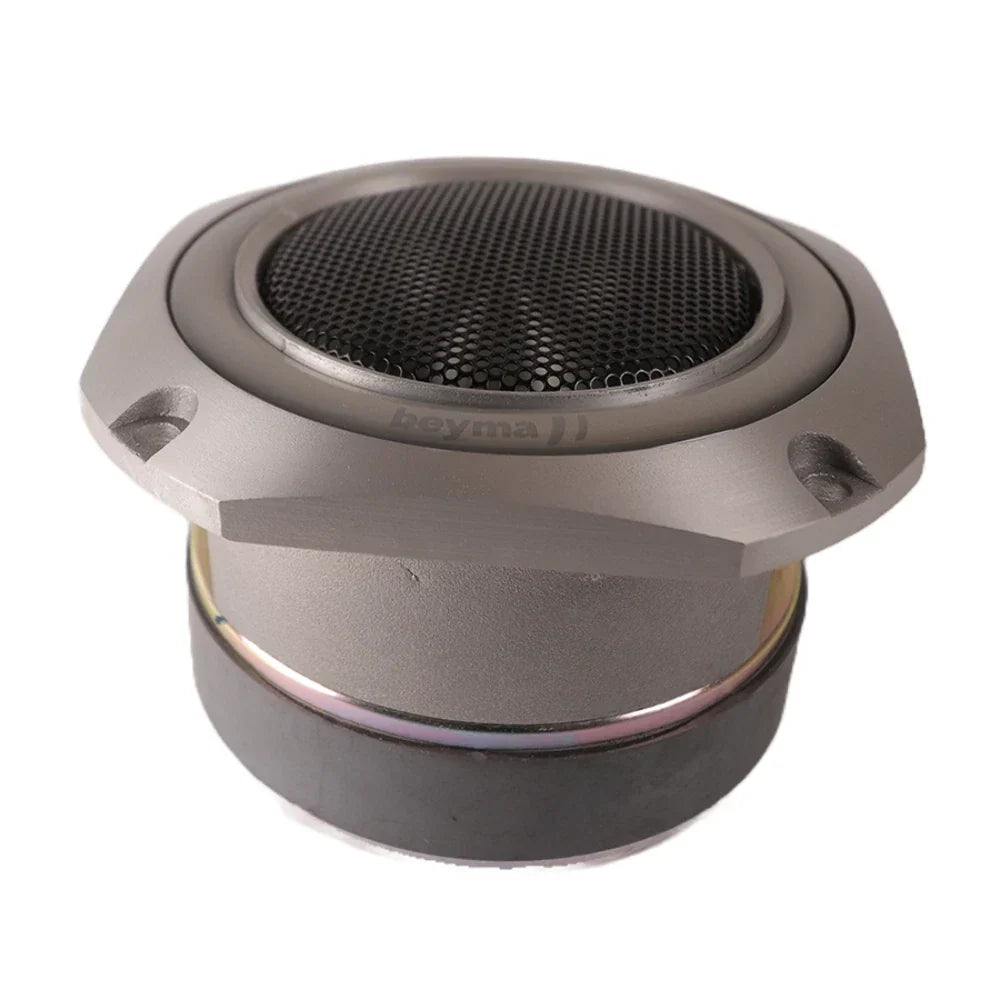

Description
Beyma AST22 4-Inch 4-Ohm Competition Tweeter
When the system is already built around very efficient mids and the top end needs real projection—not just a little extra sparkle—the AST22 is the large-format Beyma Competition tweeter we look at.
This is a 4-ohm compression tweeter sold individually, rated at 25 watts AES, 107 dB sensitivity, a 4 kHz–20 kHz published range, a 1.5-inch voice coil and a 40-degree conical dispersion pattern. That tells you immediately what kind of job it was designed for: high-output systems where the high-frequency section has to stay present beside pro-style midrange drivers.
The AST22 is not simply a physically larger AST05. It trades compact packaging for a larger high-frequency platform and another step in published sensitivity. If the build does not need that extra output, the smaller tweeter can be the smarter solution. If the mids are already overpowering conventional high-frequency drivers, this is where the AST22 starts making sense.
What problem does 107 dB sensitivity solve?
A multi-driver motorcycle bag, Jeep panel or custom door can have several high-efficiency mids working together. Once those speakers are playing at real volume, a typical car-audio tweeter can sound like it vanishes even though it is technically still playing.
The AST22 starts at 107 dB sensitivity. That gives the tweeter enough acoustic efficiency that we are not trying to solve the mismatch by brute-force amplifier power.
For the customer, the benefit is headroom. We can level the tweeter down to where it belongs and still have output in reserve when the whole system comes up. That is a much healthier way to build a loud system than running a lower-efficiency tweeter at the edge of its capability all the time.
AST22 versus AST05: output versus packaging.
AST05: pair, 4 ohms, 25 watts RMS each, compact neodymium motor, 1.02-inch voice coil and 105 dB sensitivity. It makes sense when the system needs serious efficiency but panel space and weight still matter.
AST22: single, 4 ohms, 25 watts AES, 1.5-inch voice coil, ferrite motor and 107 dB sensitivity. It makes sense when the panel has room for a much larger tweeter and the system genuinely benefits from the extra acoustic efficiency and focused 40-degree conical pattern.
That is the actual buying decision. The AST22 is not automatically “better” because it is larger. It is the more specialized choice when the output target and available space justify it.
AST22 versus AST07: fixed large-format projection versus diffuser flexibility.
The AST07 is sold as a pair, is rated at 35 watts AES per tweeter and 106 dB sensitivity, and comes with four diffusers. That package gives the installer options in how the high-frequency section is presented.
The AST22 goes the other direction. It is a larger single tweeter with a published 40-degree conical dispersion pattern and 107 dB sensitivity.
Choose AST07 when a pair with diffuser flexibility fits the fabrication and output target. Choose AST22 when a fixed, larger, focused high-frequency source is what the system layout calls for.
The 4 kHz response limit is not the crossover setting.
Beyma publishes the AST22 from 4 kHz to 20 kHz, but the recommended crossover is 5 kHz or higher with at least a 12 dB/octave slope.
That one-kilohertz difference is important. The lower edge of a frequency-response specification tells us where the driver produces measurable output; it does not tell us the safest place to dump amplifier power into it in a high-output system.
We use the manufacturer’s 5 kHz-or-higher recommendation as the starting point. Then we make sure the midrange below it can actually reach that handoff cleanly. If the mid cannot, we change the system architecture rather than forcing the tweeter lower.
Why the 40-degree conical pattern matters.
At high frequencies, coverage is part of the product. The AST22’s published 40-degree conical dispersion is relatively focused compared with a wide-coverage conventional tweeter.
That can be useful in an open-air system where we want the energy aimed toward a defined listening zone instead of sprayed everywhere. It can also be a liability if the tweeter is mounted poorly. A focused driver pointed at the listener works very differently from one aimed into a leg, windshield edge or open space beside the vehicle.
So we plan the tweeter angle before the panel is finished. DSP can adjust level, EQ and timing; it cannot turn a physically mis-aimed 40-degree source into a wide-dispersion tweeter.
The wattage number only makes sense beside the sensitivity number.
The AST22 is rated at 25 watts AES and 50 watts program, with manufacturer listings also showing 100 watts maximum. On paper, 25 watts can look small next to a 200- or 300-watt midrange.
But the AST22 is 107 dB sensitive and only reproduces the high-frequency portion of the signal. It does not need midrange-style power to reach high acoustic output.
The real protection comes from clean gain structure and the correct crossover. A clipped signal or too-low high-pass point can destroy a tweeter that never needed large amplifier voltage in the first place.
Where we would use the AST22.
This makes sense in loud motorcycle and powersports systems, large Jeep/open-cabin speaker arrays, custom doors and demo-oriented builds where the midrange section has enough efficiency that high-frequency projection becomes its own engineering problem.
For example, several 8- or 10-inch mids can stay very loud through the vocal range. The AST22 gives the top end enough efficiency to remain present without forcing us into a pile of smaller tweeters.
For a normal daily-driver front stage, this can be unnecessary. If the system only needs moderate output and broad near-field coverage, a smaller tweeter can be easier to package and easier to blend.
How we would tune it.
We start with the 5 kHz-or-higher high-pass requirement and enough filter slope for the intended power. Then we set the AST22 level against the midrange, check the acoustic crossover with measurement, and correct polarity and time arrival before trying to EQ the response flat.
Because the driver is so efficient, attenuation is often part of the correct tune. The goal is not to make the tweeter prove how loud it can get. The goal is to have enough headroom that the highs remain clean when the rest of the system reaches the customer’s target volume.
The practical result: the AST22 is the large-format Beyma Competition tweeter for builds that truly need a focused, extremely efficient high-frequency source to stay with a serious pro-style midrange section.
Manufacturer Specifications
| Model | AST22 |
|---|---|
| Sold as | Single tweeter |
| Nominal impedance | 4 ohms |
| Power handling | 25 W AES |
| Program power | 50 W |
| Maximum power | 100 W |
| Sensitivity | 107 dB, 1 W / 1 m |
| Published frequency range | 4 kHz–20 kHz |
| Recommended crossover | 5 kHz or higher, 12 dB/octave minimum |
| Dispersion | 40° conical |
| Voice-coil diameter | 37.6 mm / 1.5 in |
| Overall dimensions | 103 × 103 mm / 4.06 × 4.06 in |
| Overall depth | 71 mm / 2.80 in |
| Baffle cutout | 92 mm / 3.62 in |
| Bolt-circle diameter | 107 mm / 4.21 in |
| Diaphragm | Aluminum |
| Magnet | Ferrite |
System guidance: follow the 5 kHz-or-higher crossover recommendation and size amplifier voltage, attenuation and DSP around the exact midrange package and intended SPL.
Where this fits in the build
These speakers have to work where wind, road noise, mounting space and exposure change the job. Match the driver to the actual location, output target, amplifier power and environment instead of treating it like a normal door-speaker replacement.