

Description
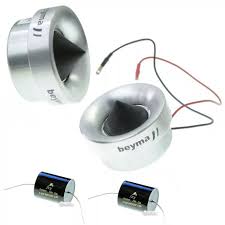
Beyma AST50B 4-Ohm Compact Aluminum-Diaphragm Tweeter Pair
When the system needs more top-end efficiency than a conventional car-audio tweeter but does not need the 105–107 dB output of Beyma’s larger Competition tweeters, the AST50B is the compact step in between.
This is a pair of 4-ohm high-frequency tweeters built around a 1-inch edgewound aluminum voice coil, aluminum diaphragm and neodymium motor. Beyma’s AST-50 technical data rates the platform at 25 watts AES per tweeter, 50 watts program, 98 dB sensitivity and a 5 kHz–20 kHz operating range.
That combination is why the AST50B makes sense in pillars, dash panels, motorcycle fairings, compact pods and custom doors where panel space is tight but the high-frequency section still has to keep up with a real amplified midrange.
What problem does the AST50B solve?
There is a big jump between a normal low-90-dB tweeter and a 105- or 107-dB Competition bullet tweeter. A lot of systems do not need either extreme.
If the mids are efficient enough that a conventional tweeter starts sounding buried at volume, but the system does not need AST05- or AST22-level projection, the AST50B gives us 98 dB sensitivity in a much smaller package.
That means more usable high-frequency headroom without creating a system where the tweeter has to be heavily attenuated just to sound balanced.
AST50B vs. SQL60B: same size class, different design priorities.
These two are close enough in size and application that the buyer needs to understand the actual difference.
AST50B: 25 watts AES, 98 dB sensitivity, 5 kHz–20 kHz, 1-inch edgewound aluminum voice coil and aluminum diaphragm. Choose it when the system specifically benefits from the aluminum-diaphragm AST platform and slightly higher published sensitivity.
SQL60B: 30 watts AES, 97.5 dB sensitivity, 5 kHz–20 kHz and Beyma’s PM4 polymer diaphragm. Choose it when the system benefits from the SQL60B’s additional power capacity and polymer-diaphragm construction.
The half-decibel sensitivity difference is not enough to choose one by itself. The diaphragm, power target, system voicing and the rest of the speaker package matter more than chasing one number.
AST50B vs. AST05: compact balance vs. Competition output.
AST50B: roughly 1.93 inches across, 98 dB sensitivity and a 5 kHz-up operating role. It is the better fit when packaging matters and the mids are strong but not extreme.
AST05: 105 dB sensitivity, 25 watts RMS and a larger 2.36-inch front format. It makes sense when the system is fighting wind, road noise or several very efficient mids and the tweeter genuinely needs Competition-level acoustic output.
The AST05 has much more headroom. The AST50B is easier to package and easier to balance in a system that does not need that much top-end capability.
AST50B vs. SC30: crossover position changes the whole system.
SC30: lower published sensitivity, but it can be used lower in frequency. That makes it useful when the midrange below it needs the tweeter to take over earlier.
AST50B: higher efficiency, but its job starts at 5 kHz. It makes sense when the midrange can comfortably carry the system through the upper mids and the tweeter mainly needs to add clean, efficient top-end output.
This is why we do not choose a tweeter by sensitivity alone. The crossover point has to match what the midrange can actually do.
The 5 kHz operating range keeps the job clear.
Beyma publishes the AST50 platform from 5 kHz to 20 kHz. This is a dedicated high-frequency driver, not a wideband upper-midrange solution.
That means the speaker below it needs to remain clean and controlled high enough to make the handoff work. If the midrange becomes directional or rough well before 5 kHz, the right fix is a different driver combination—not forcing the AST50B lower because the panel is already cut.
For system protection, we treat 5 kHz as the lower edge of the manufacturer’s intended operating window and use an appropriate high-pass filter and slope for the amplifier power and target output.
Why 25 watts AES is enough here.
Tweeter wattage cannot be compared directly with midrange wattage. The AST50B only reproduces the upper portion of the spectrum, and at 98 dB sensitivity it needs far less electrical power than a typical cone driver to reach a useful acoustic level.
The real risks are incorrect crossover protection and bad gain structure. A clipped high-frequency channel or too-low crossover can damage the tweeter long before a larger amplifier sounds “too powerful.”
We set the amplifier for clean voltage, then level-match the tweeter to the mids. The goal is headroom and clarity, not using every watt printed on the spec sheet.
The compact neodymium motor is part of the reason to buy it.
The AST50 platform is approximately 49 mm / 1.93 inches in overall diameter and about 33 mm / 1.30 inches deep. That is a useful package when a tweeter needs to fit into a pillar, dash, fairing or compact custom pod without creating a large visible opening.
The neodymium motor helps keep that package small. In real fabrication, that can matter more than another couple of decibels of output if the larger tweeter simply does not fit where the system needs it.
Where we would use the AST50B.
This is a strong match for efficient 6.5- and 8-inch mids in a daily-driven high-output system, a motorcycle or powersports build that does not need extreme horn-level output, or a custom front stage where the installer wants more tweeter headroom than a conventional dome can provide without cutting a large Competition-style opening.
With DSP, we would protect it first, then set level, polarity, timing and EQ around the actual installed response. Because the AST50B is still substantially more efficient than many conventional tweeters, the final tune matters just as much as the hardware choice.
The practical result: the AST50B gives a Beyma system a compact aluminum-diaphragm top end with enough efficiency for serious mobile audio while staying easier to package and integrate than the larger Competition tweeters.
Manufacturer Specifications
| Model | AST50B / AST-50 platform |
|---|---|
| Sold as | Pair |
| Nominal impedance | 4 ohms |
| Minimum impedance | 3.9 ohms |
| DC resistance (Re) | 3.3 ohms |
| Power handling | 25 W AES per tweeter |
| Program power | 50 W per tweeter |
| Sensitivity | 98 dB, 1 W / 1 m |
| Published frequency range | 5 kHz–20 kHz |
| Voice-coil diameter | 25.4 mm / 1 in |
| Voice-coil construction | Edgewound aluminum |
| Overall diameter | 49 mm / 1.93 in |
| Overall depth | 33 mm / 1.30 in |
| Net weight | 0.20 kg / 0.44 lb |
| Diaphragm | Aluminum |
| Magnet | Neodymium |
System guidance: use manufacturer-appropriate high-pass protection at or above the AST50 platform’s 5 kHz operating range. Final crossover slope, amplifier gain, attenuation, EQ and DSP settings should be chosen around the exact midrange and intended output.
Where this fits in the build
These speakers have to work where wind, road noise, mounting space and exposure change the job. Match the driver to the actual location, output target, amplifier power and environment instead of treating it like a normal door-speaker replacement.