

Description
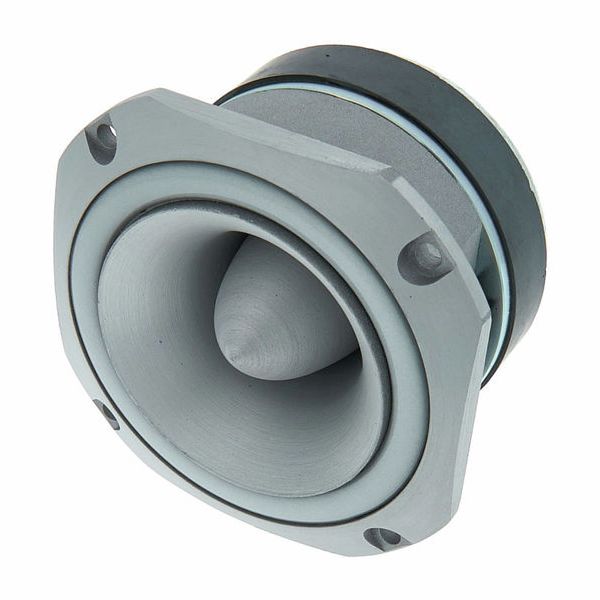
Beyma CP22/FB 8-Ohm Black Compression Tweeter
When the system needs the output and focused projection of the CP-22 platform but the tweeter is going into a dark fairing, lid, pod or speaker panel, the CP22/FB gives you the same serious high-frequency architecture in the black-finish version.
The CP22/FB is an 8-ohm black-finish compression tweeter sold individually. The CP-22 platform is rated at 25 watts AES, 50 watts program, 107 dB sensitivity and a 5 kHz–20 kHz operating range, with a 1.5-inch aluminum voice coil, aluminum diaphragm, ferrite motor and a 40-degree conical dispersion pattern.
That makes the FB a buyer decision based on both acoustics and finish. You are not giving up the CP-22’s high-output role just because the hardware needs to disappear visually into the panel.
Why choose the FB instead of the MF?
The acoustic job is the same: both are CP-22-family 8-ohm compression tweeters built for high-efficiency top-end reproduction.
CP22/FB: choose it when the black finish works better in the final installation—black motorcycle fairings, bag lids, Jeep panels, powersports pods, dark custom doors or any build where exposed silver hardware would pull attention away from the rest of the panel.
CP22/MF: choose it when the standard CP22/MF appearance fits the design.
The decision is not “which one is louder?” We keep the shared CP-22 acoustic specifications aligned and let the finish solve the visual part of the installation.
What problem does 107 dB sensitivity solve?
Several high-efficiency mids can produce enough output that a normal tweeter simply disappears when the system comes up. Turning up treble EQ only pushes the weaker high-frequency driver harder.
The CP22/FB starts at 107 dB sensitivity. That gives us enough high-frequency headroom to stay with a serious midrange section without relying on brute-force amplifier power.
The practical advantage is reserve capability. We can attenuate the tweeter to the level the system actually needs and still have headroom left when the customer turns the whole system up.
The 40° conical pattern makes aiming critical.
Beyma publishes a 40-degree conical dispersion pattern for the CP-22 platform. That is a focused high-frequency source, not a wide soft-dome pattern that can be hidden almost anywhere and expected to fill the cabin.
In an open-air motorcycle, Jeep or UTV system, that focus can be useful because more of the tweeter’s energy can be aimed toward the listening zone.
The tradeoff is that poor placement is punished harder. If the CP22/FB is pointed into an obstruction or away from the listener, EQ cannot turn it into a different dispersion pattern.
We decide the aiming before the fabrication is final.
CP22/FB vs. AST22: same sensitivity, different electrical and visual fit.
CP22/FB: 8 ohms, 107 dB sensitivity, 25 watts AES, 40° conical dispersion and black finish. Choose it when the system benefits from the 8-ohm load, the CP-22 format and a dark visual treatment.
AST22: 4 ohms, 107 dB sensitivity and another large-format high-output architecture. Choose it when the amplifier and driver-count plan are better suited to a 4-ohm tweeter.
Neither wins from sensitivity alone. The correct choice is the one that fits the amplifier, the panel and the intended coverage.
CP22/FB vs. SQL60B: projection vs. compact packaging.
SQL60B: roughly 1.93 inches across, 97.5 dB sensitivity and a compact neodymium package. Choose it when the installation needs strong high-frequency output but panel space is limited.
CP22/FB: roughly 4 inches across, 107 dB sensitivity and a focused 40-degree pattern. Choose it when the system needs substantially more projection and has room to mount the tweeter correctly.
If the SQL60B already reaches the target output, there is no reason to make the installation larger. The CP22/FB earns the extra space when the system genuinely needs what 107 dB can do.
The 5 kHz crossover requirement keeps the job clear.
Beyma publishes the CP-22 from 5 kHz to 20 kHz and recommends a crossover at 5 kHz or higher with at least a 12 dB/octave slope.
That means the midrange below it has to stay clean through the upper mids. If the mid needs the tweeter to take over at 3 kHz, the CP22/FB is the wrong tool for that system regardless of how much output it has.
Correct high-pass protection is what keeps the tweeter clean and reliable. A 107 dB driver can still be damaged very quickly by low-frequency energy it was never designed to reproduce.
Why 25 watts AES is enough at this sensitivity.
At 107 dB sensitivity, the CP22/FB does not need a huge amplifier to produce serious acoustic output. The tweeter only handles the upper portion of the spectrum, and its efficiency is dramatically higher than most conventional cone speakers.
The important part is clean voltage and proper gain structure. More amplifier power does not make the system better if the tweeter is already several decibels louder than the mids around it.
We use the available efficiency as headroom, not as a reason to run the high-frequency section wide open.
The 8-ohm load gives useful wiring flexibility.
An 8-ohm tweeter can be a practical choice when more than one high-frequency driver is used on an amplifier channel. Two 8-ohm CP22/FB tweeters wired in parallel create a 4-ohm nominal load.
That can help in large speaker arrays where driver count is dictated by coverage or system layout. It does not mean two tweeters are automatically better than one. We choose the number of drivers from the acoustic requirement first and the wiring plan second.
Where we would use the CP22/FB.
This version makes the most sense in high-output motorcycle, powersports, Jeep and custom-panel systems where the tweeter needs Competition-level projection but the hardware should blend into a black or dark installation.
It also works well in rear speaker panels and demo-style doors where a 40-degree source can be aimed deliberately instead of buried behind a factory grille.
With DSP, we protect it at 5 kHz or higher, level-match it to the mids, verify polarity and arrival time, then EQ the installed response only after the crossover is working correctly.
The practical result: the CP22/FB gives a dark-finish build the full high-output CP-22 role—107 dB sensitivity, controlled 40° projection and an 8-ohm load—without turning bright tweeter hardware into the visual centerpiece of the panel.
Manufacturer Specifications
| Model | CP22/FB / CP-22 platform |
|---|---|
| Sold as | Single tweeter |
| Finish | Black |
| Nominal impedance | 8 ohms |
| Minimum impedance | 7.9 ohms |
| DC resistance (Re) | 6.3 ohms |
| Power handling | 25 W AES |
| Program power | 50 W |
| Sensitivity | 107 dB, 1 W / 1 m |
| Published frequency range | 5 kHz–20 kHz |
| Recommended crossover | 5 kHz or higher, 12 dB/octave minimum |
| Dispersion | 40° conical |
| Voice-coil diameter | 38.1 mm / 1.5 in |
| Flux density | 1.55 T |
| BL factor | 5.2 N/A |
| Overall dimensions | 102 × 102 mm / 4 × 4 in |
| Overall depth | 71 mm / 2.79 in |
| Baffle cutout | 92 mm / 3.62 in |
| Bolt-circle diameter | 107 mm / 4.21 in |
| Net weight | 1.6 kg / 3.5 lb |
| Diaphragm | Aluminum |
| Magnet | Ferrite |
System guidance: use a 5 kHz-or-higher high-pass crossover with at least a 12 dB/octave slope, then set amplifier gain, attenuation, aiming, EQ and DSP around the exact midrange package and intended coverage.
Where this fits in the build
These speakers have to work where wind, road noise, mounting space and exposure change the job. Match the driver to the actual location, output target, amplifier power and environment instead of treating it like a normal door-speaker replacement.