

Description
Beyma PH35 4-Inch Competition High-Efficiency Tweeter
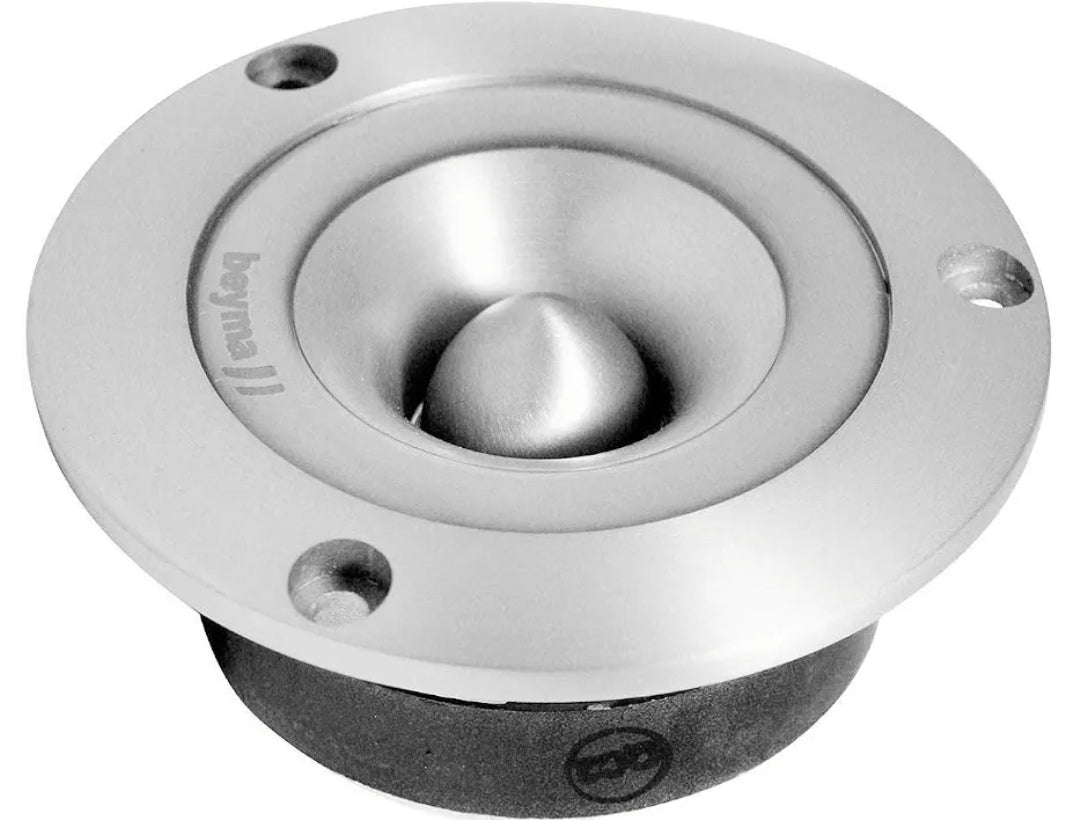
If the system needs Competition-level high-frequency output but the space behind the panel is the problem, the PH35 gives us a large front aperture with a surprisingly shallow rear package.
The Beyma PH35 is a 4-ohm Competition-series tweeter sold individually, rated at 25 watts RMS / 100 watts maximum, with 104 dB sensitivity, a published 3.5 kHz–20 kHz range, an aluminum diaphragm and a ferrite motor.
The front measures just over four inches across, but Beyma publishes only 45 mm / 1.77 inches of depth. That geometry is the reason PH35 can make sense in a door, dash, fairing or speaker panel where there is usable surface area on the front but limited room behind it.
The problem it solves is high-frequency output when rear clearance is tight.
High-output tweeters often create one of two installation problems: the face is too large for the panel, or the motor is too deep for the cavity behind it.
The PH35 accepts a larger front footprint but keeps the rear package shallow.
What that solves: if the panel has enough visible area for the 4-inch face but the structure behind it will not accept a deeper tweeter, PH35 gives us another way to reach Competition-level output without rebuilding the entire panel around the motor.
104 dB sensitivity gives the tweeter real acoustic headroom.
Beyma publishes the PH35 at 104 dB sensitivity at 1 watt / 1 meter.
That puts it firmly in high-output territory. It is dramatically more efficient than a conventional car-audio tweeter and only one decibel below AST05.
That means the high-frequency section can stay present against efficient midranges, road noise and open-cabin conditions without relying on excessive amplifier power.
The advantage is headroom: run the tweeter comfortably and tune it down to the system instead of pushing a weaker tweeter to its limit.
The published 3.5 kHz response is not the crossover setting.
Beyma publishes the PH35 from 3.5 kHz to 20 kHz, but recommends a 5 kHz crossover at 12 dB/octave.
The manufacturer also publishes a resonant frequency of 4 kHz.
That makes the crossover guidance especially important. We do not run a Competition tweeter close to resonance simply because the response graph shows energy there.
The response range tells us what the driver can reproduce. The crossover recommendation tells us how Beyma expects it to be protected.
25 watts RMS / 100 watts maximum is plenty when sensitivity starts at 104 dB.
The PH35 does not need a huge amplifier channel.
At 104 dB sensitivity, a relatively small amount of clean power creates a large amount of acoustic output. The system is far more likely to need careful level matching than a bigger amp.
Beyma publishes attenuation guidance for the PH35, including several levels of high-frequency reduction. That is exactly what we would expect from a tweeter designed to work beside very efficient mids.
The goal is not to use every decibel the driver can make. The goal is to have enough available output that the tweeter never becomes the bottleneck.
The aluminum diaphragm is built around fast high-frequency response.
Beyma uses an aluminum diaphragm and aluminum front cover in the PH35.
A high-frequency diaphragm needs to remain light and rigid so it can accelerate, stop and change direction quickly at thousands of cycles per second.
That construction supports the PH35’s high sensitivity and extended 20 kHz published upper response.
As with every metal-diaphragm high-output tweeter, the tune matters. Available projection is useful; excessive level is not.
The ferrite motor is the tradeoff behind the shallow package.
The PH35 uses a ferrite motor, not the neodymium motor used in AST05.
Ferrite is generally heavier for a given magnetic system, but it remains a proven, cost-effective motor technology.
The PH35’s installation advantage comes from how Beyma packages that motor: the tweeter is only about 1.77 inches deep despite its large front format.
If total driver weight is the primary concern, a neodymium tweeter may be the better choice. If shallow rear clearance is the problem and the panel can take the larger face, PH35 makes a lot of sense.
PH35 versus AST05.
PH35: sold individually, 104 dB sensitivity, 25 W RMS / 100 W maximum, ferrite motor, 4.04-inch front diameter and only 1.77 inches of depth. Choose it when a large front opening is acceptable but rear clearance is limited.
AST05: sold as a pair, 105 dB sensitivity, the same 25 W RMS / 100 W maximum power class, neodymium motor and a much smaller 2.36-inch front format, but approximately 2.68 inches of depth. Choose it when front-panel space and motor weight matter more than shallow rear depth.
The PH35 is wider and shallower. The AST05 is narrower and deeper.
That is a real fitment decision before we ever talk about one decibel of sensitivity.
PH35 versus AST22.
AST22: 107 dB sensitivity, larger 1.5-inch voice coil and roughly four-inch front format. Choose it when maximum high-frequency efficiency is the priority.
PH35: 104 dB sensitivity, smaller 1.02-inch voice coil and much shallower 1.77-inch depth. Choose it when the system needs serious output but the rear cavity cannot accept the deeper AST22 package.
The AST22 has more published acoustic efficiency. The PH35 is easier to fit into a shallow structure.
PH35 versus SC30.
SC30: 92 dB sensitivity, 3.5 kHz recommended crossover capability and 22 kHz published upper response. Choose it when lower crossover flexibility and conventional in-cabin balance are more important than extreme efficiency.
PH35: 104 dB sensitivity and Competition-series output, with a manufacturer-recommended 5 kHz crossover. Choose it when the top end needs much more projection.
These are not two price levels of the same tweeter. They solve two completely different output targets.
Where we would use the PH35.
This is a strong option in motorcycle fairings and bags, powersports panels, Jeep and open-cabin builds, custom doors and high-output speaker arrays where the panel has room for the large front face but the cavity behind it is shallow.
It pairs naturally with efficient Beyma mids when the top end needs real acoustic headroom but the installation does not justify the deeper or heavier packaging of another large Competition tweeter.
With DSP or a proper passive network, we can protect it at the manufacturer-recommended crossover, level-match it to the midrange and shape the response so the PH35 adds clarity and projection instead of simply adding brightness.
The result: a shallow-back Competition-series Beyma tweeter that gives us 104 dB sensitivity and serious high-frequency output from a package designed around limited rear clearance.
Manufacturer Specifications
- Model: Beyma PH35
- Series: Competition
- Product type: High-efficiency high-frequency tweeter
- Sold as: Single tweeter
- Nominal impedance: 4 ohms
- Power handling: 25 watts RMS
- Maximum power: 100 watts
- Sensitivity: 104 dB, 1 W / 1 m
- Published frequency range: 3.5 kHz–20 kHz
- Recommended crossover: 5 kHz at 12 dB/octave
- Resonant frequency (Fs): 4 kHz
- Voice-coil diameter: 25.8 mm / 1.02 inches
- Overall diameter: 102.5 mm / 4.04 inches
- Overall depth: 45 mm / 1.77 inches
- Baffle cutout: 75 mm / 2.95 inches
- Bolt-circle diameter: 90 mm / 3.54 inches
- Diaphragm: Aluminum
- Front cover: Aluminum
- Motor: Ferrite
Crossover / System Guidance
Beyma recommends crossing the PH35 at 5 kHz with a 12 dB/octave filter. Final amplifier power, attenuation, level, EQ and DSP settings must be selected around the midrange used below it and the required output of the finished system.
Where this fits in the build
These speakers have to work where wind, road noise, mounting space and exposure change the job. Match the driver to the actual location, output target, amplifier power and environment instead of treating it like a normal door-speaker replacement.