
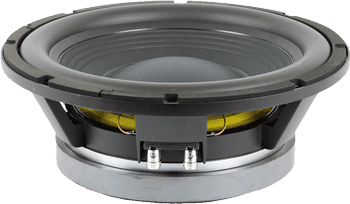

Description
Beyma POWER12N 12-Inch High-Excursion Low-Frequency / Midbass
If the system already has plenty of vocal output and what it is missing is actual bass and midbass movement from the 12-inch speaker section, the POWER12N is built for that job.
The Beyma POWER12N is a 12-inch, 4-ohm ferrite low-frequency driver rated at 500 watts, with 91 dB sensitivity, a 45 Hz–1.5 kHz operating range, a 4-inch voice coil and 10 mm Xmax.
Those numbers tell us immediately where this speaker belongs in the lineup. It gives up the extreme sensitivity of Beyma's PRO12 midrange drivers so it can move farther and work lower.
Ten millimeters of Xmax is the reason this driver belongs in the low-frequency section.
Beyma publishes 10 mm Xmax for the POWER12N.
That cone travel gives a 12-inch driver enough useful displacement to create real bass, upper-bass and midbass impact instead of simply producing high SPL through the lower vocal range.
What that solves: the speaker system itself can carry physical low-frequency weight instead of asking the subwoofer to reach too high or asking a short-travel midrange to reproduce frequencies it was never built to handle.
The 91 dB sensitivity is not a weakness—it tells you what Beyma prioritized.
Beyma publishes the POWER12N at 91 dB sensitivity.
That is much lower than the 97–101 dB ratings of several PRO12 drivers. But those drivers are built around efficiency and broader midrange output, not 10 mm of low-frequency excursion.
The POWER12N spends more of its design on movement and low-frequency capability.
If the system needs maximum output per watt through vocals, choose a PRO12. If the system needs the 12-inch cone to actually move and make bass, the POWER12N makes more sense.
The 45 Hz–1.5 kHz range keeps the job focused.
Beyma publishes the POWER12N from 45 Hz to 1.5 kHz.
That upper limit makes the intended role clear. This is not a broad-band 12-inch that should be stretched toward a tweeter. It is a low-frequency and midbass driver that belongs underneath a dedicated midrange or high-frequency section.
That is a good thing. The system does not have to compromise one cone so it can do every job badly.
We can let the POWER12N concentrate on impact and let the driver above it handle vocals and detail.
The 4-inch voice coil gives the low-frequency section real thermal capacity.
The POWER12N uses a 4-inch voice coil.
That large coil supports the driver's high-output low-frequency role and gives the system enough thermal headroom to work hard when the enclosure and crossover are correct.
At the same time, 10 mm of excursion means mechanical limits still matter. A driver can reach the end of its useful travel before the voice coil reaches its thermal limit if the enclosure or high-pass is wrong.
This is why enclosure design, amplifier power and limiting all belong in the same conversation.
POWER12N versus PRO12WFE.
PRO12WFE: 97 dB sensitivity, 5 mm Xmax and a much broader 35 Hz–4 kHz published range. Choose it when the 12-inch needs to stay efficient and carry more of the low/mid spectrum.
POWER12N: 91 dB sensitivity, 10 mm Xmax and a focused 45 Hz–1.5 kHz operating range. Choose it when the driver's main job is low-frequency displacement and midbass impact.
The WFE is the broader, more efficient woofer/midbass. The POWER12N is the more excursion-focused low-frequency tool.
POWER12N versus PRO12MND.
PRO12MND: 101 dB sensitivity, 8 mm Xmax, 700 watts AES and broad 50 Hz–4 kHz output. Choose it when extreme efficiency and wide low/mid output are the priorities.
POWER12N: lower sensitivity but more published excursion, with a focused low-frequency role. Choose it when the system is intentionally separating bass/midbass from the vocal section.
The important decision is not which 12 has the biggest marketing number. It is which 12 solves the missing part of the system.
Where we would use the POWER12N.
This makes sense in motorcycle bags, large custom doors, powersports enclosures, Jeep and open-cabin systems, and other builds where a 12-inch needs to add physical low-frequency impact beneath a separate high-output midrange section.
It also makes sense when the subwoofer system is strong but the transition into the speakers still feels weak. A real midbass/low-frequency driver can bridge that gap instead of forcing the subwoofer to play unnaturally high.
With DSP, we can set the lower protection around the actual enclosure, choose the upper handoff into the midrange above it, then align EQ, phase and timing so the impact feels connected to the rest of the music.
The result: a 12-inch Beyma that trades some raw sensitivity for the cone travel and focused low-frequency behavior needed to make bass and midbass feel physical instead of simply loud.
Manufacturer Specifications
- Model: Beyma POWER12N
- Product type: Low-frequency / midbass loudspeaker
- Sold as: Single speaker
- Nominal diameter: 12 inches
- Nominal impedance: 4 ohms
- Power rating: 500 watts
- Sensitivity: 91 dB
- Published frequency range: 45 Hz–1.5 kHz
- Voice-coil diameter: 4 inches
- Xmax: 10 mm
- Motor: Ferrite
System Design Guidance
The published frequency range is not an enclosure or crossover recommendation. Final enclosure alignment, amplifier power, limiting, high-pass, low-pass and DSP settings must be selected around the actual installation and required output.
Where this fits in the build
These speakers have to work where wind, road noise, mounting space and exposure change the job. Match the driver to the actual location, output target, amplifier power and environment instead of treating it like a normal door-speaker replacement.