

Description
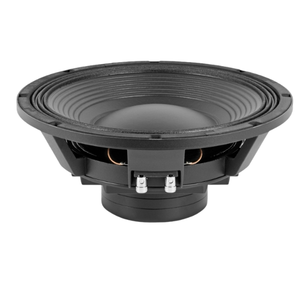
Beyma POWER12PND 12-Inch Neodymium High-Power Low-Frequency / Midbass
If the system needs serious 12-inch bass and midbass output but the POWER12N's lower sensitivity is going to cost too much amplifier power, the POWER12PND is the higher-efficiency, higher-power answer.
Beyma rates the POWER12PND at 900 watts AES, with 96 dB sensitivity, a published 45 Hz–2 kHz range, a 4-inch voice coil and 7.5 mm Xmax in a neodymium motor platform.
This is not just the lightweight version of POWER12N. The numbers show a different performance balance: much more thermal power and substantially higher efficiency, with slightly less published excursion.
96 dB sensitivity is the reason this driver needs less brute-force amplifier power.
Beyma publishes the POWER12PND at 96 dB sensitivity.
That is a major jump over the current 91 dB figure for POWER12N.
What that solves: the low-frequency section can create serious output without requiring the amplifier to make up as much ground through raw wattage.
That matters in mobile systems where electrical capacity, amplifier space and heat are all real constraints. More efficient drivers let us use available power more effectively instead of solving every output problem with a bigger amp rack.
900 watts AES and a 4-inch voice coil give it real thermal headroom.
The POWER12PND carries a current Beyma rating of 900 watts AES and uses a 4-inch voice coil.
That gives the driver substantially more thermal capacity than POWER12N while keeping the same general 12-inch low-frequency/midbass job.
The important part is still using that power correctly. A 900-watt rating does not protect the speaker from a bad enclosure, excessive energy below the useful range or an amplifier being clipped.
Power handling tells us what the motor and coil can take. System design determines whether we can use it.
Seven-point-five millimeters of Xmax keeps the driver physically capable without turning it into a deep-excursion sub.
Beyma publishes 7.5 mm Xmax for the POWER12PND.
That is less excursion than POWER12N's 10 mm, but the PND is also substantially more efficient and carries far more thermal power.
This is the tradeoff. The POWER12PND is not trying to maximize cone travel at all costs. It is balancing useful low-frequency movement with high output per watt and high power capacity.
The 45 Hz–2 kHz range gives it more upper flexibility than POWER12N.
Beyma publishes the POWER12PND from 45 Hz to 2 kHz.
That extra upper extension gives the system designer more room to choose the handoff to the dedicated midrange above it.
It still does not make a 12-inch low-frequency driver the right choice for upper vocals or high-frequency duty. It simply means the POWER12PND can cover more of the low/mid region before another driver needs to take over.
Likewise, the 45 Hz lower published response is not a universal high-pass or enclosure tuning target.
The neodymium motor is doing two jobs: reducing mass and supporting efficiency.
The POWER12PND uses a neodymium motor.
That gives the system designer a high-output 12-inch low-frequency platform without hanging the mass of a large ferrite motor off every door, bag, lid or removable panel.
The motor technology also fits the overall design goal of the PND: more performance from a more compact magnetic structure.
POWER12PND versus POWER12N.
POWER12N: 500-watt current rating, 91 dB sensitivity, 45 Hz–1.5 kHz and 10 mm Xmax with a ferrite motor. Choose it when greater published excursion and a lower-cost ferrite platform solve the system problem.
POWER12PND: 900 watts AES, 96 dB sensitivity, 45 Hz–2 kHz and 7.5 mm Xmax with a neodymium motor. Choose it when the system needs much more output per watt, more thermal capacity, reduced motor mass and a little more upper-range flexibility.
The POWER12N moves farther. The POWER12PND does more with the power you give it.
POWER12PND versus PRO12MND.
PRO12MND: 101 dB sensitivity, 700 watts AES, 8 mm Xmax and a broad 50 Hz–4 kHz range. Choose it when extreme low/mid efficiency and broad midrange capability are the priority.
POWER12PND: 96 dB sensitivity, 900 watts AES and a focused 45 Hz–2 kHz low-frequency/midbass role. Choose it when the 12-inch needs to stay lower, take more thermal power and concentrate more of its design on bass and midbass output.
The MND is the high-efficiency low/mid system driver. The PND is the high-power low-frequency system driver.
Where we would use the POWER12PND.
This makes sense in high-output motorcycle and powersports enclosures, large custom doors, Jeep and open-cabin builds, speaker walls and other systems where the 12-inch section has to make real bass and midbass while staying efficient enough to keep up with the rest of the system.
It is especially useful when motor weight matters but the system still needs substantial thermal power. Multiple large ferrite woofers can become a fabrication issue quickly; the PND gives us another way to reach the output target.
With DSP and proper limiting, we can protect the low end around the actual enclosure, set the upper handoff into the midrange above it, then align EQ, phase and timing so the low-frequency section sounds connected instead of simply loud.
The result: a 12-inch Beyma that trades a little excursion for much higher efficiency, significantly more power handling and lighter neodymium packaging—making it the smarter POWER-series choice when the complete system needs output without brute-force amplifier demand.
Manufacturer Specifications
- Model: Beyma POWER12PND
- Product type: High-power low-frequency / midbass loudspeaker
- Sold as: Single speaker
- Nominal diameter: 12 inches
- Nominal impedance: 4 ohms
- Power handling: 900 watts AES
- Sensitivity: 96 dB
- Published frequency range: 45 Hz–2 kHz
- Voice-coil diameter: 4 inches
- Xmax: 7.5 mm
- Motor: Neodymium
System Design Guidance
The published frequency range is not an enclosure or crossover recommendation. Final enclosure alignment, amplifier power, limiting, high-pass, low-pass and DSP settings must be selected around the actual installation and required output.
Where this fits in the build
These speakers have to work where wind, road noise, mounting space and exposure change the job. Match the driver to the actual location, output target, amplifier power and environment instead of treating it like a normal door-speaker replacement.