
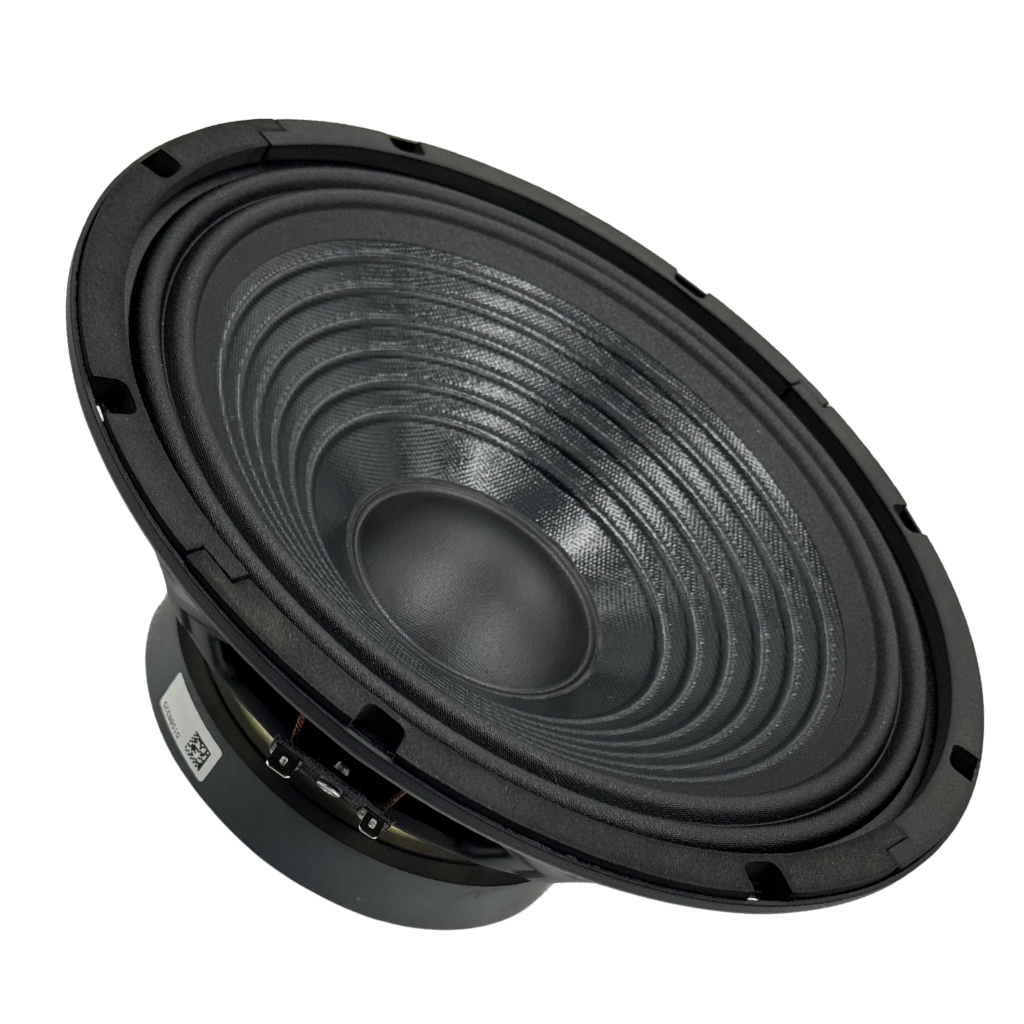
Description
Beyma PRO10BK 10-Inch High-Power Midbass/Midrange
A 10-inch speaker can solve two completely different problems. The PRO10MI is built to make the midrange brutally efficient. The PRO10BK is for the build that needs the 10-inch to reach lower and put more physical weight behind the music.
The Beyma PRO10BK is a 4-ohm ferrite driver rated at 250 watts AES, with 95 dB sensitivity, a published 65 Hz–5.6 kHz operating range and 6 mm Xmax. That combination puts it between a narrow-band high-efficiency midrange and a conventional low-frequency woofer.
In plain terms: this is the 10-inch we look at when the speaker section needs real lower-midrange and midbass impact, not just more vocal volume.
Six millimeters of Xmax gives the PRO10BK a different job than the PRO10MI.
Excursion matters when a speaker starts working lower. Kick drum, upper bass and lower-midrange information require the cone to move more air than a driver that spends most of its life on vocals.
Beyma publishes 6 mm Xmax for the PRO10BK. That gives the 10-inch cone useful displacement for the broader-band job it is being asked to do.
What that solves: we can build more body and punch into the speaker section itself instead of asking the subwoofer to reach unnaturally high or asking a dedicated vocal midrange to play lower than it wants to.
95 dB sensitivity is still efficient—but this speaker is not chasing the PRO10MI’s 101 dB number.
The PRO10BK is published at 95 dB sensitivity at 2.83 V / 1 meter.
That is still strong efficiency for a driver with this much bandwidth and excursion. The important part is understanding the tradeoff.
The PRO10MI is the choice when maximum midrange output per watt is the priority. The PRO10BK gives up some sensitivity so the cone and suspension can do more work lower in frequency.
That is not a downgrade. It is a different system tool.
The 65 Hz published floor does not make it a subwoofer.
Beyma publishes the PRO10BK from 65 Hz to 5.6 kHz.
That wide response gives us flexibility, but a published response range is not the same thing as a crossover prescription. Where we actually high-pass the driver depends on the rear chamber, amplifier power and how hard the system needs to play.
In a high-output build, we normally protect the PRO10BK above the point where low-frequency excursion starts wasting headroom. A proper woofer or subwoofer can handle the deep bass while the 10-inch owns the impact region above it.
At the top end, a dedicated tweeter or compression driver lets us choose the handoff based on dispersion and system design rather than forcing the 10-inch cone to reproduce every frequency it can technically reach.
250 watts AES gives the 10-inch room to work.
The PRO10BK carries a current Beyma rating of 250 watts AES.
That power handling makes sense in a driver expected to reproduce real midbass energy. But power is only useful when the speaker is loaded and filtered correctly.
More amplifier does not fix an undersized chamber, a weak mounting panel or a crossover set too low. If the cone is using all of its travel on bass the system should have handed to another driver, the thermal rating will not save the installation.
System design still wins: rigid mounting, the correct rear environment, clean amplifier power and crossover protection are what turn the 250-watt rating into usable output.
PRO10BK versus PRO10MI.
PRO10MI: 350 watts RMS, 101 dB sensitivity and a dedicated high-efficiency midrange role. This is the one when vocals and lower mids need extreme projection and another driver is handling the bass below it.
PRO10BK: 250 watts AES, 95 dB sensitivity, 65 Hz published lower response and 6 mm Xmax. This is the one when the 10-inch speaker itself needs to contribute more midbass and lower-frequency impact.
If somebody buys strictly by sensitivity, the PRO10MI wins. If the system actually needs broader bandwidth and more cone travel, that does not make it the better choice.
Where we would use the PRO10BK.
This makes sense in large custom doors, Jeep and open-cabin systems, motorcycle or powersports enclosures with the physical room, and speaker walls where the lower-midrange section needs real authority.
It is especially useful when we are trying to close the gap between a subwoofer and a high-output upper-midrange/tweeter section. A properly used 10-inch midbass can make kick drums hit from the speaker system instead of feeling disconnected from bass coming from somewhere else in the vehicle.
With DSP, we can control the high-pass, low-pass, phase, EQ and time alignment so that extra bandwidth becomes part of one coherent system rather than just another loud cone.
The result: a broad-band 10-inch Beyma driver with enough efficiency to play hard, enough excursion to add meaningful midbass, and enough upper-range extension to integrate cleanly into a multi-way high-output system.
Manufacturer Specifications
- Model: Beyma PRO10BK
- Product type: Midbass / midrange loudspeaker
- Sold as: Single speaker
- Nominal diameter: 10 inches
- Nominal impedance: 4 ohms
- Power handling: 250 watts AES
- Sensitivity: 95 dB, 2.83 V / 1 m
- Published frequency range: 65 Hz–5.6 kHz
- Voice-coil diameter: 1.5 inches
- Xmax: 6 mm
- Motor: Ferrite
System Design Guidance
The published 65 Hz lower response is not a universal high-pass recommendation. Final rear chamber, crossover points, amplifier power and DSP settings must be selected around the actual installation and output target.
Where this fits in the build
These speakers have to work where wind, road noise, mounting space and exposure change the job. Match the driver to the actual location, output target, amplifier power and environment instead of treating it like a normal door-speaker replacement.