
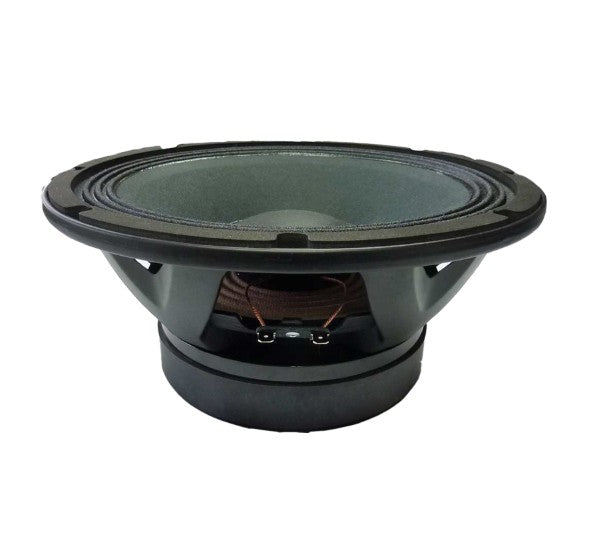


Description
Beyma PRO10MC 10-Inch High-Power Midbass/Midrange
If the system needs a 10-inch driver that can hit hard through the midbass and still carry serious midrange output, the PRO10MC sits right between Beyma's efficiency-first mids and its deep-excursion low-frequency drivers.
Beyma rates the PRO10MC at 500 watts AES, 98 dB sensitivity, a published 55 Hz–5 kHz range and 8 mm Xmax. It uses a 2.5-inch voice coil and ferrite motor.
Those numbers tell the story: this is not a short-travel vocal driver and it is not a 13 mm-Xmax POWER10iX. The PRO10MC is the middle ground when one 10-inch needs real cone movement, strong power handling and enough efficiency to stay aggressive through the lower mids.
Eight millimeters of Xmax gives the 10-inch room to create actual impact.
Beyma publishes 8 mm Xmax for the PRO10MC.
That matters because midbass and lower-midrange impact require displacement. A 10-inch cone can have plenty of surface area, but if it cannot move far enough under control, the system still runs out of punch as the volume rises.
What that solves: the speaker section can create physical kick and lower-midrange body instead of leaving all the impact to the subwoofer.
The result is a system where drums and bass guitar feel connected to the doors, bags or speaker panel instead of sounding like deep bass from one location and thin vocals from another.
500 watts AES gives the PRO10MC serious working headroom.
The current Beyma rating is 500 watts AES.
That is a major step above many of the efficiency-first midrange options in the same diameter. It gives the PRO10MC enough thermal capacity for a high-output low/mid section that is being asked to work hard for long periods.
But the power number only matters if the crossover and enclosure keep the speaker inside its mechanical limits.
More amplifier does not replace system design. The 8 mm Xmax, rear loading and lower crossover still determine how much useful output the driver can make before excursion becomes the limit.
98 dB sensitivity keeps it efficient even though it has real excursion.
Beyma publishes the PRO10MC at 98 dB sensitivity.
That is what makes this driver interesting. It gives up some sensitivity compared with the 101 dB PRO10MI, but it gains substantially more low-frequency movement.
At the same time, it remains far more efficiency-oriented than a conventional low-sensitivity woofer.
The practical result: we can get real midbass movement without needing ridiculous amplifier power just to make the driver keep up through the vocal range.
The 55 Hz–5 kHz response gives the system designer a lot of room.
Beyma publishes the PRO10MC from 55 Hz to 5 kHz.
That is broad enough to use the driver as a serious low/mid section in several different architectures.
In a three-way system, we can let the PRO10MC concentrate on midbass and lower mids, then hand vocals and upper mids to a smaller driver above it.
In a simpler high-output system, it has enough upper extension to cover more of the midrange before the handoff to a compression driver or tweeter.
The lower published limit is still not an automatic high-pass point. Where the system crosses it depends on the enclosure, power and required output.
PRO10MC versus PRO10MI.
PRO10MI: 101 dB sensitivity, 350 watts RMS and a dedicated high-efficiency midrange role. Choose it when extreme vocal/lower-midrange projection per watt is the priority.
PRO10MC: 500 watts AES, 98 dB sensitivity and 8 mm Xmax. Choose it when the 10-inch needs substantially more cone travel and power handling so it can contribute meaningful midbass along with the midrange.
The MC gives up a few decibels of sensitivity for a much broader mechanical job.
PRO10MC versus POWER10iX.
POWER10iX: 13 mm Xmax and a 40 Hz published lower range. Choose it when low-frequency displacement is the main job.
PRO10MC: 8 mm Xmax and 98 dB sensitivity. Choose it when you need a more balanced high-output low/mid driver that can hit hard without giving up as much efficiency through the midrange.
That is why buying a 10-inch speaker strictly from wattage or diameter does not work. These drivers are built around completely different priorities.
Where we would use the PRO10MC.
This is a strong choice for large custom doors, motorcycle and powersports enclosures, Jeep and open-cabin systems, and high-output speaker panels where a 10-inch needs to do more than vocals but does not need to act like a dedicated subwoofer.
It can be the impact driver underneath a smaller high-efficiency midrange, or it can carry a broader low/mid section when the system layout calls for fewer drivers.
With DSP, we can set the high-pass around the actual rear chamber, choose the upper handoff around the driver above it, and then manage EQ, phase and timing so the 10-inch adds weight without sounding detached from the rest of the system.
The result: a 10-inch Beyma with enough excursion to make real midbass, enough power handling to work hard, and enough sensitivity to stay aggressive through the midrange without turning the amplifier rack into the whole solution.
Manufacturer Specifications
- Model: Beyma PRO10MC
- Product type: High-power midbass / midrange loudspeaker
- Sold as: Single speaker
- Nominal diameter: 10 inches
- Nominal impedance: 4 ohms
- Power handling: 500 watts AES
- Sensitivity: 98 dB
- Published frequency range: 55 Hz–5 kHz
- Voice-coil diameter: 2.5 inches
- Xmax: 8 mm
- Motor: Ferrite
System Design Guidance
The published 55 Hz lower response is not a universal high-pass recommendation. Final rear loading, crossover points, amplifier power and DSP settings must be selected around the actual installation and required output.
Where this fits in the build
These speakers have to work where wind, road noise, mounting space and exposure change the job. Match the driver to the actual location, output target, amplifier power and environment instead of treating it like a normal door-speaker replacement.