
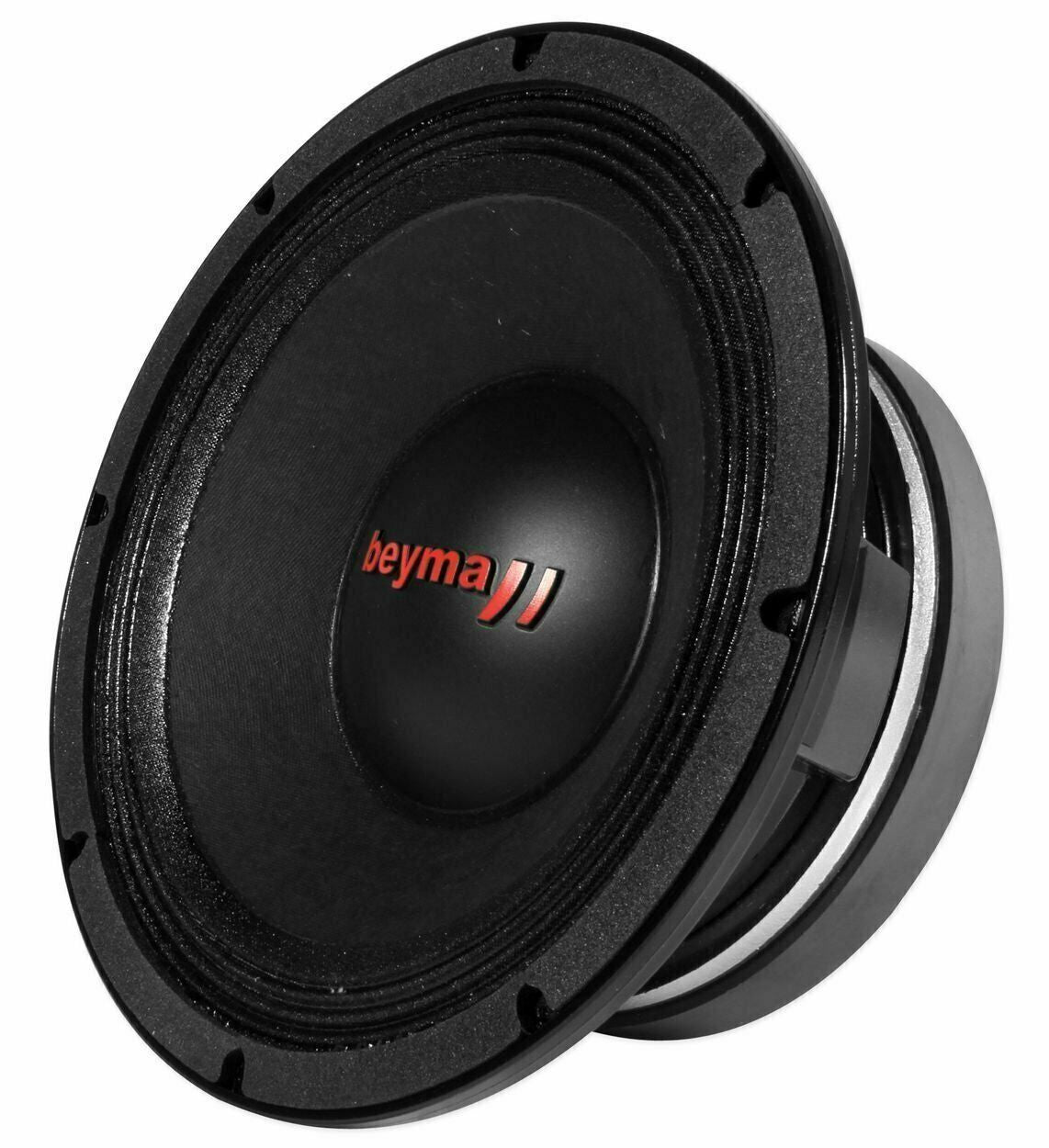

Description
Beyma PRO10MI 10-Inch High-Efficiency Midrange
When a high-output system reaches the point where the midrange itself needs real cone area, the PRO10MI starts making sense.
The Beyma PRO10MI is a 10-inch, 4-ohm Competition-series midrange built for one thing: very high output through the lower-midrange and vocal range without throwing away clarity.
This is not a 10-inch subwoofer wearing a midrange label. It is not a conventional woofer. It is a dedicated high-efficiency midrange with a huge 3-inch voice coil, 350 watts RMS power handling and a published sensitivity of 101 dB at 1 watt / 1 meter.
That combination is why this speaker can get violent without needing ridiculous amplifier power.
101 dB sensitivity changes the whole system design.
At 101 dB sensitivity, the PRO10MI starts several steps ahead of a typical conventional car-audio speaker in raw acoustic efficiency.
That matters because once a build has multiple high-output mids, a large bass section and enough amplifier power to get everything moving, the vocal range cannot be the part of the system that runs out of output first.
The PRO10MI gives us a midrange section that can keep pace with a serious system without forcing us to throw thousands of watts at it just to make voices and instruments audible.
What that solves: instead of turning the treble up harder or adding more small midranges because the system sounds buried under the bass, we can build the vocal range around a driver with enough efficiency and cone area to stand on its own.
The 10-inch cone gives the midrange real physical weight.
The PRO10MI has 380 cm² of effective cone area. That is a lot of radiating surface for a dedicated midrange.
The advantage is not that we suddenly use it as a subwoofer. The advantage is that drums, lower vocals, guitars and the lower part of the midrange have more physical presence than they do from a smaller dedicated mid driver.
This is the kind of speaker that can make a high-output door or panel sound big instead of only loud.
With the right crossover below it, the PRO10MI can carry enough lower-midrange body that the handoff to the woofer or subwoofer feels natural instead of leaving a hole between “bass” and “everything else.”
The published 70 Hz response is not permission to run it like a woofer.
Beyma publishes the PRO10MI with a 70 Hz–4 kHz frequency range. That tells us what the driver can reproduce under measurement conditions. It does not tell us where a high-output car-audio system should cross it.
Beyma’s own Competition guidance recommends a 150–200 Hz minimum high-pass region for the PRO10MI, with the upper crossover around 3 kHz and at least a 12 dB/octave filter slope.
That is the number that matters when the speaker is being asked to play loud.
Running a 10-inch midrange lower because “the spec sheet says 70 Hz” wastes excursion on frequencies the speaker was not designed to carry at high output. Proper filtering lets the voice coil and cone spend their energy on the range where this driver is exceptional.
This is a perfect example of why published frequency response and recommended system crossover are not the same thing.
350 watts RMS is serious power for a midrange.
Beyma rates the PRO10MI at 350 watts RMS / 700 watts maximum and uses a 77 mm / 3-inch voice coil.
That gives the driver substantial thermal capacity, but the same rule still applies: power handling only matters when the speaker is protected from low-frequency excursion.
Give it clean amplifier power, filter it correctly and the PRO10MI can produce the kind of midrange output that normally takes several smaller drivers to approach.
Give it unfiltered bass and the size of the voice coil will not save it from being used for the wrong job.
PRO6MI, PRO8MI or PRO10MI?
These three speakers are not just size options.
PRO6MI: the compact dedicated midrange. Best when installation space is tight or a strong midbass driver is already handling the range below it.
PRO8MI: more cone area and lower-midrange authority while keeping 98 dB sensitivity. A strong middle ground for custom doors, motorcycles and open-cabin systems.
PRO10MI: the high-output choice when the midrange itself needs serious physical output, lower-midrange body and the ability to keep up with a large system.
The PRO10MI is not automatically the better speaker because it is bigger. It is the better choice when the system has room for a 10-inch midrange and actually needs what that extra cone area and 101 dB sensitivity can do.
Where we would use it.
This is a natural fit for large custom doors, speaker walls, high-output Jeep builds, show vehicles and other systems where the midrange has to project far beyond a normal factory listening position.
It can also make sense in large motorcycle or powersports installations where packaging allows it and the goal is extreme output, but this is not a “drop it into any 10-inch hole” speaker. The enclosure or baffle, mounting strength and crossover strategy have to be designed around the driver.
In a properly built multi-way system, we would typically use a dedicated tweeter above it and a true woofer/subwoofer below it. DSP lets us control the transition points, level, EQ, phase and timing so the 10-inch midrange adds authority without pulling the entire image down to the speaker location.
The motor strength and low Qts tell us this is not a lazy cone.
Beyma publishes a 15.8 N/A BL factor and a 0.17 Qts for the PRO10MI.
Those numbers support what the driver is trying to do: strong motor control and high efficiency rather than loose low-frequency excursion.
That is another reason we do not treat it like a bass driver. The motor and suspension are optimized around controlled, efficient midrange output.
The result: a 10-inch midrange that can bring serious lower-midrange body, vocal projection and output to a large system without making the customer choose between “loud” and “clean”—provided the rest of the system is designed around what the PRO10MI actually is.
Manufacturer Specifications
- Model: Beyma PRO10MI
- Product type: Dedicated midrange loudspeaker
- Series: Competition
- Sold as: Single speaker
- Nominal diameter: 250 mm / 10 inches
- Nominal impedance: 4 ohms
- Power handling: 350 watts RMS
- Maximum power: 700 watts
- Sensitivity: 101 dB, 1 W / 1 m
- Published frequency range: 70 Hz–4 kHz
- Voice-coil diameter: 77 mm / 3 inches
- BL factor: 15.8 N/A
- Moving mass: 0.039 kg
- Resonant frequency (Fs): 46 Hz
- DC resistance (Re): 3.7 ohms
- Qms: 7.24
- Qes: 0.17
- Qts: 0.17
- Equivalent compliance volume (Vas): 62 L
- Reference efficiency: 3.5%
- Effective cone area (Sd): 380 cm²
- Voice-coil inductance (Le @ 1 kHz): 1.3 mH
- Overall diameter: 260 mm / 10.24 inches
- Cutout diameter: 228 mm / 8.98 inches
- Mounting depth: 124 mm / 4.88 inches
- Magnet: Ferrite
Beyma Crossover Guidance
- Recommended lower high-pass region: 150–200 Hz minimum
- Recommended upper low-pass: Approximately 3 kHz
- Minimum recommended filter slope: 12 dB/octave
Installation note: Final crossover, amplifier power, enclosure/baffle design, EQ and timing must be set around the actual installation and the drivers used above and below the PRO10MI.
Where this fits in the build
These speakers have to work where wind, road noise, mounting space and exposure change the job. Match the driver to the actual location, output target, amplifier power and environment instead of treating it like a normal door-speaker replacement.