
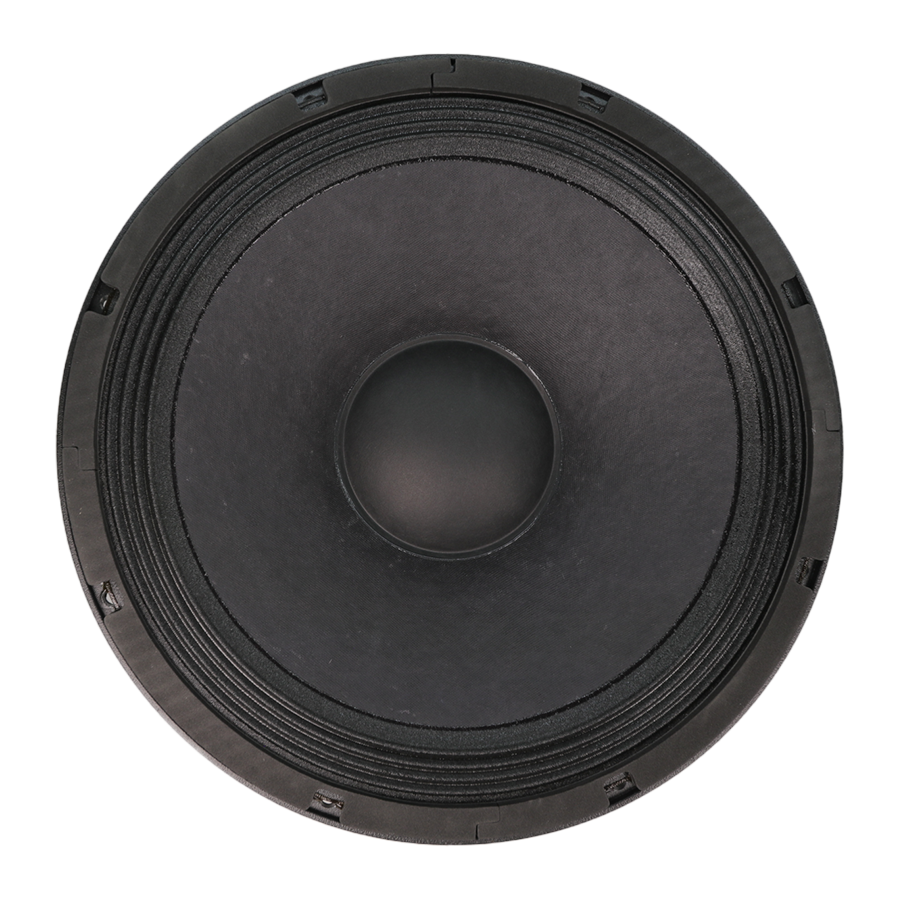

Description
Beyma PRO12WFE 12-Inch High-Efficiency Woofer / Midbass
If the system needs the speaker section itself to sound big—real upper bass, kick, lower-midrange weight and enough efficiency to keep up at high output—the PRO12WFE is built for that job.
The Beyma PRO12WFE is a 12-inch, 4-ohm ferrite woofer/midbass rated at 500 watts AES, with 97 dB sensitivity, a published 35 Hz–4 kHz range, a 3-inch voice coil and 5 mm Xmax.
That combination is important. This is not a deep-excursion subwoofer that happens to be 12 inches, and it is not a short-travel vocal midrange. It is a large, efficient low/mid driver designed to give the speaker system scale and authority without needing absurd amplifier power.
The 12-inch cone gives the speaker system real physical size.
A 12-inch driver moves a lot of air simply because of its cone area.
That matters when kick drum, bass guitar and lower vocals need to feel substantial instead of sounding like a subwoofer underneath a bunch of smaller speakers.
What that solves: the transition from deep bass into the speaker section can sound connected. The music has weight through the upper-bass and lower-midrange instead of a hole between the subwoofer and the mids.
97 dB sensitivity keeps the large cone efficient.
Beyma publishes the PRO12WFE at 97 dB sensitivity.
That is a strong number for a 12-inch driver that is also expected to reach down into useful low-frequency territory.
In a high-output mobile system, efficiency matters because a large speaker should not automatically require huge amplifier power just to stay present with the rest of the build.
The practical result: the PRO12WFE can add real body and scale without turning amplifier size into the only way to get output.
Five millimeters of Xmax tells us what kind of 12-inch this is.
Beyma publishes 5 mm Xmax for the PRO12WFE.
That gives the cone enough useful movement for strong woofer and midbass duty, but it is not the long-travel architecture of a dedicated subwoofer.
That distinction matters. If the customer wants a 12-inch to live on deep bass and chase maximum excursion below the speaker range, there are better tools for that job.
If the customer wants a large, efficient 12-inch to create upper-bass impact and lower-midrange authority while still reaching much higher than a subwoofer, the PRO12WFE makes a lot more sense.
The 35 Hz–4 kHz published range is unusually broad—but it still needs a defined job.
Beyma publishes the PRO12WFE from 35 Hz to 4 kHz.
That wide response gives us a lot of system-design flexibility. It does not mean we should run one 12-inch from 35 Hz all the way to 4 kHz in every installation.
The lower crossover depends on the enclosure, output target and whether a dedicated subwoofer is handling deep bass. The upper crossover depends on the midrange or high-frequency driver above it and how the large 12-inch cone behaves in the actual installation.
Wide bandwidth gives us options. It does not remove the need for crossover design.
500 watts AES and a 3-inch voice coil give it real working headroom.
The current Beyma rating is 500 watts AES, with a 3-inch voice coil.
That is enough thermal capacity for a serious low/mid section when the driver is used inside its intended range.
The 500-watt rating is not a reason to send maximum power blindly. At lower frequencies, mechanical excursion can become the limit before the voice coil reaches its thermal limit.
So the amplifier, enclosure and crossover still have to be chosen together.
PRO12WFE versus a dedicated subwoofer.
A dedicated subwoofer is normally built around deeper excursion, lower-frequency optimization and a narrower operating range.
The PRO12WFE is built around a different goal: high-efficiency low-frequency and midbass output with enough upper extension to remain part of the speaker system.
If the build already has subwoofers but still lacks chest impact and lower-midrange scale, that is exactly the kind of problem the PRO12WFE can solve.
Where we would use it.
This makes sense in large custom doors, speaker walls, powersports enclosures, Jeep and open-cabin systems, and other builds where the speaker section needs more physical output than an 8- or 10-inch low/mid can provide.
It also makes sense below a dedicated midrange in a serious three-way high-output system. The PRO12WFE can own the woofer/midbass region while a smaller driver handles vocals and upper mids.
With DSP, we can set the lower crossover around the actual enclosure, set the upper handoff around the midrange above it, then control EQ, phase and timing so the 12-inch adds scale without sounding like a separate bass source.
The result: a 12-inch Beyma that gives the speaker system real size, impact and lower-frequency authority while staying efficient enough to work as part of a high-output multi-way system instead of acting like a conventional subwoofer.
Manufacturer Specifications
- Model: Beyma PRO12WFE
- Product type: Woofer / midbass loudspeaker
- Sold as: Single speaker
- Nominal diameter: 12 inches
- Nominal impedance: 4 ohms
- Power handling: 500 watts AES
- Sensitivity: 97 dB
- Published frequency range: 35 Hz–4 kHz
- Voice-coil diameter: 3 inches
- Xmax: 5 mm
- Motor: Ferrite
System Design Guidance
The published 35 Hz lower response is not a universal high-pass recommendation. Final enclosure alignment, crossover points, amplifier power and DSP settings must be selected around the actual installation and required output.
Where this fits in the build
These speakers have to work where wind, road noise, mounting space and exposure change the job. Match the driver to the actual location, output target, amplifier power and environment instead of treating it like a normal door-speaker replacement.