
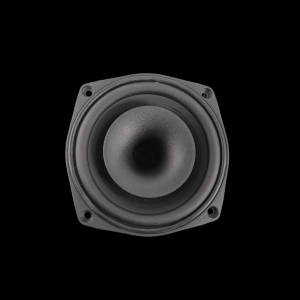

Description
Beyma PRO5CXND 5-Inch Neodymium High-Output Coaxial
If the mounting location is too small for a separate midrange and high-frequency driver, but the system still needs real output and controlled top end, the PRO5CXND solves that packaging problem in one 5-inch location.
The Beyma PRO5CXND is a professional coaxial with separate 8-ohm low/mid and high-frequency sections built into one compact neodymium assembly. Beyma’s detailed technical data lists 150 / 40 watts AES LF/HF, 300 / 80 watts program, 94 / 104 dB LF/HF sensitivity, a 200 Hz–20 kHz published system range and 5.5 mm LF Xmax.
The value here is not simply that two drivers fit in one basket. It is that one small mounting location can cover the midrange and high-frequency jobs without forcing us to put the high-frequency driver somewhere else and then fight the extra path-length and aiming problems that come with it.
The coaxial layout solves a real installation problem.
When the midrange and high-frequency driver are mounted far apart, the crossover region can become harder to integrate because the two sources are arriving from different physical locations.
The PRO5CXND keeps both sections on the same acoustic axis.
What that solves: a compact motorcycle pod, fairing, dash location or speaker panel can use one opening for a true two-way section instead of finding room for a separate mid and high-frequency driver.
That does not eliminate crossover and tuning work. It eliminates one of the biggest packaging problems.
The 200 Hz lower limit tells us exactly what this speaker is—and what it is not.
Beyma publishes the complete coaxial system from 200 Hz to 20 kHz.
That means the PRO5CXND is not the speaker we choose when a 5-inch location is expected to create real midbass. A larger midbass, woofer or subwoofer still needs to handle the frequencies below it.
The advantage is that we are not wasting the small cone trying to do a larger driver’s job. We can keep the PRO5CXND where its efficiency, controlled midrange and compact size actually make sense.
5.5 mm LF Xmax still gives the low/mid section useful mechanical headroom.
Beyma publishes 5.5 mm Xmax and 19 mm peak-to-peak excursion before damage for the low/mid section.
That gives the 5-inch cone useful controlled travel inside its intended range, but it does not change the basic system role. This is still a compact midrange/coaxial solution, not a deep midbass driver.
The crossover should be set around the actual installation and output target rather than simply chasing the lowest number the cone can survive.
The HF section is a real horn-controlled driver.
Beyma uses a dedicated high-frequency section with a 44.4 mm / 1.75-inch voice coil, polyester diaphragm and approximately 70-degree coverage.
That controlled coverage matters in motorcycles, Jeeps and other open-cabin systems because high frequencies need projection and direction if they are going to stay intelligible over wind and road noise.
The goal is not extra brightness for the sake of brightness. The goal is enough high-frequency output and control that detail does not disappear as soon as the vehicle starts moving.
150 / 40 watts AES means the two sections still need to be treated separately.
The low/mid section is rated at 150 watts AES / 300 watts program. The high-frequency section is rated at 40 watts AES / 80 watts program.
Those are separate section ratings. They should not be added together and treated like one conventional 190-watt coaxial input rating.
Beyma specifies the HF crossover at 2.5 kHz or higher with at least a 12 dB/octave slope. That protection is part of using the speaker correctly.
The coaxial frame combines the drivers physically. The crossover still divides the work electrically and acoustically.
The 8-ohm LF/HF architecture gives us useful multi-speaker wiring flexibility.
Both sections are nominally 8 ohms. Beyma’s detailed data lists minimum impedances of 6.7 ohms LF and 5.2 ohms HF.
That can be useful when multiple coaxials need to share amplifier channels. Two like 8-ohm sections can be paralleled into a 4-ohm nominal load while still leaving the system designer room to build the crossover and amplifier plan correctly.
The point is not to chase the lowest impedance possible. The amplifier channels, driver count and crossover architecture all need to work together.
The common neodymium motor keeps the package compact.
Beyma uses a common neodymium magnetic system for the coaxial assembly.
That helps keep the motor package and overall weight reasonable in a speaker that is doing two jobs from one small opening.
That matters in fairings, pods and fabricated panels where rear clearance and hanging mass can become a problem long before the speaker itself runs out of output.
The shorting cup addresses distortion before DSP ever gets involved.
Beyma specifies a shorting cup for reduced harmonic distortion in the motor design.
DSP can correct frequency response, level and timing. It cannot completely remove nonlinear distortion generated inside the driver itself.
Starting with a more controlled motor gives the final tune a better foundation.
PRO5CXND versus PRO6CXND.
PRO5CXND: choose it when the opening is the limiting factor. It gives us the coaxial two-way architecture in a 5-inch frame, but it needs the lower part of the system handled elsewhere.
PRO6CXND: choose it when the installation can take the larger 6.5-inch frame and we want more cone area, more low/mid power handling and substantially more lower-frequency reach from that speaker location.
The 5-inch is the packaging solution. The 6.5-inch is the stronger low/mid solution.
PRO5CXND versus a separate mid + high-frequency driver.
A separate component layout gives us more freedom to position and aim each driver independently.
The PRO5CXND makes more sense when the vehicle simply does not give us two good locations—or when keeping both sections together is the cleaner acoustic and fabrication choice.
That is why this style of coaxial works so well in compact motorcycle and powersports installations.
Where we would use it.
This is a strong fit for compact motorcycle fairings, powersports pods, tight dash locations and custom speaker panels where a separate midrange and high-frequency driver would consume too much space.
It can also make sense in repeated multi-speaker layouts where every location needs its own mid/high coverage and we want the sources physically aligned.
With the correct crossover and DSP, we can protect the LF section, set the LF/HF handoff, balance the two sections and control level, EQ and timing so the speaker stays clear and aggressive without becoming harsh.
The result: a compact 5-inch Beyma coaxial that gives one small mounting location a real professional midrange section and dedicated high-frequency driver without pretending the 5-inch cone is supposed to replace the system’s midbass.
Manufacturer Specifications
- Model: Beyma PRO5CXND
- Product type: Professional coaxial loudspeaker
- Sold as: Single coaxial speaker
- Nominal diameter: 5 inches
- LF / HF nominal impedance: 8 / 8 ohms
- LF / HF minimum impedance: 6.7 / 5.2 ohms
- LF / HF power handling: 150 / 40 watts AES
- LF / HF program power: 300 / 80 watts
- LF / HF sensitivity: 94 / 104 dB
- Published frequency range: 200 Hz–20 kHz
- LF Xmax: 5.5 mm
- Peak-to-peak excursion before damage: 19 mm
- HF voice-coil diameter: 44.4 mm / 1.75 inches
- HF crossover guidance: 2.5 kHz or higher
- Minimum HF crossover slope: 12 dB/octave
- HF coverage: approximately 70 degrees
- HF diaphragm: Polyester
- Spider: Conex
- Motor feature: Shorting cup for reduced harmonic distortion
- Motor: Common neodymium magnet system
Crossover / System Guidance
The PRO5CXND contains separate LF and HF sections in one coaxial frame. Beyma specifies the HF crossover at 2.5 kHz or higher with at least a 12 dB/octave slope. Final LF high-pass, LF/HF crossover implementation, amplifier configuration, level, limiting and DSP settings must still be selected around the actual installation and output target.
Where this fits in the build
These speakers have to work where wind, road noise, mounting space and exposure change the job. Match the driver to the actual location, output target, amplifier power and environment instead of treating it like a normal door-speaker replacement.