
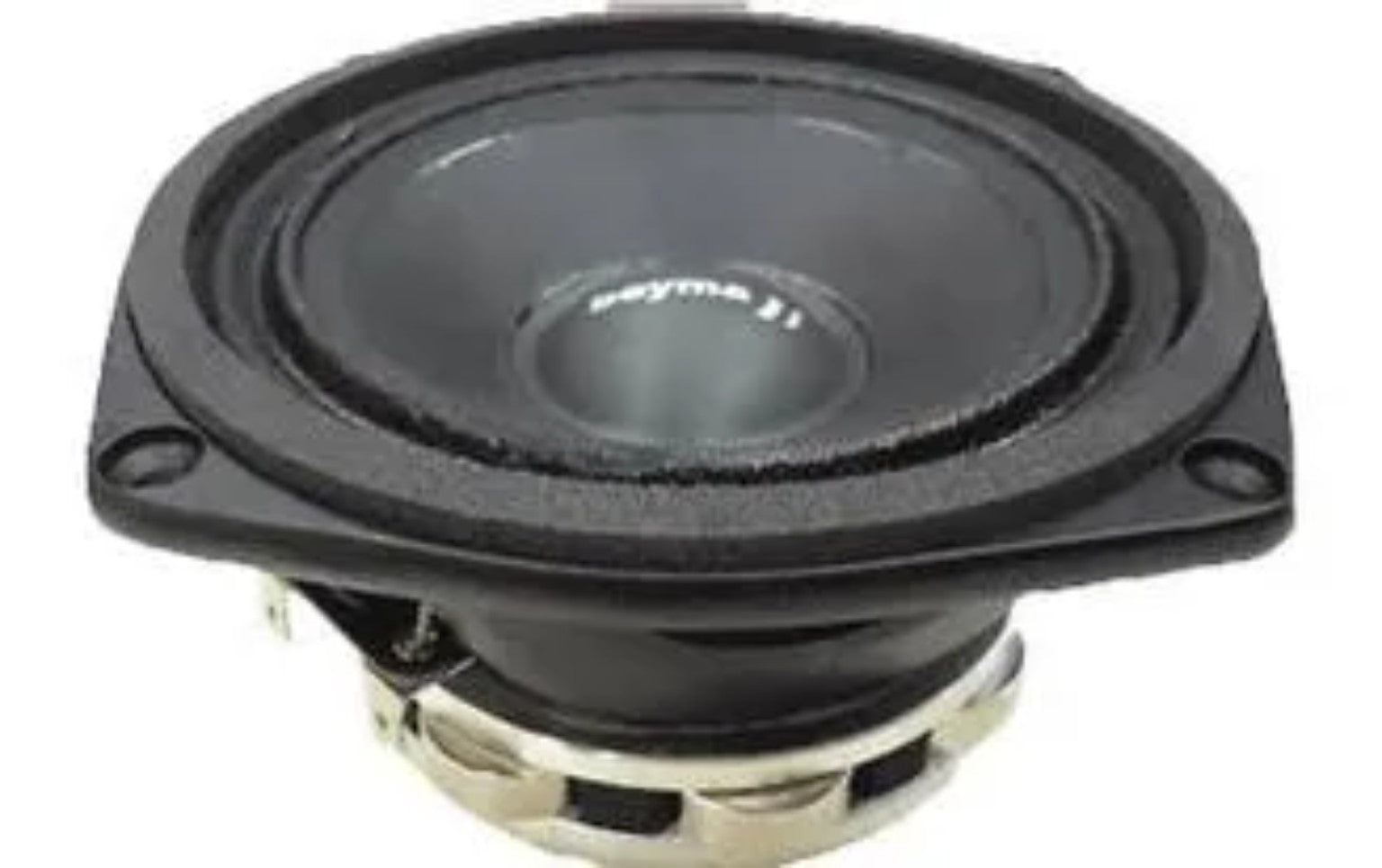

Description
Beyma PRO5Q200ND 5-Inch Neodymium Midbass / Midrange
If the build needs real cone movement and midbass impact from a 5-inch driver instead of a narrow vocal-only speaker, the PRO5Q200ND is the compact Beyma option built around excursion and lower-frequency capability.
The Beyma PRO5Q200ND is a 5-inch, 4-ohm neodymium midbass/midrange rated at 150 watts AES / 300 watts program, with 92 dB sensitivity, 4.5 mm Xmax and a published 75 Hz–8 kHz operating range.
That immediately separates it from the ultra-efficient small pro mids. The PRO5Q200ND gives up some sensitivity in exchange for much more excursion and a lower operating range, making it the better tool when the 5-inch location has to do more than just play vocals loudly.
4.5 mm Xmax is the number that changes the job.
Beyma publishes 4.5 mm Xmax for the PRO5Q200ND.
That is substantial linear excursion for a compact 5-inch pro-style driver.
What that solves: a small speaker can only produce meaningful midbass if the cone has room to move. A high-sensitivity vocal mid with 1 or 2 mm of excursion may get extremely loud in its intended band, but it will run out of mechanical travel much faster if you ask it to reach down into the lower midbass region.
The PRO5Q200ND is built to give the cone more room before that happens.
75 Hz–8 kHz gives the system a lot of crossover flexibility.
Beyma publishes the driver from 75 Hz to 8 kHz.
That means the 5-inch can potentially cover a large section of the music depending on how it is mounted and how hard it needs to play.
In a sealed pod or well-controlled door location, it can carry more lower-midrange and upper-midbass energy than a narrow-band 5-inch mid. Up top, 8 kHz of published extension gives plenty of room to choose a handoff to a dedicated tweeter or horn.
Important: the published range is not a universal crossover recommendation. A motorcycle fairing cavity, leaky door, tiny pod and sealed chamber will all change how low the driver should actually be used.
92 dB sensitivity is lower than the ultra-efficient mids—for a reason.
The PRO5Q200ND is rated at 92 dB sensitivity.
That is lower than something like the 6MND or other high-efficiency vocal mids, but sensitivity and excursion are always part of a tradeoff.
This driver is not trying to win a sensitivity contest. It is trying to provide more usable stroke and lower-frequency capability from a compact diameter.
If the system needs maximum vocal output from limited amplifier power, use the high-sensitivity mid. If the system needs the 5-inch speaker to carry real body and impact, the PRO5Q200ND makes more sense.
150 watts AES works because the speaker is designed to move.
Beyma rates it at 150 watts AES / 300 watts program.
That power rating combines with the 4.5 mm Xmax to give the driver useful mechanical and thermal capability for a compact midbass role.
Clean power still matters. A clipped 100-watt channel can damage a speaker faster than a clean, correctly set 150-watt channel. The DSP crossover and gain structure are part of keeping the driver inside its real operating limits.
The neodymium motor helps compact installations.
The PRO5Q200ND uses a neodymium motor.
That is especially useful in 5-inch locations because the whole reason to choose a driver this small is often packaging. A huge ferrite motor can defeat the point if the speaker is going into a tight pod, fairing, dash or custom enclosure.
Neo keeps motor bulk and weight under control while the driver still delivers useful magnetic force.
PRO5Q200ND versus a high-sensitivity 5- or 6-inch vocal mid.
High-sensitivity mid: choose it when the job is maximum vocal projection and efficiency above a higher crossover point.
PRO5Q200ND: choose it when the compact speaker needs more excursion and lower-frequency reach, even if that means giving up some sensitivity.
One is optimized around acoustic efficiency. The other is optimized around bandwidth and movement.
PRO5Q200ND versus PRO6Q200ND.
The 6.5-inch PRO6Q200ND gives you more cone area and typically more acoustic output through the lower range when there is room for the larger basket.
The 5-inch PRO5Q200ND exists for the system where that extra diameter simply does not fit.
Choose the 5-inch when packaging is the hard limit. Choose the 6.5-inch when the space is available and the system can use the extra cone area.
Where we would use the PRO5Q200ND.
This driver makes sense in custom motorcycle fairings, dash pods, compact Jeep or powersports speaker pods, custom door builds and three-way front stages where a small-format driver has to carry more than a narrow vocal band.
It can work above a dedicated lower midbass, but it is also capable enough to become the primary midbass/midrange in a compact system when the mounting volume and crossover support it.
With DSP, we would set the high-pass around the actual installation, choose the upper crossover based on the tweeter or horn above it, and manage level, EQ, phase and timing so the 5-inch integrates cleanly with the rest of the system.
The result: a compact Beyma driver that trades some headline sensitivity for the excursion and bandwidth needed to make a 5-inch speaker sound bigger than its diameter suggests.
Manufacturer Specifications
- Model: Beyma PRO5Q200ND
- Product type: 5-inch neodymium midbass / midrange
- Sold as: Single speaker
- Nominal diameter: 5 inches
- Nominal impedance: 4 ohms
- Power handling: 150 watts AES
- Program power: 300 watts
- Sensitivity: 92 dB, 1 W / 1 m
- Published frequency range: 75 Hz–8 kHz
- Xmax: 4.5 mm
- Motor: Neodymium
System Design Guidance
The published 75 Hz lower response is not a universal high-pass recommendation. Final crossover points, power, rear loading and DSP settings must be selected around the actual installation and output target.
Where this fits in the build
These speakers have to work where wind, road noise, mounting space and exposure change the job. Match the driver to the actual location, output target, amplifier power and environment instead of treating it like a normal door-speaker replacement.