
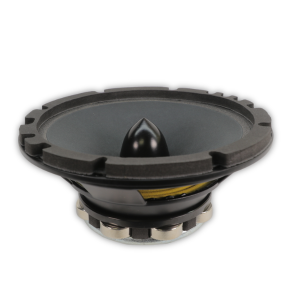

Description
Beyma PRO65ND 6.5-Inch Neodymium High-Efficiency Midrange
If you like what the PRO6MI does but the system needs even more acoustic output from the same 6.5-inch footprint, this is the one to look at.
The Beyma PRO65ND is a 6.5-inch, 4-ohm dedicated Competition-series midrange built around 100 dB sensitivity, a neodymium motor and strong motor control. It keeps the same basic 100-watt RMS / 200-watt maximum power class as the PRO6MI, but it does more with the power you give it.
That is the reason this speaker exists.
Two extra decibels of sensitivity is not a cosmetic spec.
Beyma publishes the PRO65ND at 100 dB sensitivity at 1 watt / 1 meter. The PRO6MI is rated at 98 dB.
That difference matters in a real high-output system because sensitivity is the starting point before amplifier power gets involved. A more efficient driver needs less power to reach the same acoustic level, which gives us more room to keep the midrange clean as the rest of the system gets louder.
What that solves: the vocal range can keep up with a strong bass section, multiple mids or an open-cabin environment without making the amplifier do all the work.
The stronger motor gives the cone more control.
Beyma publishes a BL factor of 8.2 N/A on the PRO65ND versus 6.5 N/A on the PRO6MI.
We are not putting that number on the page just to make the specification list longer. BL is part of the motor-force relationship that controls the moving assembly.
In practical terms, the PRO65ND is built around a stronger motor structure for this 6.5-inch midrange platform. That supports the efficiency and controlled midrange response the driver is designed to deliver.
This is still a dedicated midrange—not a small midbass just because it is 6.5 inches.
Beyma publishes a 150 Hz–8 kHz frequency range, but its Competition guidance recommends a 400 Hz minimum high-pass for the PRO65ND when it is being used as intended at high output.
The upper crossover is typically in the 5–6 kHz region, with at least a 12 dB/octave filter slope.
That is the same important lesson as the PRO6MI: published response tells us what the driver can reproduce. The recommended crossover tells us how Beyma expects it to be protected when we are actually asking it to get loud.
If the system needs bass or deep midbass from the same speaker, this is the wrong product. If it needs a very efficient vocal/midrange driver, that is exactly what the PRO65ND is for.
PRO65ND or PRO6MI?
These two speakers share the same nominal size, impedance, power rating and published frequency range, so the decision is not about which one “fits more frequencies.”
PRO6MI: the straightforward ferrite Competition midrange. 98 dB sensitivity, 100 watts RMS, proven dedicated-midrange role.
PRO65ND: the higher-efficiency neodymium option. 100 dB sensitivity and stronger published motor force in the same general 6.5-inch midrange job.
If the system has enough amplifier power and the PRO6MI already meets the output target, it remains a solid choice. If every decibel of efficiency matters—motorcycles, Jeeps, powersports, large multi-driver doors or a system that has to stay aggressive without adding unnecessary amplifier load—the PRO65ND earns the upgrade.
Where we would use it.
This is a strong dedicated midrange for custom doors, dash or pod fabrication where a 6.5-inch driver is being asked to carry vocals and instruments at high level.
It also makes sense in motorcycle and powersports systems where amplifier space and electrical capacity are limited. When the speaker itself is efficient, we do not have to solve every output problem with a larger amplifier.
In a Jeep or other open-cabin build, the 100 dB sensitivity helps the midrange stay present when road and wind noise start eating away at apparent volume.
And in multi-driver panels, the efficiency adds up quickly when several PRO65NDs are working together.
How we would build the system around it.
The PRO65ND should normally live between a dedicated low-frequency driver and a tweeter.
Below it, a real midbass, woofer or subwoofer handles the frequencies that demand excursion. Above it, a tweeter handles the top end. The PRO65ND stays in the middle where its efficiency and motor control actually matter.
With DSP, we can set the crossover accurately, level-match the driver to the rest of the system, correct response and control timing so the high-output midrange still integrates into one coherent front stage.
The result: a compact 6.5-inch dedicated midrange that gives us more output per watt than the PRO6MI while keeping the same 100-watt RMS power class and the same focused midrange job.
Manufacturer Specifications
- Model: Beyma PRO65ND
- Product type: Dedicated midrange loudspeaker
- Series: Competition
- Sold as: Single speaker
- Nominal diameter: 165 mm / 6.5 inches
- Nominal impedance: 4 ohms
- Power handling: 100 watts RMS
- Maximum power: 200 watts
- Sensitivity: 100 dB, 1 W / 1 m
- Published frequency range: 150 Hz–8 kHz
- Voice-coil diameter: 38.5 mm / 1.5 inches
- BL factor: 8.2 N/A
- Moving mass: 0.007 kg
- Resonant frequency (Fs): 215 Hz
- DC resistance (Re): 3.5 ohms
- Qms: 8.0
- Qes: 0.51
- Qts: 0.48
- Equivalent compliance volume (Vas): 2.1 L
- Reference efficiency: 4%
- Effective cone area (Sd): 140 cm²
- Voice-coil inductance (Le @ 1 kHz): 0.4 mH
- Motor: Neodymium
Beyma Crossover Guidance
- Minimum recommended high-pass: 400 Hz
- Recommended upper low-pass region: 5–6 kHz
- Minimum recommended filter slope: 12 dB/octave
Installation note: Final crossover, level, EQ and amplifier settings still depend on the installation and the drivers used above and below the PRO65ND.
Where this fits in the build
These speakers have to work where wind, road noise, mounting space and exposure change the job. Match the driver to the actual location, output target, amplifier power and environment instead of treating it like a normal door-speaker replacement.