
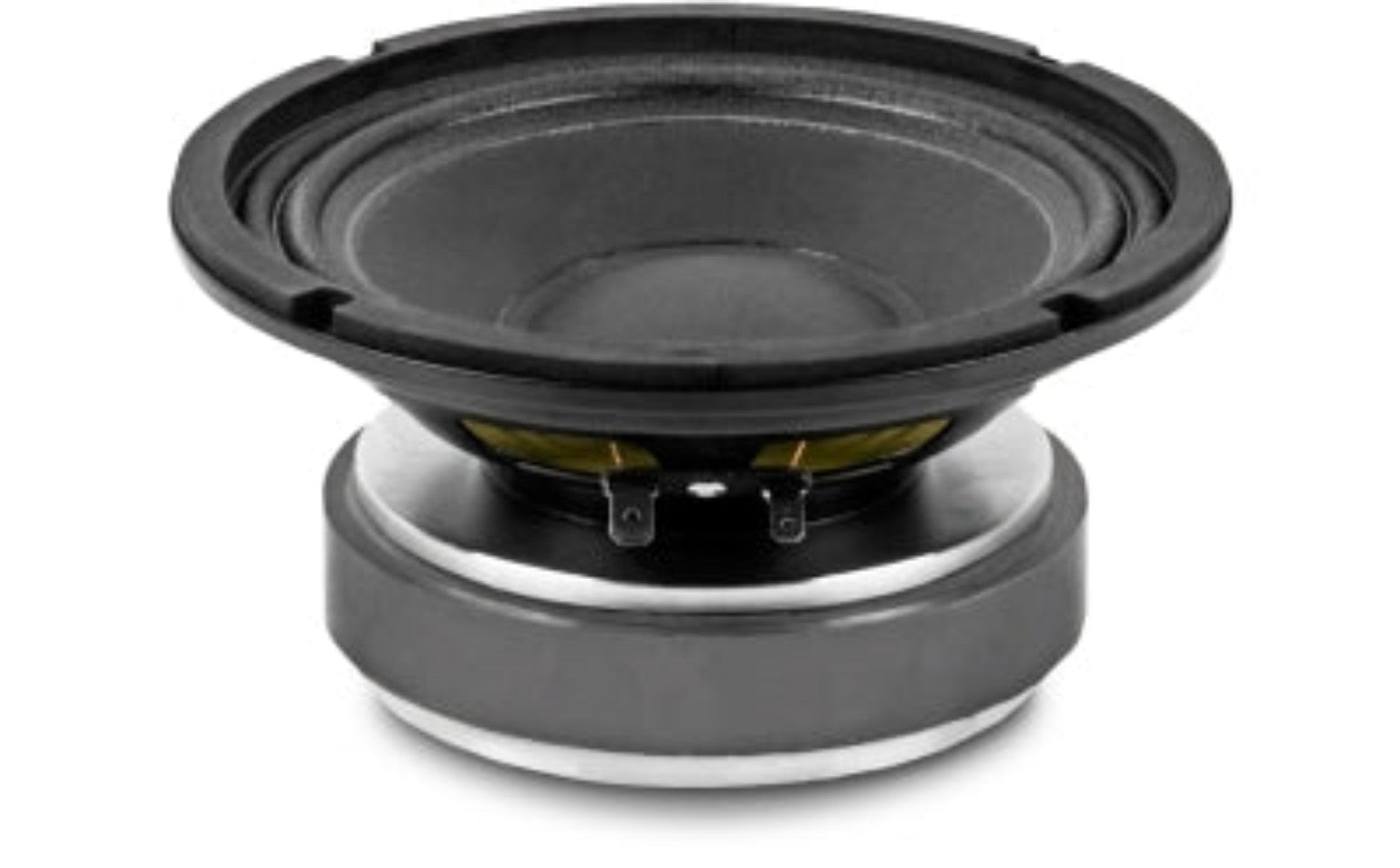

Description
Beyma PRO6BK 6.5-Inch High-Power Midrange
Not every high-output 6.5-inch needs to be crossed at 400 Hz and used strictly for vocals.
The Beyma PRO6BK is for the build that needs a 6.5-inch driver to carry more of the lower midrange while still having enough top-end extension to work as a serious midrange section. Beyma gives it 220 watts AES power handling, 94 dB sensitivity and a published 95 Hz–8 kHz range, then recommends a defined rear volume instead of treating the back of the speaker as an afterthought.
That makes the PRO6BK a very different buying decision from the PRO6MI or PRO65ND.
PRO6BK is about usable bandwidth and power—not maximum sensitivity.
The PRO6MI and PRO65ND are the efficiency specialists. They make a lot of output in the dedicated midrange and are happiest when a separate midbass driver is already doing the work below them.
The PRO6BK trades some of that raw sensitivity for more power handling and substantially more low-frequency reach. At 94 dB sensitivity it is still an efficient professional-style driver, but its published 95 Hz lower range gives the system designer more room to bring the midrange section down toward the midbass region.
What that solves: when packaging will not allow a separate large midbass driver directly below the 6.5, the PRO6BK gives us a broader operating window to work with instead of forcing a narrow-band vocal driver to do a job it was never designed for.
220 watts AES gives us real thermal headroom.
Beyma rates the PRO6BK at 220 watts AES / 440 watts program. That is more than double the published continuous power of the PRO6MI and PRO65ND.
That extra thermal capacity matters when the driver is carrying a broader section of the system and doing it for long periods. Lower midrange takes more cone movement and more amplifier energy than a narrowly filtered vocal driver.
The PRO6BK uses a 38.1 mm / 1.5-inch voice coil with a 14 mm winding in a 6 mm magnetic gap. Beyma also publishes a 9.4 N/A BL factor, giving the motor useful control over the moving assembly.
The practical point is simple: this is not a lightweight little factory-replacement speaker. It is built to take real power when the system is designed around it correctly.
The 9-liter rear volume is part of the design.
Beyma publishes a 9-liter / 0.32 cu. ft. recommended enclosure volume for the PRO6BK.
That is important because a speaker does not operate independently of whatever is behind the cone. A custom door pod, sealed chamber or speaker panel changes the loading on the driver and therefore changes how it behaves through the lower part of its range.
If we want to take advantage of the PRO6BK’s broader bandwidth, we need to give the back of the speaker a controlled environment rather than mounting it into a random cavity and expecting the spec sheet to reproduce itself.
This is where fabrication becomes part of the sound. The correct rear volume, a rigid baffle and proper sealing let the driver use the bandwidth Beyma engineered into it.
95 Hz on the sheet does not mean “run it full range and forget the crossover.”
The PRO6BK’s published frequency range is 95 Hz–8 kHz. That gives us more flexibility than the MI-series dedicated midranges, but it still does not remove the need for crossover protection.
The actual high-pass point depends on the enclosure, how hard the system needs to play and what driver is handling bass below it. If maximum output is the goal, we generally protect the speaker higher than the absolute bottom of its published response so we are not burning excursion on frequencies another driver can reproduce more efficiently.
The same logic applies at the top end. If a dedicated tweeter is in the system, we do not need to make the PRO6BK carry every last octave simply because it can reproduce upper-midrange information.
The goal is not maximum bandwidth on paper. It is maximum usable output in the finished system.
PRO6BK versus PRO6MI and PRO65ND.
PRO6MI: 98 dB sensitivity, 100 watts RMS and a dedicated vocal/midrange role. Choose it when efficiency matters and another driver is handling the lower range.
PRO65ND: 100 dB sensitivity with a neodymium motor. Choose it when output per watt and compact high-efficiency midrange performance are the priority.
PRO6BK: 220 watts AES, 94 dB sensitivity, broader published low-frequency reach and a specified 9-liter rear volume. Choose it when the 6.5-inch driver needs to carry more lower-midrange energy and accept substantially more continuous power.
None of those is automatically “better.” They are built around different system problems.
Where we would use the PRO6BK.
This makes sense in custom doors, motorcycle speaker pods, powersports enclosures and speaker panels where we want a high-output 6.5-inch to cover a broader band than a dedicated vocal driver.
It is especially useful when space limits how many different driver sizes we can install. A properly chambered PRO6BK can give us useful lower-midrange body while still reaching high enough to integrate cleanly with a tweeter.
With DSP, we can then choose the crossover points around the actual installation, control level and EQ, and time-align the driver so the broader bandwidth does not turn into a broad mess.
The result: a 6.5-inch high-power midrange that gives up some of the extreme efficiency of Beyma’s MI/ND competition mids in exchange for more power capacity, more lower-midrange reach and more flexibility when one speaker has to do a larger share of the system.
Manufacturer Specifications
- Model: Beyma PRO6BK
- Product type: High-power midrange loudspeaker
- Sold as: Single speaker
- Nominal diameter: 165 mm / 6.5 inches
- Nominal impedance: 4 ohms
- Power handling: 220 watts AES
- Program power: 440 watts
- Sensitivity: 94 dB, 1 W / 1 m
- Published frequency range: 95 Hz–8 kHz
- Recommended enclosure volume: 9 liters / 0.32 cu. ft.
- Voice-coil diameter: 38.1 mm / 1.5 inches
- BL factor: 9.4 N/A
- Moving mass: 0.013 kg
- Voice-coil winding length: 14 mm
- Air-gap height: 6 mm
- Maximum mechanical excursion before damage (peak-to-peak): 30 mm
- Motor: Ferrite
System Design Guidance
The published 95 Hz lower response is not a universal crossover recommendation. Final high-pass and low-pass settings must be chosen around the actual rear volume, required output, amplifier power and the drivers used above and below the PRO6BK.
Where this fits in the build
These speakers have to work where wind, road noise, mounting space and exposure change the job. Match the driver to the actual location, output target, amplifier power and environment instead of treating it like a normal door-speaker replacement.