


Description
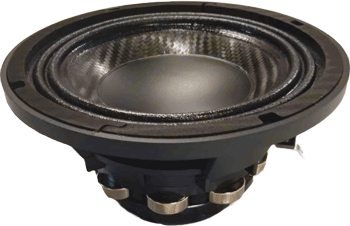
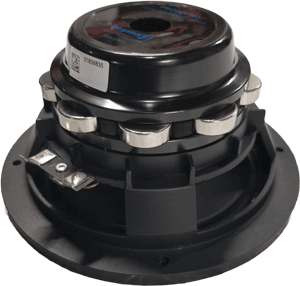
Beyma PRO6CF/ND 6.5-Inch Neodymium Carbon-Fiber Extended-Range Speaker
If the system needs one 6.5-inch driver to reach lower than a dedicated midrange, stay useful much higher than a conventional midbass, and still work cleanly in a multi-driver layout, the PRO6CF/ND is built around that exact problem.
The Beyma PRO6CF/ND is a 6.5-inch, 8-ohm neodymium extended-range driver rated at 200 watts AES / 400 watts program, with 93 dB sensitivity, a published 95 Hz–11.2 kHz range, a 2-inch voice coil and 6 mm Xmax.
That is a very unusual combination in a 6.5-inch speaker: real cone travel for upper-bass and lower-midrange work, but enough upper extension to stay useful deep into the vocal and instrumental range.
Six millimeters of Xmax is what separates this from Beyma's efficiency-first mids.
Beyma publishes 6 mm Xmax for the PRO6CF/ND.
That is substantially more linear travel than the 6MND, 6GMND or PRO65ND.
What that solves: the 6.5-inch driver can contribute meaningful upper-bass and lower-midrange body instead of handing everything below the vocals to another speaker.
That can simplify a compact motorcycle, powersports or custom-door system where there simply is not room for a separate large midbass driver.
The 95 Hz–11.2 kHz range is what makes this an extended-range driver.
Beyma publishes the PRO6CF/ND from 95 Hz to 11.2 kHz.
That does not mean we run it full range with no crossover. It means the system designer has a much wider window to work with than a conventional dedicated midbass or narrow-band midrange.
In a two-way system, the PRO6CF/ND can carry a large part of the low/mid band before handing off to a capable tweeter or compression driver.
In a three-way system, we can narrow its job and take advantage of the excursion as a powerful low/mid driver while another speaker handles the upper mids.
The advantage is flexibility. The driver gives us enough range to design around the vehicle instead of forcing the vehicle around one narrow speaker band.
The carbon-fiber cone matters because this speaker has to move and stay controlled.
The PRO6CF/ND uses a carbon-fiber cone.
That matters more here than it would on a short-travel vocal-only midrange. The cone has to stay rigid while moving farther through upper-bass and lower-midrange frequencies, then remain controlled as it continues up through the vocal range.
Carbon fiber gives the diaphragm the stiffness needed to resist flex as power and excursion rise.
The practical result: the same cone can do real mechanical work lower in the band without becoming sloppy through the mids.
200 watts AES / 400 watts program gives the extended bandwidth real thermal headroom.
Beyma rates the PRO6CF/ND at 200 watts AES / 400 watts program and uses a 2-inch voice coil.
That gives the driver substantially more thermal capacity than Beyma's smaller 100-watt efficiency-first midranges.
That extra capacity makes sense because the speaker is being asked to reproduce more lower-frequency energy, which demands more cone movement and amplifier power.
The power rating still does not replace crossover protection. The farther down we ask the speaker to play, the more the actual enclosure and excursion become part of the limit.
93 dB sensitivity is the tradeoff for the extra excursion and bandwidth.
The PRO6CF/ND is published at 93 dB sensitivity.
That is lower than the 95–100 dB numbers of Beyma's efficiency-focused 6.5-inch mids.
That is not an accident. The PRO6CF/ND is spending more of its design on excursion and broad usable bandwidth.
If the customer already has a dedicated midbass and only needs maximum vocal output per watt, a PRO65ND or 6MND makes more sense.
If the customer needs the 6.5-inch itself to cover more of the system, the PRO6CF/ND earns the tradeoff.
The 8-ohm load can be a system advantage.
The PRO6CF/ND is the 8-ohm version.
That higher individual impedance can be useful when multiple speakers need to share an amplifier channel. Two 8-ohm drivers wired in parallel create a 4-ohm final load.
What that solves: a dual-driver door, motorcycle bag or speaker panel can add cone area without automatically dropping the amplifier into an unnecessarily low impedance.
The right impedance is the one that fits the driver count and amplifier plan—not simply the lowest number available.
Neodymium keeps the broader-capability driver from becoming unnecessarily heavy.
The PRO6CF/ND uses a neodymium motor, and exact-model data lists the driver at about 4.2 lb.
That matters in motorcycles, removable panels and custom doors because driver weight adds up quickly when several speakers are installed.
The published overall depth is about 96 mm / 3.8 inches, so packaging still needs to be confirmed before fabrication, but the neo motor helps keep the magnetic structure lighter than a comparable large ferrite assembly.
PRO6CF/ND versus PRO6Q200ND.
PRO6Q200ND: 4 ohms, 200 watts AES, 92 dB sensitivity, 60 Hz–6 kHz and 5.5 mm Xmax. Choose it when deeper midbass reach is more important than upper-range extension.
PRO6CF/ND: 8 ohms, 200 watts AES, 93 dB sensitivity, 95 Hz–11.2 kHz and 6 mm Xmax. Choose it when the system needs a much wider upper range while still keeping real cone travel.
The Q200ND leans lower. The CF/ND reaches much higher.
PRO6CF/ND versus 6GMND.
6GMND: 95 dB sensitivity, 100 watts RMS, 90 Hz–12 kHz and 2.5 mm Xmax. Choose it when efficiency and broad midrange coverage matter more than excursion.
PRO6CF/ND: more power handling and more than twice the published Xmax, with slightly lower sensitivity. Choose it when the speaker needs to do more mechanical work through the lower part of the band.
Both can cover a wide range. The PRO6CF/ND is the more physically capable low/mid platform.
Where we would use it.
This makes sense in motorcycle fairings and bags, powersports pods, Jeep and open-cabin systems, custom doors and other builds where a 6.5-inch driver has to cover more of the music than a narrow dedicated midrange.
It is especially useful when packaging limits driver count. One PRO6CF/ND can contribute real lower-midrange and upper-bass energy while still reaching high enough to make the crossover to the top-end driver practical.
With DSP, we can set the high-pass around the actual rear chamber, choose the upper handoff around the tweeter or compression driver, then control EQ, level, phase and timing so the extended bandwidth sounds coherent instead of stretched.
The result: a carbon-fiber 6.5-inch Beyma with real excursion, serious power handling, wide upper extension and an 8-ohm load that can make multi-driver system wiring easier to manage.
Manufacturer Specifications
- Model: Beyma PRO6CF/ND
- Product type: Extended-range low/mid loudspeaker
- Sold as: Single speaker
- Nominal diameter: 165 mm / 6.5 inches
- Nominal impedance: 8 ohms
- Power handling: 200 watts AES
- Program power: 400 watts
- Sensitivity: 93 dB, 1 W / 1 m
- Published frequency range: 95 Hz–11.2 kHz
- Voice-coil diameter: 50.8 mm / 2 inches
- Voice-coil winding length: 14 mm
- Air-gap height: 7 mm
- BL factor: 11.1 N/A
- Xmax: 6 mm
- Peak-to-peak excursion before damage: 20 mm
- Overall diameter: 174 mm / 6.8 inches
- Cutout diameter: 145 mm / 5.7 inches
- Mounting depth: 96 mm / 3.8 inches
- Net weight: approximately 1.9 kg / 4.2 lb.
- Basket: Die-cast aluminum
- Cone: Carbon fiber
- Surround: Treated cloth
- Dust cap: Inverted
- Metal parts: Marine treated
- Motor: Neodymium
System Design Guidance
The published 95 Hz lower response is not a universal high-pass recommendation. Final rear loading, crossover points, amplifier power and DSP settings must be selected around the actual installation and the drivers used above and below the PRO6CF/ND.
Where this fits in the build
These speakers have to work where wind, road noise, mounting space and exposure change the job. Match the driver to the actual location, output target, amplifier power and environment instead of treating it like a normal door-speaker replacement.