


Description
Beyma PRO6FX240ND 6.5-Inch Carbon-Fiber Neodymium Coaxial
If the system only gives us one 6.5-inch location but we still want real midbass movement, strong vocals and a dedicated high-frequency section from the same acoustic center, the PRO6FX240ND is built around that problem.
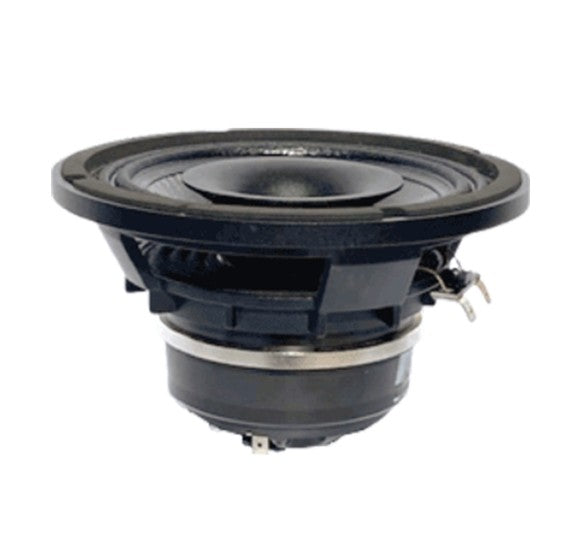
The Beyma PRO6FX240ND is an 8-ohm professional coaxial with a carbon-fiber low/mid cone and a dedicated horn-loaded high-frequency section sharing one compact neodymium motor architecture. Beyma publishes 200 / 40 watts AES LF/HF, 400 / 80 watts program, 94 / 103 dB sensitivity, a 100 Hz–20 kHz overall range and 5.5 mm LF Xmax.
That means this is not a basic full-range 6.5 with a tweeter stuck in the middle. It is a real two-way system built into one basket.
The reason to buy this coaxial is not convenience alone.
Putting the low/mid and high-frequency sections on the same axis gives us a much cleaner starting point when the vehicle does not give us separate, useful locations for a mid and tweeter.
What that solves: instead of mounting a tweeter several inches—or several feet—away from the 6.5 and then trying to make two physically separated sources behave like one speaker, the PRO6FX240ND keeps both sections originating from the same location.
That is especially useful in motorcycle bags, fairings, powersports pods and compact speaker panels where every extra cutout becomes another fabrication problem.
The carbon-fiber cone matters because this 6.5 is expected to move.
The PRO6FX240ND uses a carbon-fiber low/mid cone.
Carbon fiber gives the diaphragm high stiffness without requiring a heavy cone. That matters when the driver has to reproduce lower-midrange and upper-bass energy with 5.5 mm of published Xmax, then remain controlled as it moves up through the vocal range.
The practical result: the cone can do real mechanical work without giving up the rigidity we want when output rises.
5.5 mm Xmax means the low/mid section is doing more than vocals.
Beyma publishes 5.5 mm Xmax for the low-frequency section, with 26 mm peak-to-peak excursion before damage.
That is enough travel to give the 6.5 useful punch and lower-midrange body when it is loaded and filtered correctly.
It is still not a subwoofer, and the published 100 Hz lower range is not a universal high-pass setting. But compared with a short-travel vocal-only midrange, the PRO6FX240ND has much more mechanical capability to fill the region between the bass section and the vocals.
The HF section is a real horn-loaded driver.
Beyma uses a dedicated high-frequency section with a 1.75-inch voice coil, PM-4 diaphragm and approximately 70-degree conical coverage.
That controlled coverage matters in open-cabin systems because high frequencies have to project into the listening area instead of simply spraying energy everywhere.
On a motorcycle, Jeep or powersports build, that can be the difference between hearing cymbals and detail clearly at speed and just turning the treble up until the system becomes harsh.
200 / 40 watts AES means the LF and HF sections still need to be treated separately.
The low/mid section is rated at 200 watts AES / 400 watts program. The high-frequency section is rated at 40 watts AES / 80 watts program.
Those numbers are not one combined 240-watt input rating. The two sections are separate transducers sharing one coaxial frame.
Beyma publishes a recommended HF crossover around 2.5 kHz or higher at 12 dB/octave. That frequency division is part of making the product work correctly.
The coaxial basket solves the mounting problem. The crossover still solves the frequency problem.
The common neodymium motor keeps the package lighter and aligned.
The PRO6FX240ND uses a common neodymium magnetic system for the LF and HF sections.
That helps Beyma package both drivers into one 6.5-inch assembly without hanging a large ferrite structure behind the panel.
It also keeps the two sections physically centered around the same axis, which is exactly what we want from a coaxial when consistency through the crossover region matters.
The shorting copper pad is there to reduce distortion before DSP ever gets involved.
Beyma lists a shorting copper pad in the motor structure to reduce harmonic distortion and help linearize impedance.
That is worth explaining because DSP can correct frequency response, level and timing, but it cannot completely undo distortion generated inside the loudspeaker motor itself.
Starting with a cleaner driver gives the final tune a better foundation.
PRO6FX240ND versus PRO6CXND.
PRO6CXND: 200 / 40 watts AES, 95 / 104 dB sensitivity and an 82 Hz–20 kHz published range. Choose it when the standard Beyma neo coaxial platform and its slightly higher published sensitivity fit the goal.
PRO6FX240ND: 200 / 40 watts AES, 94 / 103 dB sensitivity, 100 Hz–20 kHz and 5.5 mm LF Xmax, with the carbon-fiber cone and FX-series construction. Choose it when cone rigidity and the carbon-fiber platform are part of the design priority.
The CXND is slightly more efficient on paper and reaches lower in its published response. The FX240ND gives us the carbon-fiber cone architecture. That is a real system choice—not a cosmetic upgrade.
PRO6FX240ND versus a separate mid + tweeter.
A separate component system still gives us more freedom to position and aim the tweeter independently from the 6.5.
The PRO6FX240ND makes more sense when we do not have that space—or when keeping both sources in one location is actually the cleaner acoustic and fabrication solution.
That is why this type of coaxial is so useful in motorcycle and powersports systems. It gives us real two-way output without requiring two separate mounting locations.
Where we would use it.
This is a strong choice for motorcycle saddlebags and fairings, powersports pods, Jeep and open-cabin systems, and custom speaker panels where one 6.5-inch location needs to cover the low/mid and high-frequency jobs at serious output.
It also makes sense in repeated multi-speaker layouts where every speaker position needs consistent two-way coverage.
With DSP or a correctly designed crossover network, we can protect the low/mid section, set the LF/HF handoff correctly, balance the two sections and control EQ and timing so the speaker stays aggressive without becoming sharp or disconnected.
The result: a carbon-fiber 6.5-inch Beyma coaxial that combines real low/mid excursion, a horn-loaded high-frequency section and a compact shared-neodymium architecture for high-output systems where one speaker location has to do a lot of work.
Manufacturer Specifications
- Model: Beyma PRO6FX240ND
- Product type: Professional carbon-fiber coaxial loudspeaker
- Sold as: Single coaxial speaker
- Nominal diameter: 165 mm / 6.5 inches
- Nominal impedance: 8 ohms
- LF / HF power handling: 200 / 40 watts AES
- LF / HF program power: 400 / 80 watts
- LF / HF sensitivity: 94 / 103 dB
- Published frequency range: 100 Hz–20 kHz
- LF / HF voice-coil diameters: 50.8 / 44.4 mm — 2 / 1.75 inches
- LF voice-coil length: 14 mm
- LF air-gap height: 7 mm
- LF Xmax: 5.5 mm
- Peak-to-peak excursion before damage: 26 mm
- BL factor: 9.1 N/A
- Recommended HF crossover: 2.5 kHz or higher at 12 dB/octave
- HF coverage: 70° conical
- Resonant frequency (Fs): 100 Hz
- DC resistance (Re): 4.6 ohms
- Voice-coil inductance (Le): 0.24 mH
- Qms: 3.5
- Qes: 0.56
- Qts: 0.48
- Equivalent compliance volume (Vas): 4 L / 0.14 cu. ft.
- Moving mass (Mms): 15 g
- Effective cone area (Sd): 0.0135 m²
- Reference efficiency: 0.83%
- Displacement volume (Vd): 74 cm³
- Overall diameter: 174 mm / 6.9 inches
- Bolt-circle diameter: 158 mm / 6.2 inches
- Baffle cutout: 145.1 mm / 5.71 inches
- Mounting holes: 4
- Driver displacement: 0.55 L / 0.02 cu. ft.
- Overall depth: 103.1 mm / 4.0 inches
- Net weight: 1.9 kg / 4.2 lb.
- Shipping weight: 2.1 kg / 4.6 lb.
- Basket: Die-cast aluminum
- LF cone: Carbon fiber
- LF surround: Two-roll treated cloth
- LF voice coil: Aluminum
- LF spider: Conex
- HF diaphragm: PM-4
- HF voice coil: Edgewound aluminum ribbon
- HF former: Kapton
- Motor: Neodymium
Crossover / System Guidance
The PRO6FX240ND contains separate LF and HF sections in one coaxial frame. Beyma specifies the HF crossover at 2.5 kHz or higher with a 12 dB/octave slope. Final LF high-pass, LF/HF crossover implementation, amplifier configuration, level, limiting and DSP settings must still be selected around the actual installation and output target.
Where this fits in the build
These speakers have to work where wind, road noise, mounting space and exposure change the job. Match the driver to the actual location, output target, amplifier power and environment instead of treating it like a normal door-speaker replacement.