

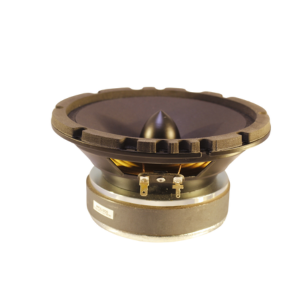


Description
Beyma PRO6MI 6.5-Inch High-Efficiency Midrange
If the system needs vocals and instruments to stay clear when the volume gets serious, a conventional 6.5-inch door speaker can become the limiting factor fast.
The Beyma PRO6MI was built for a different job. This is a dedicated 6.5-inch, 4-ohm midrange from Beyma’s Competition line, designed around high sensitivity, strong power handling and very high midrange output. It is not trying to be a full-range door speaker and it is definitely not trying to be a little subwoofer.
That distinction is the reason this speaker works.
It looks like a woofer. Do not use it like one.
Beyma specifically developed the PRO6MI for mid-frequency reproduction. The published response extends from 150 Hz to 8 kHz, but that does not mean the speaker should be asked to carry bass at high output just because the cone will physically move there.
For a real high-output system, we want the PRO6MI doing the part of the spectrum it was built for: the body of vocals, guitars, drums and the midrange information that makes the system sound alive instead of just loud.
Then we let a proper midbass driver, woofer or subwoofer handle the lower frequencies.
What that solves: instead of forcing one 6.5-inch speaker to reproduce everything from bass through vocals and watching it lose control as volume rises, we divide the work. The PRO6MI gets to stay efficient and clean in the range where it is strongest.
98 dB sensitivity is the real reason this thing gets attention.
Beyma publishes the PRO6MI at 98 dB sensitivity at 1 watt / 1 meter. That is a very different efficiency level from a typical conventional car-audio door speaker.
High sensitivity means we do not need absurd amplifier power just to make the midrange keep up with the rest of a high-output system. The speaker turns available power into usable acoustic output efficiently, which matters in motorcycle systems, Jeep builds, multi-driver doors and other installations where we need the midrange to stay present over road noise, open cabins or a strong bass section.
That does not mean “more power never hurts it.” It means the driver is efficient enough that the system does not have to rely on brute-force wattage to create output.
100 watts RMS means something different when the speaker is used in the correct band.
Beyma rates the PRO6MI at 100 watts RMS / 200 watts maximum. The important part is the crossover.
If somebody looks at the 6.5-inch frame and runs it like a woofer, the power rating stops telling the whole story. Low-frequency excursion can damage a dedicated midrange long before an amplifier reaches some impressive-looking wattage number.
Beyma’s Competition guidance recommends a 400 Hz minimum high-pass for the PRO6MI, with a 5–6 kHz maximum low-pass and at least a 12 dB/octave filter slope. That keeps the driver inside the operating range it was designed to reproduce at high level.
This is one of those speakers where proper filtering is part of the product. The crossover is not an optional tuning trick we add later. It is what lets the PRO6MI do what makes it special.
Where we would actually use the PRO6MI.
This makes sense when a normal full-range 6.5-inch is not enough and the system already has—or is being designed around—separate low-frequency and high-frequency drivers.
In a custom door or speaker pod, the PRO6MI can be the dedicated vocal/midrange section between a larger midbass driver and a tweeter. In a motorcycle or powersports build, its efficiency makes sense when the system has to fight wind and road noise without throwing huge amplifier power at every speaker. In a Jeep or open-cabin system, it gives us the kind of midrange projection that does not disappear as soon as the vehicle is moving.
It also works well in multi-driver high-output doors where several identical midranges are being used to create more cone area and output through the vocal range.
The common thread: this is not the speaker we pick because it happens to fit a 6.5-inch hole. We pick it because the system specifically needs a dedicated high-efficiency midrange.
PRO6MI versus a conventional 6.5-inch coaxial.
If the customer wants one speaker to cover most of the audible range from a factory door location with minimal additional processing, the PRO6MI is probably the wrong answer. A good coaxial or conventional component midbass is easier to integrate for that job.
If the customer wants high output, strong vocal presence and a driver that can keep up with a serious multi-way system, that is where the PRO6MI makes sense.
The tradeoff is intentional: it gives up low-frequency duty so it can be much better at the part of the spectrum it was designed to reproduce.
How we would build the system around it.
We would normally pair the PRO6MI with a dedicated tweeter above it and a midbass, woofer or subwoofer below it. With DSP, we can set the high-pass and low-pass precisely, level-match the driver to the rest of the system, correct response at the listening position and control timing so the midrange does not sound like it is coming from a separate speaker location.
That is especially important in custom doors and motorcycle systems because loud is easy. Loud and balanced takes system design.
The result: a 6.5-inch midrange that can project vocals and instruments with real authority without asking the speaker to waste excursion trying to reproduce bass it was never designed to make.
Manufacturer Specifications
- Model: Beyma PRO6MI
- Product type: Dedicated midrange loudspeaker
- Series: Competition
- Sold as: Single speaker
- Nominal diameter: 165 mm / 6.5 inches
- Nominal impedance: 4 ohms
- Power handling: 100 watts RMS
- Maximum power: 200 watts
- Sensitivity: 98 dB, 1 W / 1 m
- Published frequency range: 150 Hz–8 kHz
- Voice-coil diameter: 38.5 mm / 1.5 inches
- BL factor: 6.5 N/A
- Moving mass: 0.007 kg
- Resonant frequency (Fs): 215 Hz
- DC resistance (Re): 3.5 ohms
- Qms: 8.10
- Qes: 0.81
- Qts: 0.74
- Equivalent compliance volume (Vas): 2.1 L
- Reference efficiency: 2.5%
- Effective cone area (Sd): 140 cm²
- Voice-coil inductance (Le @ 1 kHz): 0.35 mH
Beyma Crossover Guidance
- Minimum recommended high-pass: 400 Hz
- Recommended upper low-pass region: 5–6 kHz
- Minimum recommended filter slope: 12 dB/octave
Installation note: Final crossover, level and EQ settings still depend on the installation, listening target and the drivers being used above and below the PRO6MI.
Where this fits in the build
These speakers have to work where wind, road noise, mounting space and exposure change the job. Match the driver to the actual location, output target, amplifier power and environment instead of treating it like a normal door-speaker replacement.