

Description
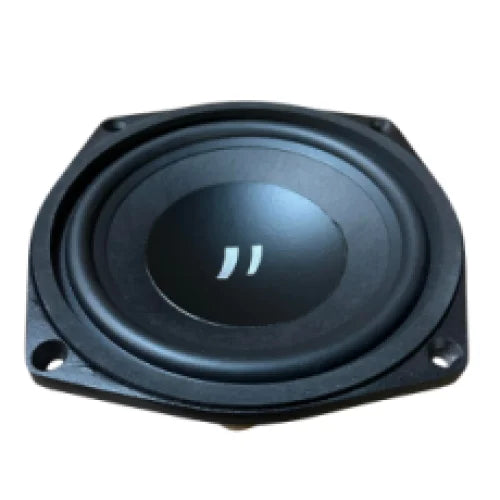
Beyma PRO6Q200ND 6.5-Inch Neodymium Midbass/Midrange
Sold individually — price is for one speaker.
If the system only has room for a 6.5-inch driver but still needs real midbass—not just loud vocals—the PRO6Q200ND is built around that problem.
The Beyma PRO6Q200ND is a compact 4-ohm low/mid-frequency driver with a lightweight neodymium motor, 2-inch voice coil and 5.5 mm Xmax. It handles 200 watts AES / 400 watts program and carries a published response from 60 Hz to 6 kHz.
That makes it a very different speaker from Beyma’s ultra-efficient dedicated midranges. The Q200ND is not trying to win the sensitivity contest. It is trying to make a 6.5-inch cone do more useful lower-frequency work without becoming a heavy conventional woofer.
The 5.5 mm Xmax is the part that changes what a 6.5-inch can do.
A vocal-focused midrange does not need much cone travel because it is normally high-passed well above the bass region. A driver expected to reproduce midbass has to move more air.
The PRO6Q200ND is published with 5.5 mm Xmax and 20 mm peak-to-peak excursion before damage.
That gives the cone useful linear travel for kick drum, upper bass and lower-midrange energy that would quickly eat up the excursion of a more narrowly focused midrange driver.
What that solves: the system can get real punch from a 6.5-inch speaker location instead of sounding like a subwoofer underneath a vocal driver with nothing connecting the two.
This is why it makes sense in a two- or three-way motorcycle system.
Motorcycle audio has limited space and limited electrical capacity. If one 6.5-inch can carry useful midbass and clean lower mids, we may not need another dedicated driver just to fill the gap between the bass section and the upper range.
In a two-way architecture, the PRO6Q200ND can carry the low/mid section while a capable high-frequency driver handles the top. In a three-way system, we can narrow its job and use it as the dedicated midbass foundation beneath a more efficient midrange and tweeter.
The correct architecture depends on how loud the bike needs to play, where the speakers are mounted and how much room we have for additional drivers.
The neodymium motor keeps the package lighter.
The PRO6Q200ND uses a neodymium motor and a die-cast aluminum basket.
That matters in motorcycle and powersports installations because weight and rear clearance are real constraints. A large ferrite magnet hanging off the back of every fairing or pod speaker adds bulk fast.
Exact-model technical data lists the driver at roughly 4.2 pounds, with a published mounting depth of 78 mm / 3.1 inches. That is a useful combination of motor strength, excursion and power handling in a compact 6.5-inch platform.
The cone, spider and surround are built for controlled travel.
The PRO6Q200ND uses a paper cone, Conex spider and rubber surround, with anti-corrosion treatment on the metal parts.
Those pieces matter because the cone has to move farther than a narrow-band vocal midrange while keeping the voice coil centered and controlled. The die-cast basket provides the rigid structure the motor and suspension work from.
For a motorcycle, Jeep or powersports build, that combination makes more sense than choosing a driver only because the diameter fits the hole.
92 dB sensitivity tells you exactly what this speaker is prioritizing.
The PRO6Q200ND is published at 92 dB sensitivity.
That is lower than the 98–100 dB efficiency of Beyma’s PRO6MI and PRO65ND. If the only goal is maximum vocal output per watt, those dedicated mids make more sense.
The Q200ND spends some of that efficiency budget on broader bandwidth and excursion. It can reach substantially lower and move farther, which is what makes it useful as a midbass/low-mid driver.
This is the tradeoff customers need to understand: more sensitivity is not automatically better if the speaker cannot reproduce the range the system actually needs it to cover.
PRO6Q200ND versus PRO6BK.
Both are broader-band 6.5-inch Beyma choices, but they approach the problem differently.
PRO6BK: ferrite motor, 220 watts AES, 94 dB sensitivity, 95 Hz–8 kHz published range and a specified 9-liter rear volume. Choose it when a little more efficiency and upper-midrange reach make sense and the larger ferrite motor is not a packaging problem.
PRO6Q200ND: neodymium motor, 200 watts AES, 92 dB sensitivity, 5.5 mm Xmax and a published 60 Hz lower response. Choose it when excursion, low-frequency extension, lighter motor weight and compact packaging matter more than raw sensitivity.
Neither choice should be made from diameter alone.
The 60 Hz number is capability—not a promise that every fairing will play 60 Hz loudly.
The PRO6Q200ND is published from 60 Hz to 6 kHz with a recommended enclosure range of 10–40 liters / 0.35–1.4 cu. ft.
Where we actually high-pass it depends on the chamber, required output and amplifier power. A tiny fairing cavity and a larger properly designed enclosure do not load the cone the same way.
If maximum output and reliability are the goal, we protect the driver where the actual installation tells us to—not simply at the lowest number printed on the spec sheet.
How we would use it.
On a motorcycle or powersports build, this is a strong choice for a fairing, pod or enclosure where we want one 6.5-inch driver to contribute meaningful punch instead of only vocals.
In a Jeep or custom door, it can serve as a dedicated midbass below a high-efficiency midrange/tweeter section, or cover a broader band when packaging limits the driver count.
With DSP, we can decide exactly how much of that 60 Hz–6 kHz capability the installation should use, then control crossover, EQ, phase and timing so the driver integrates with the rest of the system.
The result: a compact 6.5-inch Beyma that sacrifices some raw sensitivity in exchange for the cone travel, low-frequency reach and lightweight neodymium architecture needed to make real midbass in a space where a larger driver may not fit.
Manufacturer Specifications
- Model: Beyma PRO6Q200ND
- Product type: Midbass / low-mid frequency loudspeaker
- Sold as: Single speaker
- Nominal diameter: 165 mm / 6.5 inches
- Nominal impedance: 4 ohms
- Power handling: 200 watts AES
- Program power: 400 watts
- Sensitivity: 92 dB, 1 W / 1 m
- Published frequency range: 60 Hz–6 kHz
- Recommended enclosure range: 10–40 liters / 0.35–1.4 cu. ft.
- Voice-coil diameter: 50.8 mm / 2 inches
- Voice-coil winding length: 14 mm
- Air-gap height: 7 mm
- BL factor: 9.3 N/A
- Magnetic assembly weight: 1.6 kg / 3.52 lb.
- Xmax: 5.5 mm
- X-damage, peak-to-peak: 20 mm
- Resonant frequency (Fs): 56 Hz
- DC resistance (Re): 3 ohms
- Voice-coil inductance (Le): 0.2 mH
- Qms: 5.1
- Qes: 0.23
- Qts: 0.22
- Equivalent compliance volume (Vas): 11.1 L / 0.39 cu. ft.
- Moving mass (Mms): 19 g
- Effective cone area (Sd): 0.014 m²
- Reference efficiency: 0.8%
- Overall diameter: 187.5 mm / 7.38 inches
- Bolt-circle diameter: 172 mm / 6.77 inches
- Baffle cutout diameter: 146 mm / 5.7 inches
- Mounting holes: 4
- Driver displacement: 0.6 L / 0.02 cu. ft.
- Mounting depth: 78 mm / 3.1 inches
- Net weight: 1.9 kg / 4.2 lb.
- Basket: Die-cast aluminum
- Cone: Paper
- Spider: Conex
- Surround: Rubber
- Voice coil: Aluminum wire
- Former: Fiberglass
- Metal parts: Anti-corrosion treatment
- Motor: Neodymium
System Design Guidance
The published 60 Hz lower response is not a universal crossover recommendation. Final enclosure loading, high-pass, low-pass, amplifier power and DSP settings must be chosen around the actual installation and required output.
Where this fits in the build
These speakers have to work where wind, road noise, mounting space and exposure change the job. Match the driver to the actual location, output target, amplifier power and environment instead of treating it like a normal door-speaker replacement.