


Description
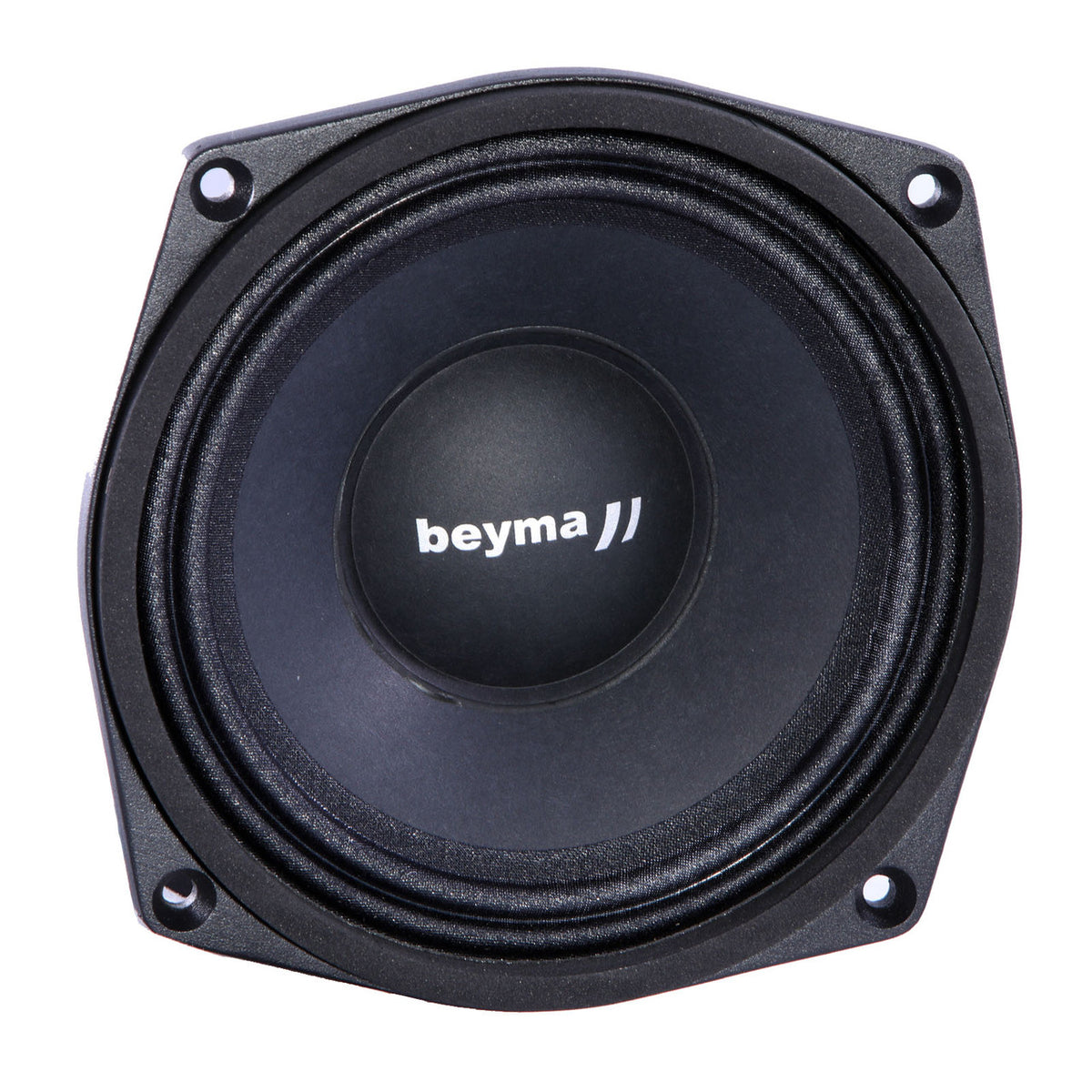
Beyma PRO6W/ND 6.5-Inch Neodymium Midbass/Midrange
When a 6.5-inch needs to play efficiently, reach down into useful midbass and still stay clean well into the mids, the PRO6W/ND sits in a very useful middle ground in Beyma's lineup.
It is not as narrow-band and sensitivity-focused as the PRO6MI or PRO65ND, and it is not built around the same deep-excursion priority as the PRO6Q200ND. Beyma gives the PRO6W/ND 150 watts RMS / 300 watts program, 97 dB sensitivity, a 70 Hz–9 kHz published range and 3 mm Xmax in a lightweight neodymium platform.
That balance is the reason this speaker makes sense.
97 dB sensitivity means the driver still gets loud efficiently.
Beyma publishes the PRO6W/ND at 97 dB sensitivity at 2.83 V / 1 meter.
That puts it much closer to the efficiency-first side of the Beyma lineup than the deeper-excursion Q-series.
On a motorcycle, Jeep or high-output custom door, that matters because available amplifier power and electrical capacity are not unlimited. A more efficient speaker gives us useful acoustic output without making amplifier size the only way to win the volume battle.
What that solves: the midrange and midbass section can stay present over road noise, wind or a strong subwoofer section without needing extreme power on every channel.
Three millimeters of Xmax gives it more room to work lower than a dedicated vocal mid.
Beyma publishes 3 mm Xmax for the PRO6W/ND.
That is not the deep-travel number of the PRO6Q200ND, but it is enough movement to give this 6.5-inch more useful lower-frequency capability than a driver designed almost entirely around vocals and upper mids.
The result is a speaker that can contribute actual punch and lower-midrange body while still maintaining the efficiency that makes the W/ND platform attractive.
The 70 Hz–9 kHz response is why this speaker is so flexible.
Beyma publishes the PRO6W/ND from 70 Hz to 9 kHz.
That does not mean we run it from 70 to 9,000 Hz in every installation. It means we have enough usable bandwidth to choose the crossover based on what the rest of the system needs.
In a two-way setup, the PRO6W/ND can carry a broad low/mid section beneath a capable tweeter or compression driver. In a three-way setup, we can narrow the bandwidth and let it work as a dedicated midbass/lower-midrange beneath a smaller, more directional midrange.
The advantage is system flexibility. The driver does not force us into one architecture.
The 2-inch aluminum voice coil is there for real power handling.
Beyma uses a 51.7 mm / 2-inch aluminum voice coil and rates the speaker at 150 watts RMS / 300 watts program.
That gives the PRO6W/ND enough thermal capacity for sustained high-output use when the driver is filtered correctly.
Beyma also publishes an 11 N/A BL factor, supporting strong motor control in the range the speaker is intended to reproduce.
As always, the power number is not a substitute for crossover protection. A clean 150-watt amplifier channel with the wrong high-pass can still push the cone past its mechanical limit.
Beyma specifies 10–30 liters behind it.
The published recommended enclosure range is 10–30 liters / 0.35–1.06 cu. ft.
That makes the acoustic space behind the speaker part of the installation. A sealed pod, custom door chamber and large open factory cavity will not make the same driver behave the same way.
If we want the PRO6W/ND to deliver useful lower-midrange and midbass instead of only surviving in the hole, we pay attention to the rear environment, sealing and baffle strength.
The neodymium motor helps with both weight and rear clearance.
Beyma specifically calls out the low weight of the neodymium magnet system.
That matters on motorcycle fairings, lids and removable pods, but it also matters in heavily fabricated door panels. Multiple large ferrite motors add weight quickly.
The PRO6W/ND's published mounting depth is only 75.5 mm / 2.97 inches, giving us a relatively shallow high-output 6.5-inch platform when rear clearance is limited.
PRO6W/ND, PRO6MI or PRO6Q200ND?
PRO6MI: 98 dB sensitivity and a dedicated midrange role. Choose it when vocal efficiency matters most and a separate driver is already doing the midbass work.
PRO6W/ND: 97 dB sensitivity, 150 watts RMS, 70 Hz–9 kHz and 3 mm Xmax. Choose it when we want high efficiency but need more lower-frequency flexibility from the same 6.5-inch.
PRO6Q200ND: 92 dB sensitivity, 200 watts AES, 60 Hz–6 kHz and 5.5 mm Xmax. Choose it when excursion and midbass authority matter more than maximum output per watt.
These are three different system tools, not three price levels of the same speaker.
Where we would use it.
The PRO6W/ND makes sense in motorcycle fairings and pods, Jeep and powersports systems, custom doors and high-output two- or three-way front stages where one 6.5-inch needs to cover more than a narrow vocal band.
It is particularly useful when amplifier power is limited but the customer still wants a speaker with enough lower-frequency reach to keep the system from sounding thin.
With DSP, we can choose the high-pass based on the actual chamber, set the upper handoff around the tweeter or midrange above it, then control level, EQ, phase and timing so the driver works as part of one system.
The result: an efficient, lightweight 6.5-inch Beyma that gives us more bandwidth and midbass flexibility than a dedicated vocal midrange without giving up the high sensitivity that makes a pro-style driver useful in a mobile system.
Manufacturer Specifications
- Model: Beyma PRO6W/ND
- Product type: Midbass / midrange loudspeaker
- Sold as: Single speaker
- Nominal diameter: 165 mm / 6.5 inches
- Nominal impedance: 4 ohms
- Minimum impedance: 4 ohms
- Power handling: 150 watts RMS
- Program power: 300 watts
- Sensitivity: 97 dB at 2.83 V / 1 m
- Published frequency range: 70 Hz–9 kHz
- Recommended enclosure volume: 10–30 liters / 0.35–1.06 cu. ft.
- Voice-coil diameter: 51.7 mm / 2 inches
- Voice-coil material: Aluminum
- Magnetic assembly weight: 1.5 kg / 3.3 lb.
- BL factor: 11 N/A
- Moving mass: 0.014 kg
- Voice-coil winding length: 9 mm
- Air-gap height: 7 mm
- X-damage, peak-to-peak: 20 mm
- Resonant frequency (Fs): 92 Hz
- DC resistance (Re): 3.9 ohms
- Qms: 6.52
- Qes: 0.27
- Qts: 0.26
- Equivalent compliance volume (Vas): 5.75 L
- Mechanical compliance (Cms): 210 µm/N
- Mechanical resistance (Rms): 1.35 kg/s
- Reference efficiency: 1.63%
- Effective cone area (Sd): 0.0140 m²
- Xmax: 3 mm
- Displacement volume (Vd): 42 cm³
- Voice-coil inductance (Le @ 1 kHz): 0.4 mH
- Overall diameter: 187.5 mm / 7.38 inches
- Bolt-circle diameter: 172 mm / 6.77 inches
- Front/rear cutout diameter: 146 mm / 5.74 inches
- Mounting depth: 75.5 mm / 2.97 inches
- Driver displacement: 0.55 L / 0.02 cu. ft.
- Net weight: 1.7 kg / 3.74 lb.
- Shipping weight: 2.3 kg / 5.06 lb.
- Motor: Neodymium
System Design Guidance
The published 70 Hz lower response is not a universal high-pass recommendation. Final rear volume, crossover points, amplifier power and DSP settings must be selected around the actual installation and output target.
Where this fits in the build
These speakers have to work where wind, road noise, mounting space and exposure change the job. Match the driver to the actual location, output target, amplifier power and environment instead of treating it like a normal door-speaker replacement.