
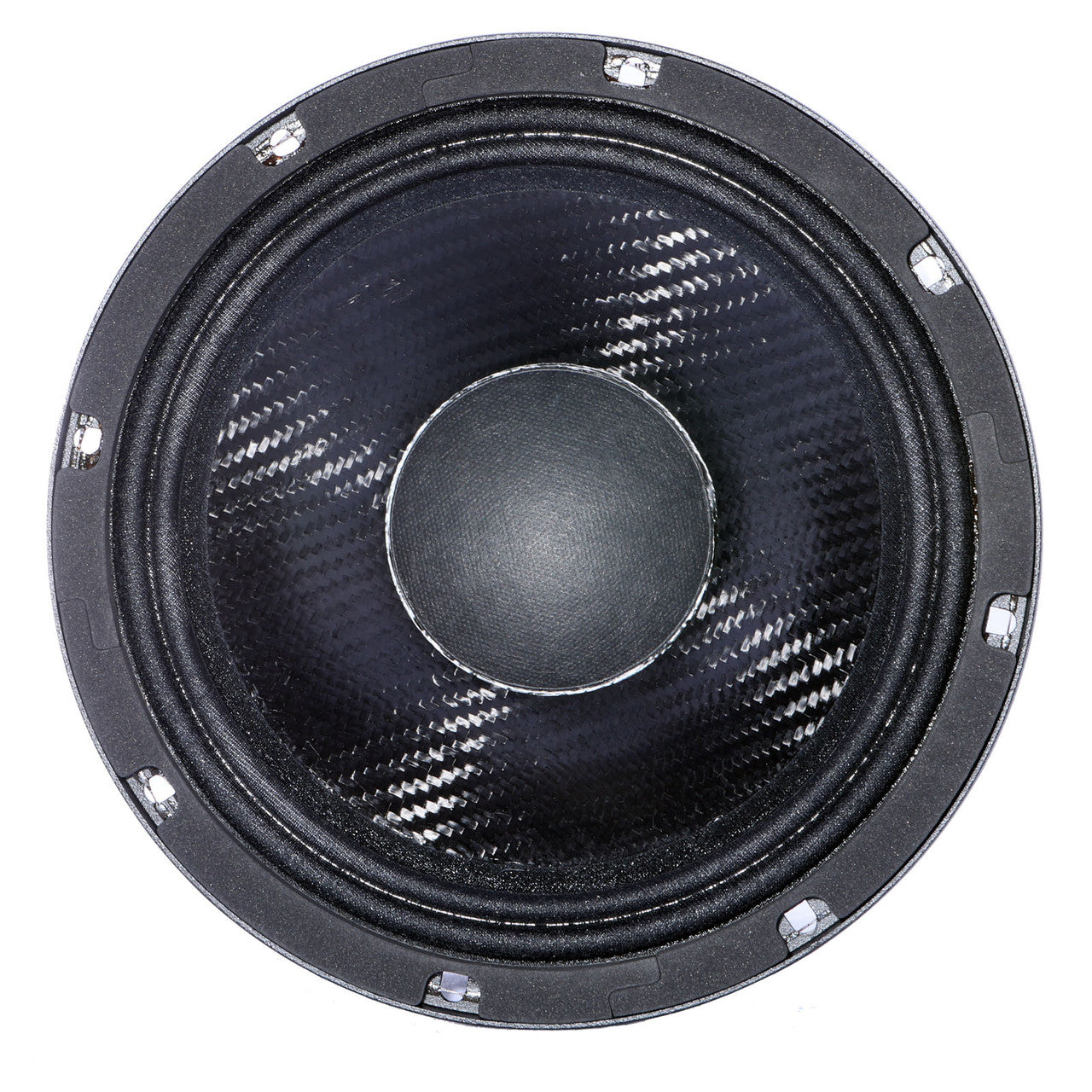

Description
Beyma PRO8CF 8-Inch Carbon-Fiber High-Excursion Midbass
If the system is already loud but still feels weak through kick drum and lower-midrange impact, the PRO8CF is built to fix that part of the system—not add more of the same vocals.
The Beyma PRO8CF is an 8-inch, 4-ohm midbass driver rated at 300 watts AES / 600 watts program, with a carbon-fiber cone, 6.3 mm Xmax and a published 80 Hz–2 kHz operating range. That combination tells us exactly what this speaker is for: move real air in the midbass and lower-midrange, stay rigid while doing it, and hand the upper range to a dedicated midrange or high-frequency driver.
This is not an 8-inch vocal speaker that happens to play a little lower. The PRO8CF is a dedicated impact driver.
The carbon-fiber cone is there because midbass puts real stress on the diaphragm.
When an 8-inch cone starts moving hard through kick drum and upper-bass frequencies, cone flex becomes part of the problem.
Beyma uses a carbon-fiber cone on the PRO8CF to increase diaphragm strength while keeping the moving structure controlled.
What that solves: instead of the cone changing shape as excursion and power rise, the diaphragm stays more rigid so the driver's movement is used to reproduce the signal rather than create extra breakup and distortion.
That matters most in exactly the range this speaker is built to cover, because midbass requires both movement and control.
6.3 mm Xmax is the reason this thing can hit.
Beyma publishes 6.3 mm of linear Xmax for the PRO8CF.
That is a substantial amount of useful travel for an 8-inch pro-style midbass driver. It gives the cone the displacement needed to create physical punch instead of only high SPL in the vocal range.
If the system has a strong subwoofer but the doors, bags or speaker panels sound thin above it, this is the kind of driver that fills the gap.
The subwoofer handles depth. The PRO8CF handles impact.
300 watts AES / 600 watts program gives us enough thermal headroom to use that excursion.
The PRO8CF carries a manufacturer rating of 300 watts AES / 600 watts program and uses a 2-inch / 50.8 mm voice coil.
That gives the driver the thermal capacity needed for sustained high-output midbass use.
But the amplifier number is only half of the story. A driver with good thermal capacity can still be mechanically overdriven if the high-pass is set too low or the rear chamber does not support the cone correctly.
So we do not choose the amplifier from the 600-watt number alone. We choose the amplifier and crossover together around the actual system.
The 80 Hz–2 kHz range tells you to stop trying to make one cone do everything.
Beyma publishes the PRO8CF from 80 Hz to 2 kHz.
That upper limit is important. This is not the speaker we use when we expect one 8-inch to carry the entire vocal range to a tweeter mounted way up high.
The PRO8CF makes the most sense in a real multi-way architecture: subwoofer or low-frequency driver below it, dedicated midrange above it, then tweeter or compression driver for the top end.
That is actually an advantage. Instead of compromising the cone so it can do a little bit of everything, Beyma lets this driver concentrate on the part of the spectrum where physical cone area and excursion matter most.
The 93 dB sensitivity is not the number to judge this speaker by.
The PRO8CF is published at 93 dB sensitivity.
If you compare that number alone with a 98 or 100 dB dedicated midrange, the PRO8CF looks less efficient. But those speakers are not being asked to do the same job.
A driver designed around more excursion and lower-frequency output naturally gives up some sensitivity in exchange for displacement.
If the system needs vocals to scream with minimal power, buy the more efficient midrange. If the system needs kick drums and lower mids to have real physical authority, the PRO8CF is the better tool.
The motor is built for control, not just brute force.
Beyma publishes a 12.6 N/A BL factor for the PRO8CF.
That tells us the motor has substantial force available to control the cone and voice-coil assembly.
The driver also uses a die-cast aluminum basket, which gives the motor and suspension a rigid structure to work from when the cone is moving hard.
That matters because flex in the speaker frame or the mounting panel turns amplifier power into vibration instead of sound.
Marine-treated metal parts make more sense in exposed mobile installs.
Beyma lists marine-treated metal components on the PRO8CF.
That is useful in motorcycles, powersports and other installations where humidity and occasional moisture exposure are more realistic than they are in a sealed home loudspeaker cabinet.
We are not calling the complete speaker waterproof. We are saying Beyma treated the metal parts to better handle exposed environments, which is exactly what the manufacturer specifies.
PRO8CF, PRO8WFE or PRO8Q300ND?
PRO8WFE: the ferrite high-excursion midbass choice with 6.5 mm Xmax and a broader 80 Hz–4 kHz range.
PRO8CF: the carbon-fiber ferrite midbass specialist. 300 watts AES, 6.3 mm Xmax and a focused 80 Hz–2 kHz working range. Choose it when cone rigidity, serious midbass power and lower-midrange impact are the priority.
PRO8Q300ND: the premium neodymium broad-band midbass/midrange. Choose it when weight, broader upper extension and neo packaging matter alongside strong excursion.
The PRO8CF is the one we choose when we are deliberately building a multi-way system and want the 8-inch driver to concentrate on impact instead of trying to cover everything.
Where we would use it.
This makes sense in motorcycle bags, high-output custom doors, Jeep and powersports panels, demo-style systems and any build where the subwoofer is strong but the system still needs more physical punch above the deep bass.
It is especially useful when we can dedicate another driver to the vocal range. That lets us low-pass the PRO8CF where its directivity and cone behavior are still comfortable instead of forcing it higher because there is nothing else in the system.
With DSP, we can set the high-pass based on the actual enclosure or rear chamber, low-pass it into the midrange above it, then align level, phase and timing so the midbass sounds connected instead of like a separate speaker hammering from the door or bag.
The result: an 8-inch Beyma built to add the part of the system customers usually describe as “hit,” “punch” or “body”—with enough cone strength, excursion and power handling to do that job at serious output.
Manufacturer Specifications
- Model: Beyma PRO8CF
- Product type: Dedicated midbass / lower-midrange loudspeaker
- Sold as: Single speaker
- Nominal diameter: 200 mm / 8 inches
- Nominal impedance: 4 ohms
- Power handling: 300 watts AES
- Program power: 600 watts
- Sensitivity: 93 dB, 1 W / 1 m
- Published frequency range: 80 Hz–2 kHz
- Voice-coil diameter: 50.8 mm / 2 inches
- Voice-coil winding length: 16 mm
- Air-gap height: 8 mm
- BL factor: 12.6 N/A
- Resonant frequency (Fs): 78 Hz
- DC resistance (Re): 3.7 ohms
- Voice-coil inductance (Le): 0.6 mH
- Qms: 2.3
- Qes: 0.38
- Qts: 0.32
- Equivalent compliance volume (Vas): 8.8 L / 0.31 cu. ft.
- Xmax: 6.3 mm
- Peak-to-peak excursion before damage: 30 mm
- Effective cone area (Sd): 0.022 m²
- Moving mass: 33 g
- Reference efficiency: 1.1%
- Displacement volume (Vd): 138 cm³
- Overall diameter: 212 mm / 8.3 inches
- Bolt-circle diameter: 195 mm / 7.7 inches
- Cutout diameter: 181 mm / 7.1 inches
- Mounting holes: 4
- Mounting depth: 95 mm / 3.7 inches
- Net weight: 3.3 kg / 7.3 lb.
- Shipping weight: 3.6 kg / 7.9 lb.
- Basket: Die-cast aluminum
- Cone: Carbon fiber
- Surround: Treated cloth
- Dust cap: Inverted
- Voice coil: Copper on fiberglass former
- Metal parts: Marine treated
- Motor: Ferrite
System Design Guidance
The published 80 Hz lower response is not a universal high-pass recommendation. Final enclosure loading, high-pass, low-pass, amplifier power and DSP settings must be selected around the actual installation and the drivers used above and below the PRO8CF.
Where this fits in the build
These speakers have to work where wind, road noise, mounting space and exposure change the job. Match the driver to the actual location, output target, amplifier power and environment instead of treating it like a normal door-speaker replacement.