
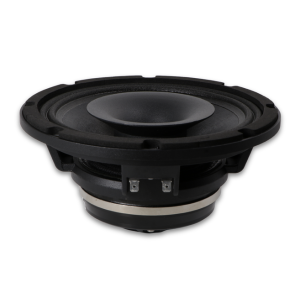

Description
Beyma PRO8CXND 8-Inch Neodymium High-Output Coaxial
If the system needs one speaker location to deliver real 8-inch low/mid authority and a dedicated high-frequency section at the same time, the PRO8CXND is where Beyma’s coaxial platform starts getting serious about physical output.
The Beyma PRO8CXND is an 8-inch professional coaxial with separate 8-ohm low-/mid-frequency and high-frequency sections sharing one frame. Beyma’s current technical sheet publishes 250 / 50 watts AES LF/HF, 500 / 100 watts program, 97 / 106 dB LF/HF sensitivity, a 90 Hz–20 kHz published range and 6 mm LF Xmax.
That combination makes this much more than a larger version of the 6.5-inch coaxial. The 8-inch cone gives the low/mid section substantially more physical capability while the coaxial HF section keeps the top end coming from the same speaker location.
The 8-inch cone is the reason this speaker can put real weight behind the music.
More cone area means the speaker can move more air through the low/mid region without asking a smaller 6.5-inch driver to do the same job with less radiating surface.
What that solves: the system can have actual punch and body from the speaker location itself instead of sounding like a powerful subwoofer underneath thin mids and highs.
In a motorcycle bag, large fairing, Jeep pod or custom door, that extra cone area can make the difference between a system that is simply loud and one that feels full.
Six millimeters of LF Xmax gives the 8-inch real mechanical capability.
Beyma publishes 6 mm Xmax for the low/mid section, along with 24 mm peak-to-peak excursion before damage.
That is useful travel for an 8-inch coaxial low/mid section when it is loaded and protected correctly.
The published 90 Hz lower limit is not a universal crossover recommendation. The actual high-pass still depends on the enclosure, required output and amplifier power.
The key is using that capability intelligently: let the installation decide how low the LF section should actually work instead of treating the bottom of the response graph like a mandatory crossover point.
97 / 106 dB sensitivity means both sections start from efficient platforms.
Beyma publishes the low/mid section at 97 dB sensitivity and the high-frequency section at 106 dB.
That matters in high-output mobile systems because the speaker is not relying on brute-force amplifier power alone to create output.
The HF section is substantially more sensitive than the LF section, so proper crossover and level matching are part of the installation. The fact that both drivers share one frame does not mean they should simply be connected together and fed the same unfiltered signal.
250 / 50 watts AES gives both sections real working headroom.
The low/mid section is rated at 250 watts AES / 500 watts program. The high-frequency section is rated at 50 watts AES / 100 watts program.
Those are separate LF and HF section ratings, not one combined conventional-coaxial power number.
Beyma specifies the HF crossover at 1.5 kHz or higher with at least a 12 dB/octave slope. That is an important part of using this speaker correctly because the compression-driver section still needs protection from low-frequency energy.
The coaxial format combines the mounting location. It does not eliminate system design.
The 2.5-inch LF voice coil is part of why this 8-inch can work hard.
Beyma gives the low/mid section a 63.5 mm / 2.5-inch voice coil, while the HF section uses a 44.4 mm / 1.75-inch diaphragm/voice-coil assembly.
The LF motor also uses a shorting cup to reduce harmonic distortion and help keep the impedance behavior more linear.
That matters when the low/mid section is carrying real output instead of functioning as a light-duty cone underneath a tweeter.
The coaxial geometry keeps the high-frequency section on the same acoustic axis.
The biggest packaging and acoustic advantage of the PRO8CXND is the coaxial layout.
Instead of putting the high-frequency driver somewhere else in the vehicle and creating another path-length and aiming problem, the HF section stays centered with the 8-inch low/mid driver. Beyma uses a 70-degree coverage horn for HF dispersion control and a PM4 diaphragm in the high-frequency section.
What that solves: one physical location can handle the two-way job while giving us a cleaner starting point through the crossover region.
This is especially useful in motorcycle and powersports applications where separate high-frequency mounting locations are limited or simply do not exist.
The 8-ohm LF/HF architecture is useful when multiple coaxials share amplifier channels.
Both the LF and HF sections are nominally 8 ohms.
That gives us useful wiring flexibility in multi-speaker systems. For example, two LF sections from two PRO8CXND speakers can be paralleled for a 4-ohm LF load, and the corresponding HF sections can be handled separately through the proper crossover/amplifier architecture.
The important part is not simply getting to the lowest impedance possible. The amplifier channels, crossover network, driver count and final loads all have to be designed together.
The neodymium motor matters more as the speaker gets bigger.
The PRO8CXND uses a common neodymium magnetic system for the LF and HF sections.
That helps keep weight and mounting depth under control even though the driver has a large 8-inch cone, a 2.5-inch LF coil and a dedicated compression-driver section in the same assembly.
On a motorcycle lid, bag, removable pod or fabricated panel, reducing unnecessary motor mass is part of making the structure easier to support and live with.
PRO8CXND versus PRO6CXND.
PRO6CXND: 6.5-inch coaxial architecture with 200 / 40 watts AES and a smaller footprint. Choose it when packaging is tighter and the system does not need the cone area of an 8-inch low/mid section.
PRO8CXND: 250 / 50 watts AES, a larger 8-inch low/mid section and 6 mm LF Xmax. Choose it when the installation has the room and the system needs more physical low/mid authority from the coaxial location.
The 6.5 is easier to package. The 8 gives the speaker section more scale and impact.
PRO8CXND versus PRO8FX370ND.
PRO8CXND: the straightforward high-output 8-inch neo coaxial platform with a paper LF cone and dedicated coaxial compression-driver section.
PRO8FX370ND: the more specialized carbon-fiber, higher-power FX platform. Choose it when its cone construction, motor architecture and high-frequency package justify the additional cost and system capability.
They share the same basic one-location/two-way idea, but they are not the same driver with different trim.
Where we would use it.
This is a strong fit for motorcycle saddlebags, large fairings, Jeep and open-cabin systems, custom doors, powersports pods and repeated speaker panels where one 8-inch location needs to deliver both substantial low/mid output and a dedicated high-frequency section.
With DSP or the correct crossover network, we can set the LF high-pass around the actual enclosure, manage the LF/HF handoff, balance the two sections and correct level, EQ and timing so the speaker sounds big without becoming uncontrolled.
The result: an 8-inch Beyma coaxial that gives one speaker location real cone area, useful excursion, high efficiency and a dedicated high-frequency section without forcing the system to find separate mounting locations for every driver.
Manufacturer Specifications
- Model: Beyma PRO8CXND
- Product type: Professional coaxial loudspeaker
- Sold as: Single coaxial speaker
- Nominal diameter: 200 mm / 8 inches
- Rated impedance (LF / HF): 8 / 8 ohms
- Minimum impedance (LF / HF): 6.9 / 5.4 ohms
- Power handling (LF / HF): 250 / 50 watts AES
- Program power (LF / HF): 500 / 100 watts
- Sensitivity (LF / HF): 97 / 106 dB, 1 W / 1 m
- Published frequency range: 90 Hz–20 kHz
- Recommended HF crossover: 1.5 kHz or higher
- Minimum HF crossover slope: 12 dB/octave
- Voice-coil diameters (LF / HF): 63.5 / 44.4 mm — 2.5 / 1.75 inches
- LF BL factor: 13.2 N/A
- LF moving mass: 21 g
- LF voice-coil winding length: 15 mm
- LF air-gap height: 7 mm
- LF Xmax: 6 mm
- Peak-to-peak excursion before damage: 24 mm
- Resonant frequency (Fs): 85 Hz
- LF DC resistance (Re): 5 ohms
- LF voice-coil inductance (Le): 0.2 mH
- Qms: 3.3
- Qes: 0.33
- Qts: 0.30
- Equivalent compliance volume (Vas): 11.2 L
- Mechanical compliance (Cms): 164 µm/N
- Mechanical resistance (Rms): 3.4 kg/s
- Reference efficiency: 2.1%
- Effective cone area (Sd): 0.022 m²
- Displacement volume (Vd): 132 cm³
- Overall diameter: 212 mm / 8.3 inches
- Bolt-circle diameter: 198 mm / 7.8 inches
- Baffle cutout diameter: 180 mm / 7.1 inches
- Mounting depth: 106 mm / 4.2 inches
- Net weight: 2.8 kg / 6.2 lb.
- Shipping weight: 3.0 kg / 6.6 lb.
- Motor: Common neodymium magnetic system
- Spider: Conex
- LF motor feature: Shorting cup for reduced harmonic distortion
- HF diaphragm: PM4
- HF coverage: 70-degree horn
Crossover / System Guidance
The PRO8CXND contains separate LF and HF sections in one coaxial frame. Beyma specifies the HF crossover at 1.5 kHz or higher with at least a 12 dB/octave slope. Final LF high-pass, LF/HF crossover implementation, amplifier configuration, limiting, level and DSP settings must still be selected around the actual installation and required output.
Where this fits in the build
These speakers have to work where wind, road noise, mounting space and exposure change the job. Match the driver to the actual location, output target, amplifier power and environment instead of treating it like a normal door-speaker replacement.