

Description
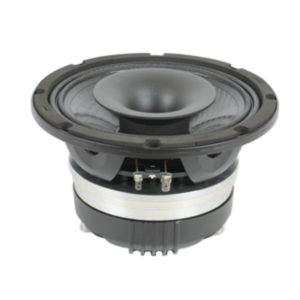
Beyma PRO8FX370ND 8-Inch Carbon-Fiber Neodymium Coaxial
If the PRO8CXND gives you the size and output you want but the system needs a more specialized high-frequency section and the rigidity of a carbon-fiber cone, the PRO8FX370ND is the premium 8-inch coaxial direction.
The Beyma PRO8FX370ND combines an 8-inch carbon-fiber low/mid section with a dedicated high-frequency compression section in one 8-ohm coaxial frame. Beyma publishes 250 / 60 watts AES LF/HF, 97 / 105 dB sensitivity, a 120 Hz–20 kHz published range, 2.5 / 2.85-inch voice coils and 6 mm LF Xmax.
The reason to spend more on this speaker is not that the model name looks more extreme. The FX platform changes the cone and the high-frequency architecture.
The carbon-fiber cone is there because an 8-inch coaxial has to move and stay rigid.
The low/mid section uses a carbon-fiber cone.
That gives the 8-inch diaphragm high stiffness while it is reproducing lower-midrange and midbass energy with meaningful excursion.
What that solves: the cone can move enough air to give the system physical body without giving up the rigidity we want as output rises.
That becomes more important in a high-output 8-inch because the cone is doing much more mechanical work than a short-travel vocal midrange.
The HF section is a real compression-driver architecture.
The PRO8FX370ND uses a dedicated high-frequency section with a 1.4-inch exit, a large 2.85-inch HF voice coil and a titanium diaphragm in published exact-model technical data.
That is a very different top-end design from a conventional little coaxial tweeter.
The goal is controlled high-frequency projection with enough acoustic output to stay present in motorcycle, powersports and open-cabin systems where wind and road noise are constantly working against the top end.
97 / 105 dB sensitivity means both sections start efficient.
Beyma publishes 97 dB LF sensitivity and 105 dB HF sensitivity.
That is important because this speaker is supposed to get loud without making amplifier power the only solution.
The practical result: the low/mid and high-frequency sections both have enough efficiency to keep up in a serious system while the amplifier retains useful headroom.
250 / 60 watts AES is section-by-section power handling.
Beyma lists 250 watts AES for the LF section and 60 watts AES for the HF section.
Those are separate transducers sharing one coaxial assembly. They are not one combined 310-watt conventional speaker rating.
The frequency split still matters. Exact-model technical data specifies an HF crossover around 1.2 kHz or higher at 12 dB/octave.
The speaker combines the acoustic center. It does not eliminate the need to divide the work correctly.
Six millimeters of Xmax gives the 8-inch real low/mid movement.
Beyma publishes 6 mm LF Xmax.
That gives the 8-inch cone useful excursion for physical lower-midrange and midbass output, provided the enclosure and lower crossover are right.
The published 120 Hz lower range should not be confused with a universal high-pass setting. The final crossover still depends on rear loading, required output and the rest of the system.
The shared neodymium architecture keeps both sections centered in one package.
Exact-model technical material describes a shared neodymium magnetic architecture for the low- and high-frequency sections.
That helps keep the assembly compact while keeping both transducers physically centered around the same coaxial axis.
That is exactly what we want when one speaker location has to function as a complete two-way source.
The demodulation ring works on distortion before the DSP ever sees it.
Beyma publishes a demodulation ring in the low-frequency motor structure to flatten impedance behavior and reduce harmonic distortion.
That matters because DSP can shape response and timing, but it cannot fully erase distortion generated by the loudspeaker motor itself.
Starting with better linearity gives us more to work with when the final system is tuned.
PRO8FX370ND versus PRO8CXND.
PRO8CXND: 250 / 50 watts AES, 96 / 104 dB sensitivity, 6 mm LF Xmax and the standard Beyma 8-inch neo coaxial platform. Choose it when strong output and broad two-way capability are the goal without paying for the FX construction.
PRO8FX370ND: 250 / 60 watts AES, 97 / 105 dB sensitivity, carbon-fiber cone and the larger high-frequency compression architecture. Choose it when the system is being built around the more specialized cone and HF section.
The CXND is the straightforward high-output coaxial. The FX370ND is the more specialized premium coaxial.
PRO8FX370ND versus separate 8-inch midbass + compression driver.
A fully separate multi-way system gives us maximum freedom to choose the low/mid driver, horn, aiming and physical placement independently.
The PRO8FX370ND makes sense when the installation needs a serious 8-inch low/mid plus compression-style highs but only gives us one practical speaker location.
That is the real product value: high-output two-way architecture without doubling the fabrication locations.
Where we would use it.
This makes sense in high-end motorcycle saddlebag lids, large fairings, powersports pods, Jeep and open-cabin systems, and custom speaker panels where one 8-inch location needs to deliver serious low/mid energy and strong projected highs.
It is especially useful when the customer wants the speaker location itself to sound complete instead of depending on a remotely mounted tweeter to fill in the top end.
With the correct crossover and DSP, we can protect the LF section, integrate the compression HF section, control level and EQ, and align the speaker with the rest of the system.
The result: a premium 8-inch Beyma coaxial that combines carbon-fiber cone control, real LF excursion, a high-output compression-style top end and a shared neodymium architecture in one speaker location.
Manufacturer Specifications
- Model: Beyma PRO8FX370ND
- Product type: Professional carbon-fiber coaxial loudspeaker
- Sold as: Single coaxial speaker
- Nominal diameter: 8 inches
- Nominal impedance: 8 ohms
- LF / HF power handling: 250 / 60 watts AES
- LF / HF sensitivity: 97 / 105 dB
- Published frequency range: 120 Hz–20 kHz
- LF / HF voice-coil diameters: 2.5 / 2.85 inches
- LF Xmax: 6 mm
- Exact-model recommended HF crossover: 1.2 kHz or higher at 12 dB/octave
- LF cone: Carbon fiber
- HF diaphragm: Titanium
- Motor feature: LF demodulation ring
- Motor: Neodymium
Crossover / System Guidance
The PRO8FX370ND contains separate LF and HF sections in one coaxial frame. Final LF high-pass, LF/HF crossover, amplifier configuration, limiting, level and DSP settings must be selected around the actual installation and required output.
Where this fits in the build
These speakers have to work where wind, road noise, mounting space and exposure change the job. Match the driver to the actual location, output target, amplifier power and environment instead of treating it like a normal door-speaker replacement.