


Description
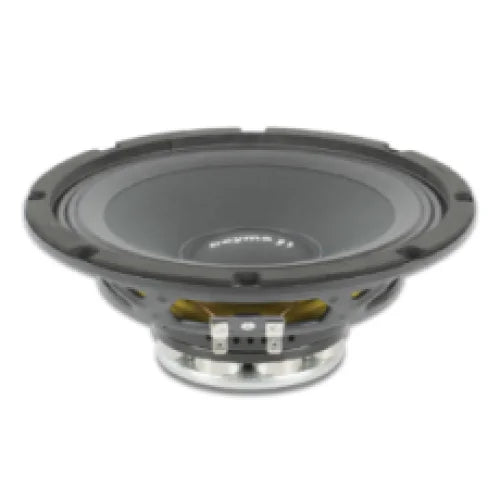
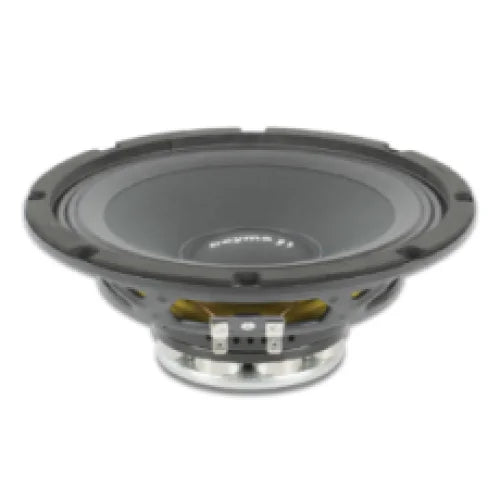
Beyma PRO8MV2ND 8-Inch Neodymium High-Efficiency Midrange
If the system needs an 8-inch midrange to get loud without adding a bunch of unnecessary motor weight, the PRO8MV2ND is built around exactly that problem.
The Beyma PRO8MV2ND is a 4-ohm neodymium midrange rated at 150 watts AES / 300 watts program, with 96 dB sensitivity and a published 120 Hz–8 kHz response. It is not trying to be a deep midbass driver and it is not trying to replace a subwoofer. It is a lightweight 8-inch built to carry vocals, instruments and lower-midrange information efficiently in systems where output matters but weight and rear clearance matter too.
That makes it a very different choice from the PRO8Q300ND or PRO8WFE.
The reason to choose PRO8MV2ND is efficient midrange without a heavy ferrite motor.
At 96 dB sensitivity, the PRO8MV2ND makes strong acoustic output without demanding huge amplifier power.
That matters in motorcycle, powersports and open-cabin systems because electrical capacity is limited and every channel has to earn its keep. A more efficient speaker gives us more usable output before amplifier size becomes the only answer.
What that solves: the vocal range can stay present over wind, road noise and a strong bass section without hanging a heavy ferrite motor behind every 8-inch speaker location.
The 120 Hz lower range tells you this is a midrange first.
Beyma publishes the PRO8MV2ND from 120 Hz to 8 kHz.
That lower number is important because it separates this driver from the deeper-excursion Q and WFE models. The PRO8MV2ND is not built around maximum cone travel or deep midbass impact. It is built around efficient, broad midrange reproduction.
In a real system, we would normally let a dedicated midbass, woofer or subwoofer handle the frequencies below it, then use the PRO8MV2ND where its sensitivity and cone area actually become an advantage.
The payoff: the driver does not waste movement trying to make bass it was not designed to carry.
The 8-inch cone gives vocals more physical authority than a smaller midrange.
An 8-inch cone gives us more radiating area than a 5-inch or 6.5-inch driver.
That does not automatically mean more bass. What it gives us here is more acoustic authority through the lower and middle vocal range. Drums, guitars and male vocals can sound bigger and more physical without asking the speaker to become a low-frequency woofer.
In a custom door, pod or speaker panel, that extra cone area can make the midrange section feel substantial instead of thin.
150 watts AES / 300 watts program is enough power when the speaker is used for the right job.
Beyma rates the PRO8MV2ND at 150 watts AES / 300 watts program.
That power rating makes sense because the driver is not being asked to spend huge excursion on deep bass. When the crossover keeps it inside the range it was designed to reproduce, the available thermal capacity goes toward usable midrange output.
The driver uses a 38.1 mm / 1.5-inch voice coil and Beyma publishes a 9.1 N/A BL factor, giving the motor useful control over the moving assembly.
The number on the amplifier still does not replace the crossover. Clean power plus the right band-pass is what keeps the speaker loud and controlled.
The neodymium motor is not just a premium-material bullet point.
Neodymium matters here because it reduces the amount of motor mass needed to create useful magnetic force.
That is especially valuable in motorcycle fairings, saddlebag lids, pods and fabricated panels where multiple speakers can add a surprising amount of weight. Less hanging mass means less stress on the panel and easier packaging behind the speaker.
It also helps when mounting depth is tight. A driver can sound perfect on paper and still be useless if the motor will not clear the vehicle structure behind it.
PRO8MV2ND, PRO8MI or PRO8Q300ND?
PRO8MI: the higher-sensitivity ferrite dedicated midrange. Use it when maximum vocal output per watt matters and motor weight is less important.
PRO8MV2ND: the lightweight neodymium 8-inch midrange. Use it when we want strong efficiency and broad midrange coverage but need a lighter motor package.
PRO8Q300ND: the high-power, deeper-excursion neodymium midbass/midrange. Use it when the 8-inch needs to contribute real midbass and accept substantially more power.
All three are 8-inch Beyma drivers. They solve different problems.
Where we would use it.
This makes sense in motorcycle fairings and lids, Jeep and powersports systems, custom doors and multi-driver speaker panels where the midrange has to project without adding unnecessary weight.
It also works well as the middle section of a three-way system: dedicated midbass below, PRO8MV2ND through the vocal range, and a tweeter or compression driver above.
With DSP, we can set the high-pass and low-pass around the actual installation, then control level, EQ, phase and timing so the 8-inch does not sound like a separate loud speaker bolted into the door or fairing.
The result: an 8-inch Beyma that gives us real midrange authority, useful efficiency and lighter neodymium packaging for systems where the speaker needs to get loud without being asked to do a midbass driver's job.
Manufacturer Specifications
- Model: Beyma PRO8MV2ND
- Product type: Dedicated midrange loudspeaker
- Sold as: Single speaker
- Nominal diameter: 200 mm / 8 inches
- Nominal impedance: 4 ohms
- Power handling: 150 watts AES
- Program power: 300 watts
- Sensitivity: 96 dB, 1 W / 1 m
- Published frequency range: 120 Hz–8 kHz
- Voice-coil diameter: 38.1 mm / 1.5 inches
- Voice-coil winding length: 7.5 mm
- Air-gap height: 6 mm
- BL factor: 9.1 N/A
- Xmax: 2.5 mm
- Resonant frequency (Fs): 105 Hz
- DC resistance (Re): 3.3 ohms
- Voice-coil inductance (Le): 0.3 mH
- Qms: 5.4
- Qes: 0.46
- Qts: 0.43
- Equivalent compliance volume (Vas): 9 L / 0.32 cu. ft.
- Moving mass (Mms): 21 g
- Effective cone area (Sd): 0.0220 m²
- Reference efficiency: 2.1%
- Displacement volume: 55 cm³
- Overall diameter: 210 mm / 8.27 inches
- Bolt-circle diameter: 192 mm / 7.6 inches
- Baffle cutout: 180 mm / 7.1 inches
- Mounting holes: 8
- Mounting depth: 75 mm / 2.9 inches
- Net weight: approximately 1.3 kg / 2.9 lb.
- Shipping weight: approximately 1.5 kg / 3.3 lb.
- Basket: Pressed steel
- Cone: Paper
- Surround: Treated cloth, double-roll profile
- Spider: Polycotton
- Voice coil: Copper wire
- Former: Glass fiber
- Motor: Neodymium
System Design Guidance
The published 120 Hz lower response is not a universal high-pass recommendation. Final crossover points, amplifier power, rear loading and DSP settings must be chosen around the actual installation and the drivers used above and below the PRO8MV2ND.
Where this fits in the build
These speakers have to work where wind, road noise, mounting space and exposure change the job. Match the driver to the actual location, output target, amplifier power and environment instead of treating it like a normal door-speaker replacement.