

Description
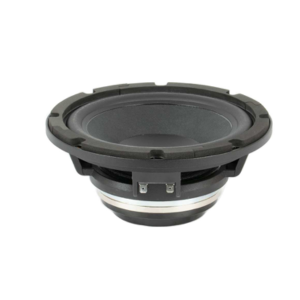
Beyma PRO8Q300ND 8-Inch Neodymium High-Power Midbass/Midrange
If the system needs an 8-inch speaker to make real midbass, stay clean into the mids and do it without hanging a huge ferrite motor off the back of the panel, this is where the PRO8Q300ND makes sense.
The Beyma PRO8Q300ND is the larger, higher-power Q-series answer to the same problem the PRO6Q200ND solves. It gives us more cone area, a larger 2.5-inch voice coil, 300 watts AES power handling and useful excursion in a lightweight neodymium platform.
This is not the 8-inch we choose for maximum vocals per watt. It is the one we choose when the 8-inch itself needs to put physical punch into the system and still transition cleanly into the midrange.
The Q-series is about excursion and bandwidth—not winning the sensitivity contest.
Published PRO8Q300ND data puts the driver at 94 dB sensitivity, with a 70 Hz–7 kHz frequency range and 6 mm Xmax.
Compare that with the PRO8MI, which is a much more sensitivity-focused dedicated midrange. The MI driver is the better tool when vocals and instruments need maximum projection and another speaker is already handling the midbass below it.
The PRO8Q300ND spends some of that efficiency budget on cone travel and broader low-frequency capability.
What that solves: the speaker section can create real kick-drum impact and lower-midrange body instead of relying on the subwoofer to reach unnaturally high or leaving a hole between the bass section and the vocals.
300 watts AES and a 2.5-inch voice coil give the 8-inch real thermal headroom.
Beyma rates the PRO8Q300ND at 300 watts AES / 600 watts program.
That is a serious amount of power for an 8-inch midbass/midrange, and the driver uses a 2.5-inch voice coil. The larger coil gives the driver more thermal capacity for the kind of sustained output a motorcycle, powersports or high-output car-audio system can demand.
But the same rule applies here as everywhere else: power handling is not permission to use the wrong crossover. If the cone is spending all of its travel on frequencies a subwoofer should be handling, more amplifier power only gets us to the mechanical limit faster.
The carbon-fiber-loaded paper cone is trying to balance two things that normally fight each other.
The PRO8Q300ND uses a carbon-fiber-loaded paper cone.
Paper is useful because of its low mass and natural damping. Adding carbon fiber gives the cone more structural stiffness so it can stay controlled as output rises.
That matters because this driver is being asked to do more than one narrow job. It needs enough low-frequency movement for midbass, but the cone also has to remain controlled as it carries vocals and instruments farther up the range.
The practical result: stronger midbass does not have to come at the expense of a heavy, slow-sounding cone through the mids.
Santoprene surround + Conex spider = a suspension built around useful travel.
The PRO8Q300ND construction uses a Santoprene half-roll surround and Conex spider.
The surround gives the cone room to move while maintaining control at the edge of the diaphragm. The Conex spider centers the voice coil and provides the restoring force behind the cone's motion.
That suspension is part of why the Q-series can work lower than Beyma's dedicated MI midranges. More usable travel means more air movement in the frequencies where punch and body live.
The neodymium motor matters most when the installation has to carry the weight.
The PRO8Q300ND uses a neodymium motor rather than a large ferrite assembly.
That is a real advantage in motorcycle bags, fairings, pods and other fabricated panels where every speaker adds weight to a removable or vibration-prone structure.
It also helps with rear clearance. A driver can be acoustically perfect and still be the wrong choice if the motor will not physically fit behind the panel.
The PRO8Q300ND gives us a high-power 8-inch platform without making the motor package unnecessarily bulky.
The motor design also addresses distortion before DSP ever enters the picture.
Exact-model technical data lists a demodulation ring in the motor structure to reduce harmonic distortion.
That matters because DSP can correct frequency response, level and timing, but it cannot undo every form of distortion created inside the loudspeaker itself.
Starting with a driver designed to stay more linear under power gives the tune a better foundation.
PRO8Q300ND, PRO8BK/V2 or PRO8MI?
These are three very different 8-inch choices.
PRO8MI: the efficiency-first dedicated midrange. Use it when vocal projection and output per watt matter more than midbass excursion.
PRO8BK/V2: the value-oriented ferrite midbass/midrange. It gives us useful excursion and broader low-frequency capability when weight and motor size are less critical.
PRO8Q300ND: the premium high-power neodymium midbass/midrange. It gives us more AES power handling, a larger 2.5-inch coil, lightweight motor architecture and the cone/suspension design needed for serious midbass while still carrying clean mids.
The right one depends on what the 8-inch is actually supposed to do in the system—not which model has the biggest number on one line of the spec sheet.
Where we would use the PRO8Q300ND.
This is a natural fit for motorcycle saddlebag systems, custom fairings and pods, Jeep and powersports enclosures, and high-output custom doors where the speaker needs to contribute real punch instead of only getting loud in the vocal range.
It also makes sense in a two-way system with a capable high-frequency driver above it, or as the dedicated midbass/lower-midrange section of a three-way build.
In a motorcycle bag, the lighter neo motor and strong midbass capability are a particularly good combination: less unnecessary mass hanging from the structure, but enough cone area and excursion to create the impact that small fairing speakers cannot.
The 70 Hz number is capability—not a universal crossover setting.
The published PRO8Q300ND frequency range begins at 70 Hz. That does not mean every door, bag or pod should be high-passed at 70 Hz.
The actual crossover depends on rear volume, enclosure alignment, amplifier power and required output. The harder the system needs to play, the more important it is to keep the driver away from unnecessary low-frequency excursion.
With DSP, we can set the high-pass around the real installation, choose the upper handoff based on the high-frequency driver, then control EQ, phase and timing so the 8-inch does not sound like a separate bass speaker bolted into the door or bag.
The result: a high-power 8-inch Beyma with the excursion to make real midbass, the bandwidth to carry clean lower mids, and the neodymium architecture to do it without the weight and bulk of a large ferrite motor.
Manufacturer Specifications
- Model: Beyma PRO8Q300ND
- Product type: Midbass / midrange loudspeaker
- Sold as: Single speaker
- Nominal diameter: 200 mm / 8 inches
- Nominal impedance: 4 ohms
- Minimum impedance: 4.5 ohms
- Power handling: 300 watts AES
- Program power: 600 watts
- Sensitivity: 94 dB, 1 W / 1 m
- Published frequency range: 70 Hz–7 kHz
- Voice-coil diameter: 63.5 mm / 2.5 inches
- BL factor: 10.3 N/A
- Moving mass: 26 g
- Voice-coil winding length: 14.5 mm
- Air-gap height: 7 mm
- Xmax: 6 mm
- X-damage, peak-to-peak: 23 mm
- Resonant frequency (Fs): 65 Hz
- DC resistance (Re): 3.4 ohms
- Voice-coil inductance (Le): 0.2 mH
- Qms: 17.8
- Qes: 0.34
- Qts: 0.33
- Equivalent compliance volume (Vas): 16 L / 0.88 cu. ft.
- Effective cone area (Sd): 0.0220 m²
- Reference efficiency: 1.2%
- Displacement volume (Vd): 132 cm³
- Overall diameter: 211.5 mm / 8.33 inches
- Bolt-circle diameter: 198 mm / 7.8 inches
- Baffle cutout diameter: 181 mm / 7.1 inches
- Mounting holes: 8
- Mounting depth: 96 mm / 3.8 inches
- Net weight: 2.3 kg / 5.1 lb.
- Basket: Die-cast aluminum
- Cone: Carbon-fiber-loaded paper
- Spider: Conex
- Surround: Santoprene
- Voice coil: Aluminum wire
- Former: Fiberglass
- Metal parts: Anti-corrosion treatment
- Motor: Neodymium
- Motor feature: Demodulation ring for reduced harmonic distortion
System Design Guidance
The published 70 Hz lower response is not a universal high-pass recommendation. Final enclosure loading, crossover points, amplifier power and DSP settings must be selected around the actual installation and required output.
Where this fits in the build
These speakers have to work where wind, road noise, mounting space and exposure change the job. Match the driver to the actual location, output target, amplifier power and environment instead of treating it like a normal door-speaker replacement.