

Description
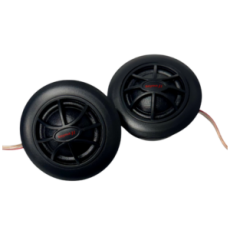
Beyma SC30 Wide-Band Neodymium Tweeter Pair
If the system needs a tweeter that can meet the midrange lower than the SQL60B can—and the goal is smooth, extended highs instead of maximum SPL—the SC30 is the Beyma that makes more sense.
The Beyma SC30 is a 4-ohm tweeter sold as a pair, rated at 25 watts AES / 50 watts program per tweeter, with 92 dB sensitivity, a published 3.5 kHz–22 kHz range, an aluminum diaphragm, a 1.02-inch voice coil and a neodymium motor.
The important number here is not the 92 dB sensitivity. It is the 3.5 kHz lower operating range. The SC30 gives us more room to make a clean crossover when the midrange below it does not want to stretch all the way to 5 or 6 kHz.
The problem it solves is the gap between a larger midrange and the top end.
Not every 6.5-, 8- or 10-inch midrange sounds its best when it is pushed high enough to meet a tweeter that cannot come in until 5 kHz.
As cone diameter gets larger, dispersion narrows and the speaker can start beaming upper-midrange energy instead of spreading it evenly through the cabin.
The SC30 gives us another option: bring the tweeter in lower, around the range Beyma actually designed it to reproduce, and let the larger midrange stop working before its upper-range limitations become the dominant part of the system.
3.5 kHz–22 kHz gives us more crossover flexibility than the SQL60B.
Beyma publishes the SC30 from 3.5 kHz to 22 kHz and recommends crossing it at 3.5 kHz or higher.
That lower crossover capability is useful when the tweeter is being paired with a larger midrange or a speaker that becomes directional higher in frequency.
The upper extension to 22 kHz also gives the SC30 a very broad published high-frequency window.
That does not mean we chase ultrasonic output with EQ. It means the tweeter has enough natural extension that the audible top octave is not sitting right at the edge of its operating range.
92 dB sensitivity tells you this is not Beyma’s maximum-output tweeter.
The SC30 is published at 92 dB sensitivity at 1 watt / 1 meter.
That is substantially lower than the SQL60B at 97.5 dB and far lower than Beyma’s 104–107 dB competition-style tweeters.
That difference matters—but it is not automatically a disadvantage.
The SC30 is solving a different problem. It prioritizes broad high-frequency coverage and lower crossover flexibility instead of maximum acoustic output per watt.
If the system needs to scream over wind noise, choose a more efficient tweeter. If it needs the tweeter to integrate lower and sound balanced in a normal cabin, the SC30 can be the better tool.
The aluminum diaphragm gives the SC30 a light, rigid high-frequency radiator.
Beyma uses an aluminum diaphragm in the SC30.
High-frequency diaphragms need very little mass so they can accelerate and stop quickly. At the same time, the diaphragm has to remain rigid enough that it does not deform as frequency rises.
Aluminum gives the SC30 that lightweight, rigid structure for crisp transient response and extended top-end reproduction.
That is part of why this tweeter can reach to a published 22 kHz without needing a physically large diaphragm.
25 watts AES is enough when the tweeter is used in its actual band.
Each SC30 is rated at 25 watts AES / 50 watts program.
That does not look like much if somebody compares the number directly with a 200-watt midrange, but tweeters do not reproduce the same amount of energy.
Above 3.5 kHz, the system needs much less electrical power to reach the correct acoustic balance—especially when the tweeter is properly filtered.
The crossover is the protection. Sending lower-frequency energy into the SC30 because an amplifier has “only” 25 watts available is exactly how a tweeter gets damaged.
The neodymium motor keeps the assembly manageable for custom placement.
The SC30 uses a neodymium motor.
That helps keep the magnetic assembly compact enough for pillars, dash panels, motorcycle fairings and custom speaker pods.
The published overall diameter is about 60 mm / 2.36 inches, with approximately 68 mm / 2.68 inches of depth, so it is still important to verify rear clearance before fabrication.
It is not as tiny as the SQL60B, but the larger package buys us a different operating range.
SC30 versus SQL60B.
SC30: 92 dB sensitivity, 3.5 kHz–22 kHz, 25 watts AES and aluminum diaphragm. Choose it when lower crossover capability and broad top-end extension matter more than maximum output per watt.
SQL60B: 97.5 dB sensitivity, 5 kHz–20 kHz, 30 watts AES, PM4 polymer diaphragm and a much smaller 1.93-inch overall diameter. Choose it when compact packaging and higher efficiency are the bigger priorities.
The SQL60B gets louder more easily. The SC30 reaches lower and gives us more crossover freedom.
That is the actual buying decision.
SC30 versus a 104–107 dB competition tweeter.
A very high-sensitivity bullet or compression tweeter is the right answer when the system is built around extreme output, open-air projection and large high-efficiency midranges.
The SC30 is the better choice when the system needs a more conventional high-frequency balance and does not need the tweeter to overpower the rest of the front stage.
More sensitivity is useful only when the system actually needs it.
Where we would use it.
This is a strong choice in car and truck front stages, custom pillars, dash locations, Jeep systems and motorcycle builds where the midrange below it benefits from a crossover closer to 3.5–4 kHz.
It works especially well when we want to stop a larger midrange before beaming becomes a problem, but the installation still needs useful high-frequency output from a compact tweeter.
With DSP, we can set the crossover safely, level-match the SC30 to the midrange, correct response and align timing so the high-frequency section disappears into the stage instead of sounding like a separate speaker.
The result: a Beyma tweeter for systems that value crossover flexibility and smooth wide-band high-frequency coverage more than simply chasing the highest sensitivity number.
Manufacturer Specifications
- Model: Beyma SC30
- Product type: Wide-band high-frequency tweeter
- Sold as: Pair
- Nominal impedance: 4 ohms
- Power handling: 25 watts AES per tweeter
- Program power: 50 watts per tweeter
- Sensitivity: 92 dB, 1 W / 1 m
- Published frequency range: 3.5 kHz–22 kHz
- Recommended crossover: 3.5 kHz or higher
- Voice-coil diameter: 25.8 mm / 1.02 inches
- Overall diameter: 60 mm / 2.36 inches
- Baffle cutout: 58.7 mm / 2.30 inches
- Bolt-circle diameter: 51.5 mm / 2.03 inches
- Overall depth: 68 mm / 2.68 inches
- Diaphragm: Aluminum
- Front cover: Aluminum
- Motor: Neodymium
Crossover / System Guidance
Beyma recommends crossing the SC30 at 3.5 kHz or higher. Final crossover slope, amplifier power, level, EQ and DSP settings must be chosen around the midrange used below it and the required output of the finished system.
Where this fits in the build
These speakers have to work where wind, road noise, mounting space and exposure change the job. Match the driver to the actual location, output target, amplifier power and environment instead of treating it like a normal door-speaker replacement.