
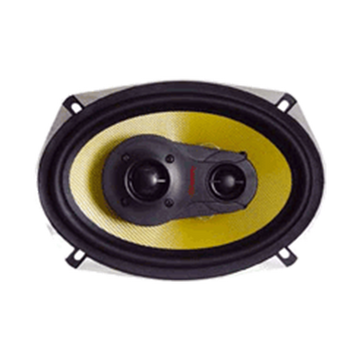

Description
Beyma SC6903 6x9-Inch 3-Way Full-Range Speaker Pair
If the vehicle already gives us a 6x9-inch speaker location, dropping down to a smaller 6.5 and giving away cone area usually does not make sense. The SC6903 uses that factory-sized opening to give a daily system more body, more output and a broader full-range presentation without turning the install into a pro-audio build.
The Beyma SC6903 is a 4-ohm, 3-way Sound Concept speaker sold as a pair. Each speaker is rated at 100 watts AES / 200 watts program, with 91 dB sensitivity, a published 40 Hz–20 kHz response, a high-resistance fiberglass cone and 3 mm Xmax.
The point of the SC6903 is not maximum SPL. It is to use the larger oval cone area to make a conventional car-audio system sound fuller and more complete from one factory-style speaker location.
The 6x9 cone gives us something a smaller round speaker cannot fake: more radiating area.
A 6x9 has more usable cone area than a conventional 6.5-inch speaker. That matters because bass and lower-midrange output depend on moving air.
What that solves: when the vehicle already has a 6x9 opening in the door, rear deck or side panel, the SC6903 can make better use of that space instead of reducing the speaker size and then asking the subwoofer to fill everything back in.
That extra cone area gives kick drums, bass guitar and lower vocals more physical weight in a daily system.
This is still a Sound Concept speaker—not a PRO-series SPL driver.
The SC6903 is designed for broad full-range reproduction, not for one narrow high-efficiency band.
That is why it belongs in a normal car or truck system where one speaker location needs to cover bass, midrange and highs together.
A Beyma PRO midrange may get dramatically louder through vocals, but it also needs a dedicated driver below it and a tweeter or compression driver above it. The SC6903 is the simpler answer for the customer who wants the factory-sized 6x9 location to sound complete.
40 Hz–20 kHz gives the 6x9 broad published bandwidth.
Beyma publishes the SC6903 from 40 Hz to 20 kHz.
The 40 Hz number does not mean we would run a door or deck-mounted 6x9 full power at 40 Hz with no protection. The actual low-frequency capability depends heavily on the rear cavity, mounting surface and required volume.
What the published range does tell us is that Beyma designed the SC6903 as a broad-band speaker rather than a limited midrange.
In a daily system, that gives us flexibility: run it with sensible high-pass protection when a subwoofer is present, or let it carry more low-frequency information when the installation and power level support it.
100 watts AES per speaker gives the larger cone useful amplifier headroom.
Each SC6903 is rated at 100 watts AES / 200 watts program.
That is a meaningful step up from the smaller SC603 and matches the larger cone’s ability to do more acoustic work.
For a normal four-channel amplified system, that gives us enough power capability to build a strong front or rear speaker section without needing an oversized amplifier just to make the speakers come alive.
As always, clean power and crossover protection matter more than chasing a large amplifier number.
91 dB sensitivity keeps the larger speaker easy to drive.
The SC6903 is published at 91 dB sensitivity at 1 watt / 1 meter.
That is one decibel higher than the SC603 and gives the larger 6x9 a useful efficiency advantage in a conventional car-audio system.
It is not trying to compete with a 100+ dB pro midrange. It does not need to. The SC6903 is trading some extreme efficiency for broader bandwidth and full-range behavior.
The fiberglass cone is doing the same job here as it does in the SC603—only over a larger surface.
Beyma uses a high-resistance fiberglass cone in the SC6903.
With a larger cone, rigidity becomes even more important. The diaphragm needs to move as one controlled surface instead of flexing as bass and lower-midrange energy increase.
The practical result: the 6x9 can deliver more body without turning that extra cone area into sloppy cone breakup.
Three millimeters of Xmax gives useful movement, but this is not a dedicated midbass.
Beyma publishes 3 mm Xmax.
That is enough travel for a full-range 6x9 to contribute useful low-end and lower-midrange output in a normal vehicle installation.
It is not the 5–6 mm excursion we see in Beyma’s dedicated high-output low/mid drivers. That is intentional.
The SC6903 is built to cover a broad musical range, not to sacrifice efficiency and upper response just to chase maximum cone travel.
The 4-ohm load makes amplifier integration straightforward.
The SC6903 is a conventional 4-ohm speaker.
One speaker per amplifier channel is the simple layout. There is no need to design around 8-ohm multi-driver arrays or parallel several speakers just to reach a normal load.
That makes this a natural fit for a daily four-channel amplifier or a system where the front and rear speaker pairs each have their own channels.
SC6903 versus SC603.
SC603: 6.5-inch pair, 75 watts RMS per speaker, 90 dB sensitivity and 50 Hz–20 kHz. Choose it when the vehicle has a 6.5-inch location or packaging is tighter.
SC6903: 6x9 pair, 100 watts AES per speaker, 91 dB sensitivity and 40 Hz–20 kHz. Choose it when the vehicle already has a 6x9 opening and the customer wants more cone area, more low-frequency authority and more power handling.
If the hole is already 6x9, the SC6903 usually makes more sense than adapting down unless another system-design reason tells us otherwise.
SC6903 versus a high-output Beyma coaxial.
The PRO-series coaxials are built around motorcycles, powersports and other systems where high efficiency and extreme output are major priorities.
The SC6903 is the better fit when the customer wants a conventional full-range car speaker with strong daily sound and does not need to turn the vehicle into a PA system.
That difference matters. A daily listening system should not be pushed into a high-output architecture just because the larger numbers look impressive on a spec sheet.
Where we would actually use it.
We would use the SC6903 in factory 6x9 door locations, rear decks, quarter panels and other conventional car or truck locations where we want to keep the install simple but make better use of the available cone area.
It also makes sense as strong rear fill in a larger vehicle where a small 6.5-inch speaker would leave too much low/mid energy on the table.
Rigid mounting, sealing the speaker properly to the panel and controlling the rear cavity still matter. A good 6x9 can only perform as well as the surface it is mounted to.
The result: a larger Sound Concept speaker pair that gives a daily system more body, more useful output and broader low-frequency authority while keeping the installation in a clean, conventional 4-ohm full-range architecture.
Manufacturer Specifications
- Model: Beyma SC6903
- Series: Sound Concept
- Product type: 3-way full-range car speaker
- Sold as: Pair
- Nominal size: 155 x 225 mm / 6 x 9 inches
- Nominal impedance: 4 ohms
- Power handling: 100 watts AES per speaker
- Program power: 200 watts per speaker
- Sensitivity: 91 dB, 1 W / 1 m
- Published frequency range: 40 Hz–20 kHz
- Low-frequency voice-coil diameter: 30 mm / 1.2 inches
- BL factor: 5.4 N/A
- Resonant frequency (Fs): 47 Hz
- DC resistance (Re): 3.9 ohms
- Qms: 7.13
- Qes: 0.94
- Qts: 0.83
- Equivalent compliance volume (Vas): 29 L / 1.02 cu. ft.
- Reference efficiency: 0.3%
- Effective cone area (Sd): 206 cm²
- Xmax: 3 mm
- Voice-coil inductance (Le): 0.52 mH
- Overall size: 155 x 225 mm / 6 x 9 inches
- Baffle cutout: 220 x 166 mm / 8.66 x 6.54 inches
- Mounting depth: 119 mm / 4.69 inches
- Basket: Die-cast aluminum
- Cone: High-resistance fiberglass
- Surround: Rubber
- Motor: Ferrite
System Design Guidance
The published 40 Hz lower response is not a universal high-pass recommendation. Final crossover, amplifier power and rear-cavity loading should be selected around the actual vehicle, required output and whether a subwoofer is being used.
Where this fits in the build
These speakers have to work where wind, road noise, mounting space and exposure change the job. Match the driver to the actual location, output target, amplifier power and environment instead of treating it like a normal door-speaker replacement.