
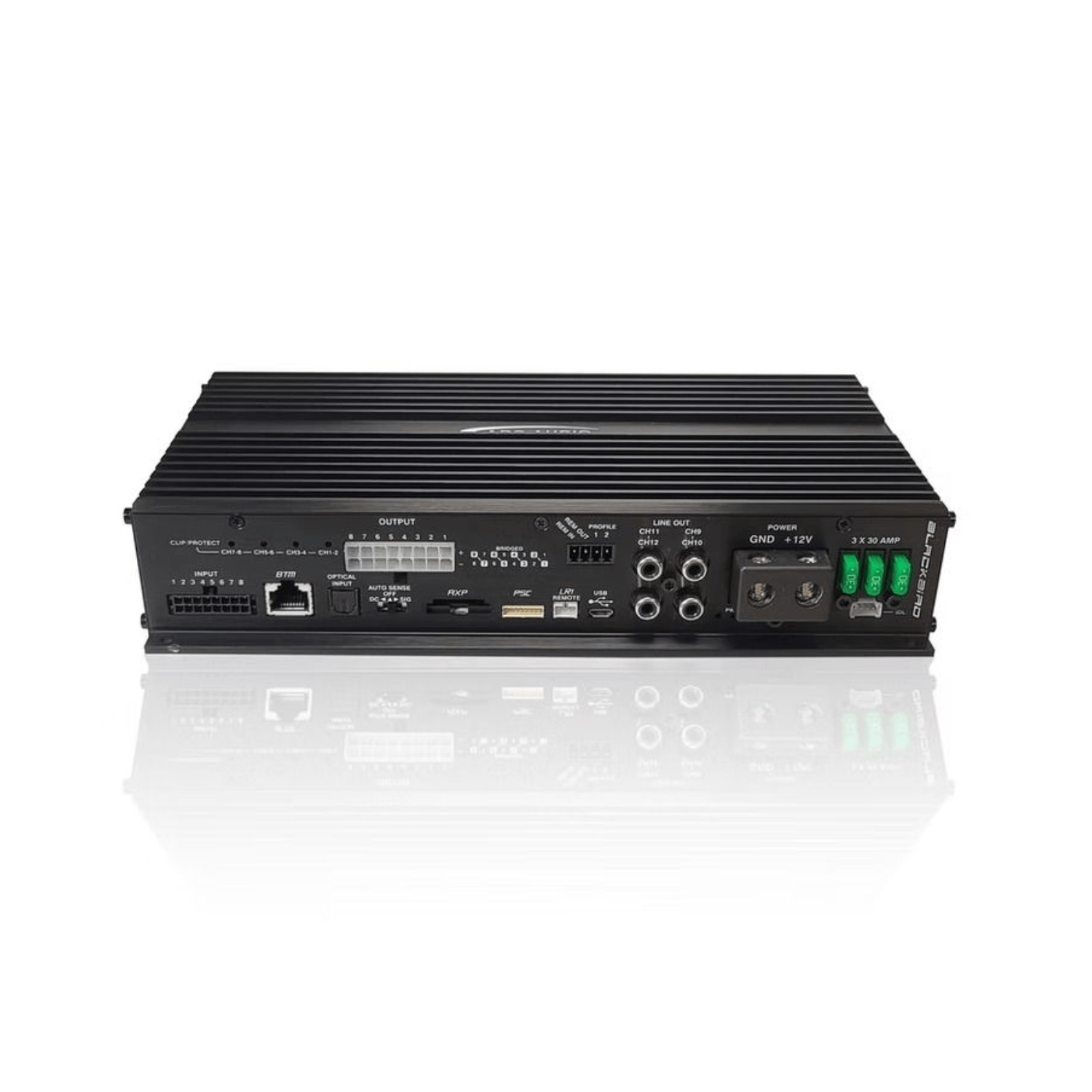

Description
ARC Audio Blackbird 8-Channel DSP Amplifier
Eight amplified channels. Twelve independent DSP outputs. One compact platform that can run the front stage, integrate the factory radio and still leave room for the system to grow.
The Blackbird makes sense when a build needs real DSP control and real amplification, but twelve internal amplifier channels would be more than the system actually needs. ARC gives us eight fully bridgeable Class-D channels plus four independent processed RCA outputs, which means the Blackbird can sit at the center of a surprisingly serious system without turning the amplifier rack into a pile of separate boxes.
ARC’s own design goal is clean installation, honest power and professional tuning flexibility. That is exactly why Blackbird works so well in daily-driver sound-quality systems: we can spend internal amplifier channels where they make sense and hand higher-power jobs to external amplifiers without leaving the same DSP environment.
Eight amplifier channels does not mean an eight-channel system.
This is the point that matters most. All twelve Blackbird outputs are independently configurable—eight amplified channels and four RCA outputs.
An active three-way front stage can use six amplifier channels immediately. We can use the remaining two for rear fill, bridge channel pairs when stronger midbass power is needed, or run eight factory speaker locations directly. Then the four processed RCA outputs can feed a dedicated subwoofer amp, additional midbass amplifier or another section of the system.
ARC specifically built the Blackbird around this kind of hybrid architecture. If the system needs more low-frequency power, something like the ARC Audio Nighthawk can take that job while the Blackbird remains the tuning and routing center.
What that solves: we do not have to choose between an all-in-one amplifier and a system that can expand later. Blackbird gives us both.
Factory radio staying? Blackbird is built for that problem.
Modern factory systems can send anything from low-level signal to very high-voltage amplified output. Blackbird’s analog input range runs from 0.5 to 32 volts RMS, so it can accept a broad range of aftermarket and OEM signals without requiring the same integration strategy on every vehicle.
On supported vehicles, iDatalink Maestro AR compatibility gives us a more direct route around the factory amplifier while retaining the OEM interface and vehicle functions the customer actually wants to keep.
The result is a cleaner starting point for tuning. Instead of replacing a factory radio just because the factory amplifier is the problem, we can retain the source, integrate correctly, then rebuild the speaker and amplifier system behind it.
The DSP is what turns the Blackbird into a system tool.
Blackbird runs ARC Audio’s Pro-Series DNA tuning environment on an Analog Devices ADAU1462 processor with AKM Velvet Sound conversion. The internal DSP operates at 96 kHz / 32-bit, while the digital input can accept high-resolution streams up to 192 kHz / 32-bit.
DNA gives us up to 444 bands of EQ along with all-pass and shelving filters, per-channel delay, phase control, crossover control and flexible input/output routing. That means every tweeter, midrange, midbass, rear speaker and processed external-amplifier channel can be treated as its own acoustic problem instead of relying on one global EQ to fix everything.
That is the difference between “it has DSP” and having the tools to actually build a stage. We can correct arrival time, shape crossover interaction, manage phase and tune the system around the seats and speaker locations the vehicle gave us.
Bridge it when the system needs more muscle.
Each Blackbird amplifier channel is rated at 75 watts into 4 ohms or 125 watts into 2 ohms. Because the outputs are fully bridgeable, we can combine pairs for up to 250 watts × 4 into 4 ohms when the system needs fewer channels with more power.
That flexibility is useful on midbass. A six-channel active front stage might use four channels for tweeters and midranges, then bridge the remaining four into two stronger midbass channels. Or we can keep all eight channels independent and use an external amplifier for the high-power section.
There is no one “correct Blackbird system.” The point is that the amplifier does not lock us into one architecture.
The four RCA outputs are not an afterthought.
Channels 9–12 are independent DSP-controlled preamp outputs capable of up to 8 volts. They receive the same processing control as the amplified channels, so adding an external amplifier does not create a second tuning world.
That matters for subwoofers especially. We can route and process the bass section inside DNA, then send a strong clean signal to a dedicated mono amplifier. If the build changes later, those outputs can be reassigned instead of forcing a complete DSP replacement.
ARC rates the amplifier like an amplifier, not a marketing department.
ARC highlights that Blackbird is CTA-2006 compliant and conservatively rated. That matters because the customer is paying for usable power and system control, not inflated numbers measured under conditions the amplifier will never see in a vehicle.
The eight internal channels can deliver up to roughly 1,000 watts of real-world combined output depending on configuration, but the more important part is how that power can be distributed. We can use eight moderate-power channels, four bridged channels, or a hybrid of internal and external amplification based on what the speakers actually need.
Blackbird or Falcon?
The ARC Audio Falcon is the answer when the system benefits from twelve internal amplifier channels and sixteen total DSP channels. Blackbird makes more sense when eight internal channels cover most of the speaker system and the higher-power sections are better handled by external amplifiers.
Neither is automatically “better.” We choose the architecture that keeps the system clean, gives every speaker the power it needs and leaves the right amount of room for expansion.
The result: Blackbird gives us a compact foundation for an active, OEM-integrated system with enough internal power to do serious work and enough processed expansion to avoid painting the build into a corner later.
Manufacturer Specifications
- Amplified channels: 8 fully bridgeable Class-D channels
- Total DSP-controlled outputs: 12 — 8 amplified and 4 RCA outputs
- Power at 4 ohms: 75 watts × 8
- Power at 2 ohms: 125 watts × 8
- Bridged power at 4 ohms: 250 watts × 4
- DSP processor: Analog Devices ADAU1462, native 32-bit
- DSP resolution: 96 kHz / 32-bit
- Conversion: AKM Velvet Sound ADC/DAC architecture
- DSP software: ARC Audio DNA
- Equalization: Up to 444 bands
- Analog input range: 0.5–32 V RMS
- Analog inputs: 8-channel differential, RCA or speaker-level
- Digital input: S/PDIF optical; audio streams up to 192 kHz / 32-bit
- Digital coaxial: Supported with compatible ARC Audio D.O.C. adapter
- Processed RCA outputs: 4 independent DSP-controlled outputs, up to 8 V
- Auto turn-on: Signal sense and DC/BTL detection
- OEM integration: iDatalink Maestro AR compatible in supported applications
- User presets: Up to 4
- Controller compatibility: ARC Audio PSC and LR-2
- Fusing: 3 × 30 A Mini ATC blade fuses
- Dimensions: 10.35 × 6 × 2 inches
- Rating standard: CTA-2006 compliant
Where this fits in the build
This is a system-control or DSP component. The correct choice depends on the signal path, channel count, routing, retained features and the rest of the amplifier and speaker plan.
Authorized Dealer — In-Store Purchase