
Description
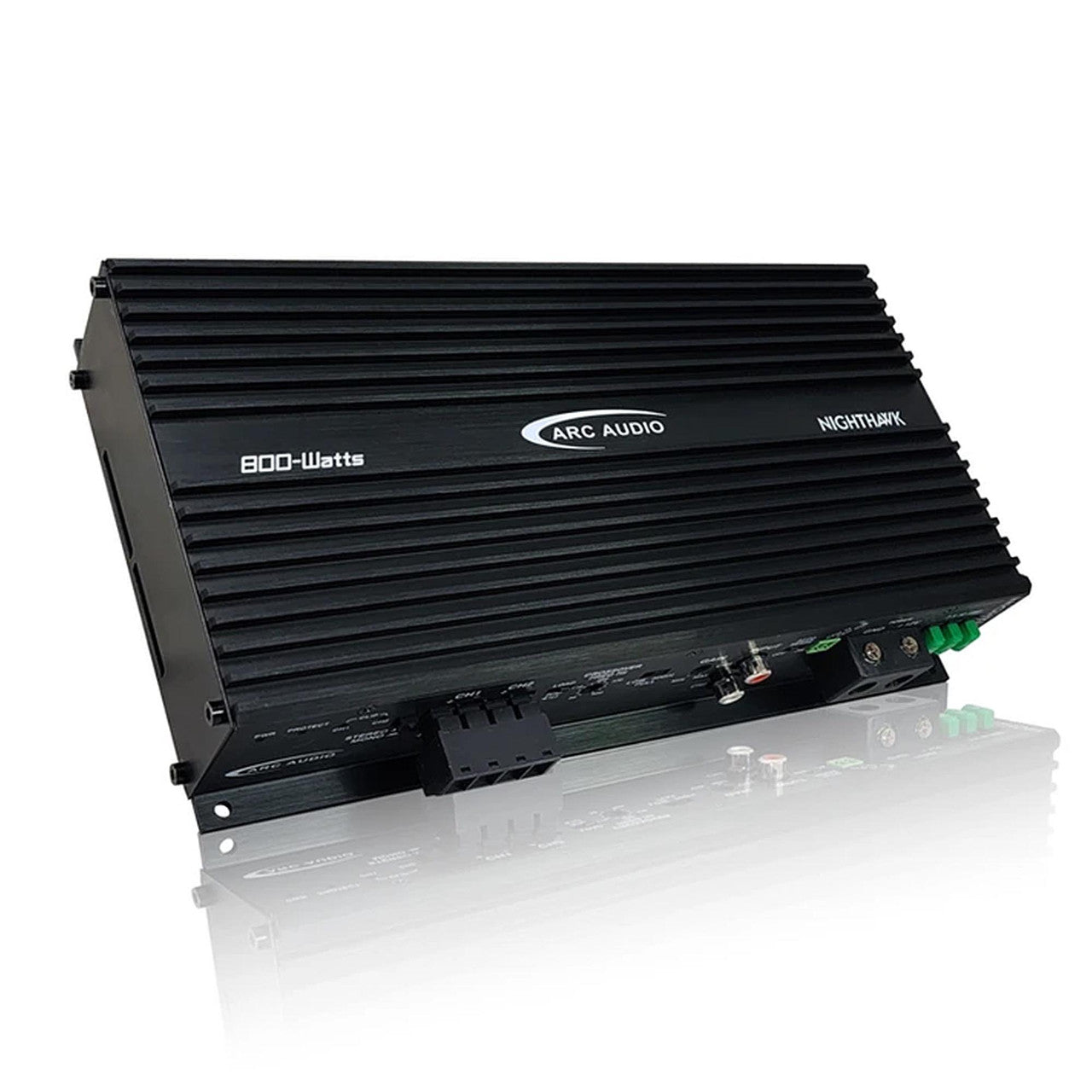
ARC Audio Nighthawk 2-Channel Class-D Amplifier
You already solved the signal and tuning. Now one part of the system simply needs more clean power.
That is the job ARC Audio built the Nighthawk to do. It is a reference-class, full-range two-channel Class-D amplifier with no built-in DSP, designed to expand a properly processed system without adding another layer of routing, conversion or tuning that the build does not need.
ARC specifically positions it as the natural companion to DSP amplifiers like the Blackbird, but Nighthawk is not locked into one ARC system. It can run midbass, full-range speakers or a subwoofer section, and it can work as a standalone amplifier anywhere the system needs strong, low-distortion two-channel power.
Sometimes the problem is not tuning. It is headroom.
A DSP can fix timing, crossover behavior, phase and frequency response. It cannot create amplifier headroom that is not there.
If an active front stage is tuned correctly but the midbass starts running out of authority when volume comes up, adding more EQ is not the answer. If the DSP amp is handling the front stage perfectly but the subwoofer section needs substantially more power, replacing the entire electronics package is not the answer either.
Nighthawk gives us 250 watts × 2 at 4 ohms or 400 watts × 2 at 2 ohms. Bridge the two channels and ARC rates it at 800 watts × 1 into 4 ohms.
What that solves: we can add output exactly where the system is running out of muscle while leaving the part that is already working alone.
Midbass is one of the places Nighthawk really makes sense.
Strong front-stage midbass needs more than a low crossover point. The speaker needs enough amplifier headroom to reproduce kick drums and lower-midrange transients without the amplifier becoming the bottleneck.
Run Nighthawk as a stereo amplifier and each side gets its own high-power channel. That can be a very clean way to take midbass duty away from a multi-channel DSP amplifier while still letting the DSP handle every crossover, delay, EQ and phase decision upstream.
The customer gets more physical impact from the front stage without changing the tonal balance or system architecture that already works.
Need one strong subwoofer channel? Bridge it.
Nighthawk is fully bridgeable and CTA-2006 rated for 800 watts into a 4-ohm mono load. That makes it useful when the Blackbird or another processor is already providing the subwoofer signal and the only missing piece is the amplifier power to drive the woofer correctly.
Because Nighthawk is full-range from 10 Hz to 32 kHz, it is not a bass-only amplifier pretending to be versatile. The same chassis can legitimately be used on subwoofers, midbass or full-range high-demand speakers depending on how the system is designed.
Blackbird + Nighthawk is a clean hybrid system for a reason.
The ARC Audio Blackbird gives us twelve processed outputs—eight amplified and four RCA. Those RCA outputs are exactly where an expansion amplifier like Nighthawk fits.
Blackbird can keep control of the crossover, EQ, delay, phase and routing while Nighthawk handles the higher-current job. That keeps the system under one tuning strategy instead of stacking processors or building a second signal path just to add power.
The matching Blackbird/Nighthawk chassis also makes physical integration cleaner when both amplifiers share the same rack or installation area.
Reference-class here means more than “it gets loud.”
Nighthawk puts the emphasis on low distortion, headroom, clarity and control. The amplifier is CTA-2006 compliant and conservatively rated, following ARC’s under-promise/over-deliver philosophy rather than relying on inflated marketing power.
That matters when the amplifier is being used on midbass or full-range speakers. The goal is not simply to make more watts. It is to add power without throwing away the detail, dynamics and control the rest of the system was built to achieve.
Built for modern vehicle electrical systems.
Nighthawk supports start-stop operation down to 4.6 volts and is designed for operation across the wide voltage conditions found in real vehicles. ARC also publishes a thermal operating range from -4°F to 180°F.
Balanced differential inputs help reject common electrical noise, and selectable stereo/mono operation gives the installer flexibility when the source configuration changes. ARC’s high-current speaker connection system keeps the output connections compact and secure.
Those details are why the amplifier can make sense outside a traditional car as well. ARC specifically positions Nighthawk for automotive, motorcycle, marine and powersports systems where compact packaging and reliable high-output operation both matter.
Nighthawk or a bigger DSP amplifier?
If the system actually needs more processing channels, then moving to something like the ARC Audio Falcon may be the cleaner architecture.
If the DSP already has enough outputs and the only problem is that one section needs more amplifier power, Nighthawk is the smarter answer. Do not buy another DSP just to get watts you could add directly.
The result: Nighthawk lets us keep a good system design intact and add reference-class power exactly where the speakers or subwoofer need more headroom.
Manufacturer Specifications
- Amplifier type: Full-range Class D
- Channels: 2, fully bridgeable
- Stereo power at 4 ohms: 250 watts × 2
- Stereo power at 2 ohms: 400 watts × 2
- Bridged power at 4 ohms: 800 watts × 1
- Rating standard: CTA-2006 compliant
- Frequency response: 10 Hz–32 kHz (-3 dB)
- Input type: Balanced differential
- Operating configuration: Selectable stereo or mono
- Start/stop compatibility: Supports operating voltage down to 4.6 V
- Operating temperature: -4°F to 180°F (-20°C to 82°C)
- Application: Subwoofer, midbass or full-range amplification
- Chassis: Matching industrial design and footprint to ARC Audio Blackbird
Where this fits in the build
An amplifier should be chosen around the channels, load, speaker or subwoofer plan, available electrical support and how hard the system needs to play.
Authorized Dealer — In-Store Purchase