


Description
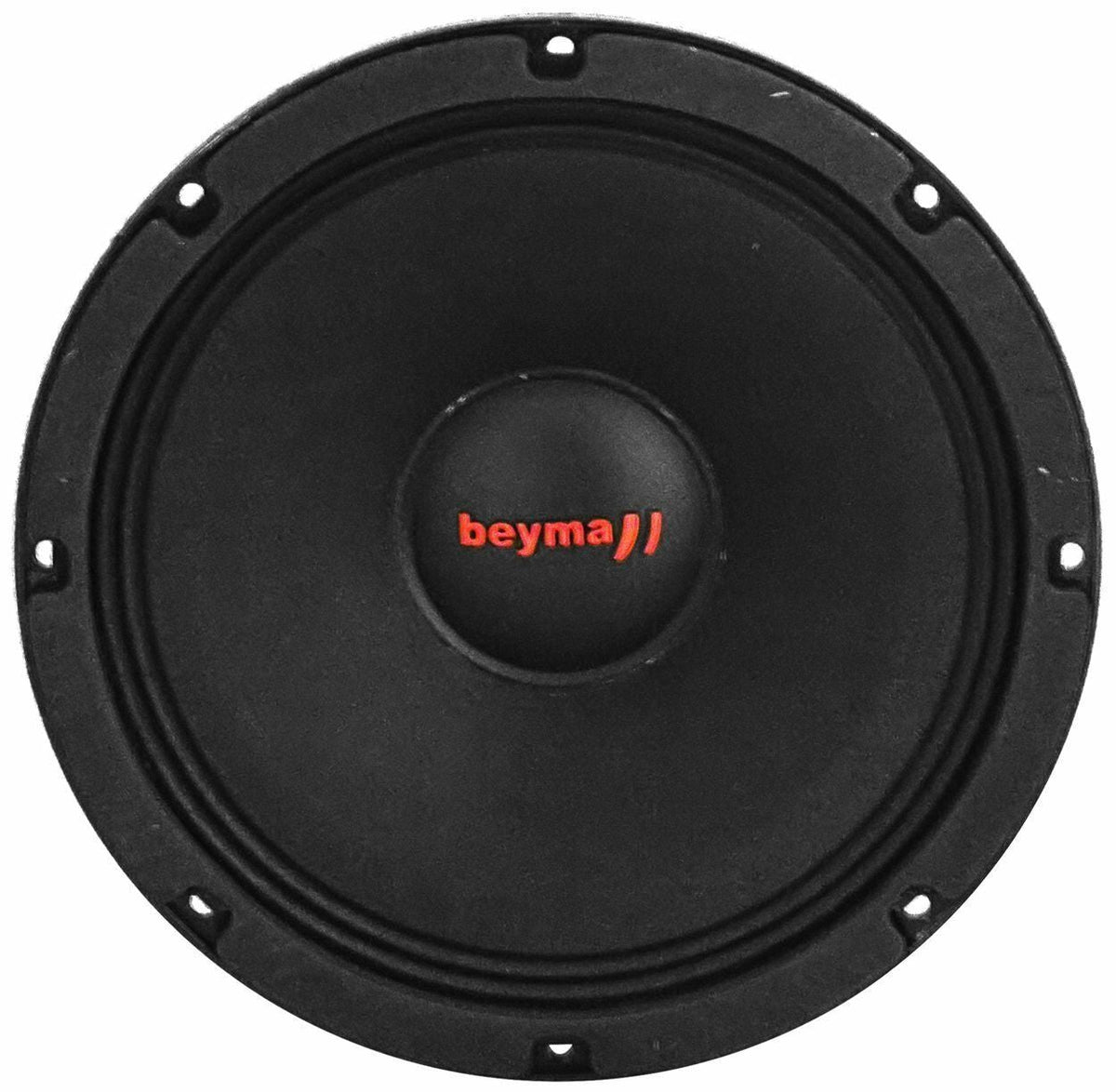
Beyma PRO8MI 8-Inch High-Efficiency Midrange
Sometimes the system does not need another woofer. It needs the vocal range to have enough cone area and efficiency to keep up with everything else.
The Beyma PRO8MI is an 8-inch, 4-ohm dedicated midrange from Beyma’s Competition line. It takes the same basic idea as the PRO6MI—high sensitivity, high output and dedicated mid-frequency reproduction—and gives it more cone area, a larger 2-inch voice coil and twice the RMS power handling.
That changes where we can use it.
The PRO8MI is still not a subwoofer and it is not a conventional full-range 8-inch door speaker. But compared with a smaller dedicated midrange, it can carry more of the lower-midrange region with authority and do it while staying very efficient.
This is the driver we use when the vocal section needs more weight, not just more volume.
An 8-inch cone gives us more radiating area than a 6.5-inch midrange. In a high-output system, that means the speaker can move more air through the lower part of the vocal range and create more body around drums, guitars and male vocals without asking the driver to become a bass speaker.
Beyma publishes the PRO8MI from 150 Hz to 7 kHz, but its own Competition crossover guidance still treats it as a dedicated midrange. For high-output use, Beyma recommends a 200 Hz minimum high-pass and roughly a 4–5 kHz upper low-pass, with at least a 12 dB/octave slope.
What that solves: we can bring the dedicated midrange section lower than we typically would with the PRO6MI, giving the system more punch and body through the lower mids while keeping true bass duty on the woofer or subwoofer that was designed for it.
98 dB sensitivity means it does not need ridiculous amplifier power to get loud.
The PRO8MI is published at 98 dB sensitivity at 1 watt / 1 meter.
That is a major advantage in high-output mobile systems because the speaker is doing more with each watt before we even start talking about amplifier size. When the goal is to build a door, motorcycle, Jeep or powersports system that stays intelligible at high volume, efficiency matters just as much as raw power handling.
A speaker that is difficult to drive can consume a lot of amplifier power just trying to reach the output level of the rest of the system. The PRO8MI starts from a much more efficient platform.
The practical result: more of the amplifier’s available power becomes usable midrange output instead of simply heat.
200 watts RMS gives us real headroom—if the crossover is right.
Beyma rates the PRO8MI at 200 watts RMS / 400 watts maximum.
That number makes sense because the driver also uses a larger 51.7 mm / 2-inch voice coil. But just like the PRO6MI, the power rating assumes we are using the speaker for the frequencies it was designed to reproduce.
If we let low bass into an 8-inch dedicated midrange just because the cone looks big enough to handle it, excursion becomes the problem long before the voice coil reaches its thermal limit.
That is why the high-pass matters. The PRO8MI can handle serious power in the midrange, but it has to be protected from the low-frequency work it was not built to do.
Where PRO8MI makes more sense than PRO6MI.
The PRO6MI is the better choice when mounting space is tighter, we are building a more compact multi-way front stage, or there is already a strong dedicated midbass driver directly below the midrange.
The PRO8MI makes more sense when we have the space and want the midrange section to reach lower with more cone area and more physical authority.
In a custom door, that can mean an 8-inch PRO8MI carrying the lower vocal range while a tweeter handles the top end and a subwoofer or larger midbass takes over below it. In motorcycle and open-cabin systems, the larger cone area helps keep vocals and instruments present when road and wind noise rise.
In multi-driver panels, the PRO8MI gives us another option when we want fewer larger midranges instead of filling the same space with several smaller drivers.
This is not simply a “bigger is better” decision. The right choice depends on where the crossover needs to land, how much mounting room we have and what driver is handling the frequencies below it.
The die-cast basket matters when the speaker is being pushed.
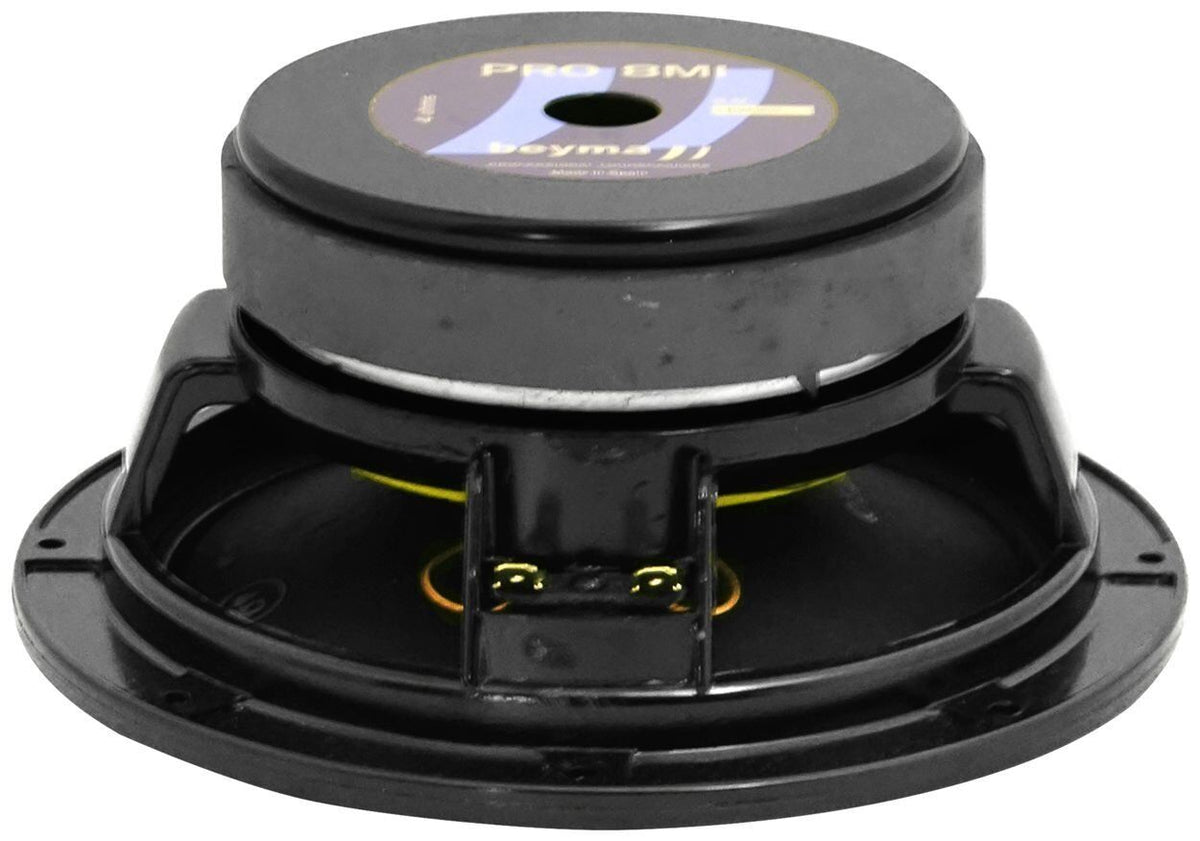
The PRO8MI uses a die-cast aluminum basket rather than a lightweight stamped frame.
At high output, the motor and cone assembly need a rigid structure to work from. The basket is what keeps the motor, suspension and mounting points aligned while the speaker is moving hard.
That also matters in custom doors and speaker panels. We want the speaker mounted to a rigid baffle, and we want the speaker’s own frame to be equally solid. Flex in either one wastes energy and can turn output into vibration instead of sound.
How we would build around it.
We would normally run the PRO8MI as part of an active multi-way system with DSP or properly designed crossover protection.
A dedicated tweeter handles the frequencies above it. A real midbass, woofer or subwoofer handles the low end below it. The PRO8MI owns the midrange where vocals and most instruments live.
With DSP, we can then control crossover shape, level, EQ, phase and time alignment so the larger 8-inch midrange does not sound like a separate speaker playing from the door or pod.
That is the difference between throwing loud speakers into a panel and designing a loud system.
The result: more lower-midrange body and authority than the smaller PRO6MI, the same excellent 98 dB efficiency, and enough power handling to stay composed in a serious high-output system—as long as we let it be the midrange Beyma designed it to be.
Manufacturer Specifications
- Model: Beyma PRO8MI
- Product type: Dedicated midrange loudspeaker
- Series: Competition
- Sold as: Single speaker
- Nominal diameter: 200 mm / 8 inches
- Nominal impedance: 4 ohms
- Power handling: 200 watts RMS
- Maximum power: 400 watts
- Sensitivity: 98 dB, 1 W / 1 m
- Published frequency range: 150 Hz–7 kHz
- Voice-coil diameter: 51.7 mm / 2 inches
- BL factor: 7.6 N/A
- Moving mass: 0.018 kg
- Resonant frequency (Fs): 86 Hz
- DC resistance (Re): 3.4 ohms
- Qms: 10.40
- Qes: 0.56
- Qts: 0.53
- Equivalent compliance volume (Vas): 14 L
- Reference efficiency: 1.5%
- Effective cone area (Sd): 220 cm²
- Voice-coil inductance (Le @ 1 kHz): 0.3 mH
- Overall diameter: 212 mm / 8.35 inches
- Cutout diameter: 182 mm / 7.17 inches
- Mounting depth: 95 mm / 3.74 inches
- Basket: Die-cast aluminum
- Cone: Paper
- Magnet: Ferrite
Beyma Crossover Guidance
- Minimum recommended high-pass: 200 Hz
- Recommended upper low-pass region: 4–5 kHz
- Minimum recommended filter slope: 12 dB/octave
Installation note: Final crossover, level, EQ and amplifier settings still depend on the installation and the drivers being used above and below the PRO8MI.
Where this fits in the build
These speakers have to work where wind, road noise, mounting space and exposure change the job. Match the driver to the actual location, output target, amplifier power and environment instead of treating it like a normal door-speaker replacement.